
Medicare Special Election Periods are one of the easiest places for agents to lose a client without realizing it. A beneficiary calls outside AEP, wants to change plans, and the first instinct is often: “You probably have to wait until October.” Sometimes that is true. Sometimes the client just gave you the exact fact pattern that creates a Special Election Period.
This guide is built to help agents think through Medicare Advantage and Part D Special Election Periods in a practical, client-scenario way.
This guide covers Medicare Special Election Periods for 2027, using the CMS CY 2027 enrollment and disenrollment guidance. It includes all 36 categories in CMS Section 30.6, practical client scenarios, nonrenewal dates, D-SNP restrictions and the cases that require CMS involvement. The catalog contains many continuing rules; it is not a list of 36 new SEPs.
Start with the quick SEP finder, then use the 2027 reference tables to check the permitted action and timing. Related rights, such as MA OEP and the additional Part D IEP at age 65, are explained separately.
This is an agent education guide, not a substitute for carrier instructions, CMS guidance, plan-specific enrollment processing rules, or legal advice. Before submitting an application, verify the client’s plan type, service area, Medicare entitlement, Medicaid/LIS status, and the applicable carrier or CMS process.
SEP screening is only one part of the workflow. If the conversation moves into plan-specific discussion or phone enrollment, keep the election-period question separate from the Scope of Appointment validity workflow and the telephonic enrollment recording workflow.
If the caller is asking about Marketplace coverage instead of Medicare Advantage or Part D, use the companion 2026 ACA SEP guide for health insurance agents instead. ACA Special Enrollment Periods use different triggers, state rules, Medicaid/CHIP timing, and documentation workflows.
If the caller is asking how to get Original Medicare because active employer coverage is ending, handle that before MA or Part D plan selection. Use the Part A and Part B enrollment after 65 employer-coverage SEP workflow to separate Part B-only cases from clients who have neither Part A nor Part B.
If you are studying for AHIP or carrier certifications and need the broader exam-prep map, start with the 2027 Medicare agent certification primer, then come back here for the field-level SEP scenarios.
If the client is asking about GLP-1 drugs, keep the coverage question separate from the election-period question. The Medicare GLP-1 Bridge guide for agents explains when a weight-management prescription may belong in the temporary Bridge workflow instead of normal Part D, but the Bridge itself is not a general SEP or a reason to change plans by itself.
Do not start SEP analysis by asking only, “Is it AEP?” Start by asking, “What changed?”
The agent mindset: do not ask “Is it AEP?” Ask “What changed?”
Most SEP analysis starts with one simple question:
What changed in the client’s life, coverage, residence, eligibility, or plan?
A client may have an SEP because they moved, lost creditable drug coverage, gained or lost Medicaid, entered or left an institution, lost SNP eligibility, received a plan termination notice, missed an election because of a declared disaster, or experienced a CMS-recognized exceptional circumstance.
The practical agent workflow is:
| Question | Why it matters |
|---|---|
| What coverage does the client have now? | MA-only, MA-PD, PDP, Original Medicare, employer coverage, PACE, cost plan, SNP, and other starting points have different paths. |
| What changed? | The SEP usually comes from the triggering event. |
| What date did it happen, or when did the client receive notice? | SEP windows are usually date-driven. |
| What does the client want to do? | Not every SEP allows every type of change. Some are PDP-only, some are MA-only, and some are coordinating SEPs. |
| Who can process it? | Most are processed by plans, but some require CMS approval or 1-800-MEDICARE. |
| What proof or attestation should be captured? | CMS generally relies on attestation for many election-period determinations, but some scenarios require stronger documentation or CMS approval. |
The goal is not to force every client into an SEP. The goal is to avoid missing a valid enrollment right when the client actually has one.
First, separate true SEPs from other election periods
Agents often call everything an SEP. That creates confusion.
Medicare Advantage and Part D have several election periods. CMS lists the main categories as the Part D Initial Enrollment Period, Initial Coverage Election Period, Annual Election Period, Medicare Advantage Open Enrollment Period, Open Enrollment Period for Institutionalized Individuals, and Special Election Periods.
Here is the practical distinction:
| Election period | Technically an SEP? | Agent explanation |
|---|---|---|
| IEP / Part D IEP | No | The client’s first chance to enroll in Medicare or Part D. Usually tied to turning 65, disability, or first eligibility. |
| ICEP | No | The client’s first Medicare Advantage enrollment period. |
| AEP | No | October 15 through December 7 for January 1 effective dates. |
| MA OEP | No | January 1 through March 31 for people already enrolled in MA; also available for newly MA-eligible individuals during their first 3 months of MA eligibility. It can create a coordinating Part D right. |
| OEPI | No | Open Enrollment Period for Institutionalized Individuals. This is an MA open enrollment period, not an MA SEP, but it can create a coordinating Part D SEP when leaving MA-PD. |
| SEP | Yes | A special election opportunity triggered by specific circumstances. |
A good rule for agents: do not get hung up on the label first. Get the facts first. Some opportunities are technically not SEPs but still let the client move.
What agents need to know about Medicare SEPs in 2027
Which 2027 dates apply?
The CY 2027 final rule took effect June 1, 2026. Its marketing and communications provisions apply beginning October 1, 2026; its general coverage applicability is January 1, 2027. AEP still runs October 15 through December 7. October 1 is not permission for agents to accept AEP applications early. Use the Medicare AEP workflow for agents to keep preparation, marketing and enrollment dates separate.
For the updated enrollment guidance, the CMS enrollment webpage says plans are expected to use it for requests received on or after January 1, 2027, with optional use for AEP enrollments effective that date. The manual introduction instead refers to enrollments effective on or after January 1, 2027. Confirm the receiving plan’s fall-2026 implementation instructions. Optional early use of guidance does not override an applicable regulation.
Prior CMS approval: identify the issue, then use the authorized process
The regulations expressly require prior CMS approval for four SEP categories: contract violations, CMS sanctions, inadequate information about creditable drug coverage and other exceptional circumstances. Plans cannot transmit elections under these provisions without that approval. This clarifies the approval process; it does not create four unrestricted switching opportunities. See MA approval requirements, Part D enrollment approval and Part D disenrollment approval.
CMS’s 2027 guidance directs beneficiaries to 1-800-MEDICARE for these cases. Contract violations, inadequate creditable-coverage information and other exceptional circumstances use a CMS-operated election mechanism. For sanctions, also follow the eligibility and election instructions in any CMS-authorized notice. An agent should not self-approve the SEP because the client’s account sounds persuasive.
These are not the only cases involving CMS. Federal employee error and significant provider-network changes also require CMS determinations. Record the relevant approval or notice and the election instructions before proceeding.
A provider leaving a network does not automatically create an SEP
CMS did not finalize the proposed general provider-termination SEP in the 2027 final rule, Section I.D. The existing CMS-determined significant-provider-network-change SEP remains separate. It applies to affected enrollees under its specific criteria, including qualifying care from or assignment to a terminated provider, and the CMS-directed notice process.
The temporary Plan Finder provider-information remedy was limited to 2026. The CMS notice has not established a 2027 right. For a 2027 provider problem, check the current CMS notice and applicable SEP; do not reuse the temporary 2026 provision automatically.
Monthly dual/LIS and integrated-care SEPs are different
The regular dual/LIS SEP permits full-benefit duals, partial-benefit duals and other LIS-eligible individuals to make a once-per-month standalone PDP election. It does not permit MA-PD enrollment or MA-PD-to-MA-PD switching. The Part D drug-management restrictions for at-risk and potential at-risk beneficiaries still apply.
A separate monthly integrated-care SEP permits certain full-benefit dual eligible individuals to enroll in a FIDE SNP, HIDE SNP or AIP D-SNP aligned with the plan’s affiliated Medicaid MCO. These monthly rights began January 1, 2025; they are continuing rules for 2027. See CMS’s D-SNP integration guidance and the 2027 manual, Sections 30.6.7 and 30.6.35.
D-SNP eligibility: the 2027 new-enrollment rule is not the 2030 rule
Beginning in 2027, certain D-SNPs with affiliated Medicaid MCOs in overlapping service areas must restrict new enrollment to people enrolled in, or in the process of enrolling in, that Medicaid MCO. The organizational relationships, service areas, state Medicaid contracts and regulatory exceptions matter. This is not a rule that every D-SNP nationwide has identical alignment requirements.
For affected plans, the general federal restriction on continuing coverage of unaligned existing members starts in 2030, not 2027. State or plan requirements can affect a member sooner. Check 42 CFR 422.514(h) and the receiving plan’s instructions, alongside the D-SNP, C-SNP and I-SNP eligibility guide.
An SEP answers when a permitted election can occur. It does not establish eligibility for the receiving plan. This distinction also applies during AEP.
Turning 65 is usually not an SEP
Turning 65 is usually an IEP/ICEP issue, not an SEP.
The true SEP65 is narrower. It applies when an MA-eligible individual elected an MA plan during the Part B IEP surrounding their 65th birthday. SEP65 lets that person disenroll from that first MA plan and return to Original Medicare during the 12-month period beginning with the effective date of MA coverage. CMS also states that people entitled to Medicare before age 65 are not eligible for SEP65.
Agent translation: “I am turning 65” is usually initial enrollment. “I joined my first MA plan when I turned 65 and now I want out within the first year” may be SEP65.
Disability beneficiaries turning 65 have a separate election right
This is different from SEP65.
CMS guidance states that people eligible for Medicare before age 65, such as due to disability, will have another Part D IEP when they turn 65. Where someone has that additional Part D IEP at 65, they are also eligible to make a coordinating MA election. The regulation at 42 C.F.R. 422.62(b)(22) describes the related MA SEP: it may be used to disenroll from MA, return to Original Medicare, or enroll in an MA plan that does not include Part D, and it runs concurrently with the additional Part D IEP.
Agent translation: do not confuse this with SEP65. SEP65 is for someone who first elected MA during the age-65 IEP. The disability-to-65 rule is a coordinating election right tied to the additional Part D IEP.
Quick SEP finder: common client statements and what to check
| Client says… | Check for… |
|---|---|
| “I moved.” | Permanent residence change SEP. Check old ZIP, new ZIP, move date, and whether new plan options exist. |
| “I am moving next month.” | Move SEP may begin the month before the move if the plan is notified in advance. |
| “I lost my drug coverage.” | Involuntary loss of creditable drug coverage SEP. Confirm whether the coverage was creditable and whether loss was involuntary. |
| “My employer coverage is ending.” | Employer/union coverage SEP and/or loss of creditable coverage. Confirm termination date and whether retiree, COBRA, or union plan rules apply. For Original Medicare timing, use the Part A and Part B enrollment after 65 when employer coverage ends workflow. |
| “I got Medicaid or Extra Help.” | Dual/LIS monthly PDP SEP or gain/change/loss Medicaid/LIS SEP. Do not assume broad MA-PD switching. |
| “I lost Medicaid or Extra Help.” | One-time SEP for gain, loss, or change in dual or LIS status. |
| “I am in a nursing home.” | Part D institutionalized SEP and possibly MA OEPI, depending on plan type and institution status. |
| “I left jail.” | Permanent residence change SEP can apply upon release from incarceration. |
| “I moved back to the U.S.” | Permanent residence change SEP. |
| “I became lawfully present.” | Check the SEP and current CMS/SSA Medicare eligibility requirements; lawful presence alone does not establish entitlement or receiving-plan eligibility. |
| “My plan is ending.” | Read the notice to distinguish nonrenewal, service-area reduction and the type of contract termination. Their SEP windows differ. |
| “My doctor is no longer in network.” | Check the CMS-determined significant-network-change SEP and the actual notice. The proposed general provider-termination SEP was not finalized, and the temporary Plan Finder remedy was limited to 2026. |
| “The plan or agent misled me.” | Potential contract violation or other exceptional circumstances: prior CMS approval is required. Refer to 1-800-MEDICARE and follow the CMS-operated process. |
| “I never agreed to this plan.” | Potential CMS exceptional circumstances case. Escalate. |
| “I could not enroll because of a wildfire, flood, or emergency.” | Disaster/emergency SEP, but only if the person was eligible for another election period and missed it because of the emergency. |
| “I asked for materials in large print, Braille, or audio and got them late.” | Accessible-format SEP. |
| “I want to switch because I do not like the plan.” | Dissatisfaction alone does not create an SEP. Check MA OEP, an eligible 5-star plan, a CMS-determined significant network change or another qualifying event. |
The 2027 Medicare SEP reference table for agents
These tables summarize the 36 SEP categories in CMS Section 30.6, grouped by the facts agents hear from clients. Use the cited rule and carrier instructions for the actual case. A coordinating right does not mean every combination of MA and PDP coverage is allowed.
Unless a specific rule says otherwise, SEP elections are generally effective the first day of the month after the election is made. CMS says SEP effective dates are generally first-of-the-month calendar dates, and the MA and Part D effective-date regulations say SEP changes are effective the first day of the calendar month after the election unless otherwise noted.
Age, entitlement, residence, custody, citizenship, and institutional status
| Scenario | Applies to | What it permits | Timing | Regulatory basis |
|---|---|---|---|---|
| SEP65 | MA / MA-PD, with possible coordinating PDP | Client who joined an MA plan during the Part B IEP around their 65th birthday may leave that first MA plan and return to Original Medicare. If leaving MA-PD, they may also enroll in a standalone PDP. | 12 months beginning with the MA effective date. | 42 C.F.R. 422.62(c); 42 C.F.R. 423.38(c)(5) |
| Retroactive Medicare entitlement determination | MA / MA-PD | Client whose Medicare entitlement was retroactive and who missed the MA ICEP may elect MA. | Begins when client receives notice of retroactive entitlement and continues for 2 additional calendar months. | 42 C.F.R. 422.62(b)(10) |
| Part B GEP without premium-free Part A | PDP / MA-PD | Client not entitled to premium-free Part A who enrolls in Part B during the GEP may elect Part D. MA-PD also requires entitlement to Part A and enrollment in Part B. | Begins when the Part B application is submitted and continues through the first 2 months of Part B enrollment. | 42 C.F.R. 423.38(c)(16) |
| Permanent residence change | MA / MA-PD / PDP | Client moves outside service area, gains new plan options, returns to the U.S., or is released from incarceration. | Usually begins on the move date, or the month before the move if advance notice is given; generally ends 2 months after the month it begins or 2 months after the move month, whichever is later. | 42 C.F.R. 422.62(b)(2); 42 C.F.R. 423.38(c)(7) |
| Institutionalized individual SEP | PDP only | Client who moves into, resides in, or moves out of an institution may enroll in or disenroll from Part D. | Begins when the client moves into or out of the institution, continues while institutionalized, and ends 2 months after the month they move out. | 42 C.F.R. 423.38(c)(15) |
| Using OEPI to leave MA-PD | PDP coordinating SEP | Client using the MA institutionalized open enrollment period to leave an MA-PD may enroll in a PDP. | Begins the month the MA disenrollment is requested and ends 2 months after the month MA enrollment ended. | 42 C.F.R. 423.38(c)(25) |
| PACE in or out | MA / MA-PD / PDP | Client leaving PACE may enroll in MA or Part D; client leaving MA or Part D may enroll in PACE. | Begins on the effective date of disenrollment from the prior coverage; ends 2 calendar months after that effective date. | 42 C.F.R. 422.62(b)(7); 42 C.F.R. 423.38(c)(14) |
| New lawful presence: verify current Medicare eligibility | MA / MA-PD / PDP | The SEP remains in CMS Section 30.6.32, but lawful presence alone does not establish Medicare eligibility under the statutory change flagged in the 2027 guidance. Confirm current CMS/SSA eligibility instructions and the receiving plan requirements. | Begins the month lawful presence starts and ends 2 months after that month. | 42 C.F.R. 422.62(b)(16); 42 C.F.R. 423.38(c)(21) |
| Premium Part A or Part B exceptional-condition crossover | MA / MA-PD / PDP | Client who uses an exceptional-condition SEP to enroll in premium Part A or Part B receives a downstream MA/Part D SEP. | Begins when the premium Part A or Part B application is submitted and lasts through the first 2 months of premium Part A or Part B enrollment. | 42 C.F.R. 422.62(b)(26); 42 C.F.R. 423.38(c)(34); 42 C.F.R. 406.27; 42 C.F.R. 407.23 |
CMS specifically lists release from incarceration, return to the U.S., moving outside a plan service area, and gaining new plan options after a permanent move as common scenarios under the permanent residence change SEP. CMS also states that the client must provide the specific permanent address where they will reside so the sponsor can determine service-area eligibility.
Medicaid, LIS, SPAP, and SNP status
| Scenario | Applies to | What it permits | Timing | Regulatory basis |
|---|---|---|---|---|
| Monthly dual/LIS SEP | PDP only | Full-benefit duals, partial-benefit duals, and other LIS-eligible clients may make a once-per-month standalone PDP election. This does not allow MA-PD enrollment or MA-PD-to-MA-PD switching. | Once per month; effective first of the following month. Not available while the client is identified as at-risk or potential at-risk under Part D drug management rules. | 42 C.F.R. 423.38(c)(4); 42 C.F.R. 423.153(f) |
| Gain, loss, or change in Medicaid/LIS status | PDP / MA-PD | One-time opportunity when Medicaid or LIS begins, ends, or changes level. | Election must be made within 3 months after the change or notice, whichever is later. | 42 C.F.R. 423.38(c)(9) |
| SPAP enrollment or loss of SPAP | PDP / MA-PD | Qualified State Pharmaceutical Assistance Program enrollee may make one election per year; loss of SPAP creates a short follow-on SEP. | Available while enrolled in SPAP; after loss, lasts 2 calendar months after the later of loss or notice. | 42 C.F.R. 422.62(b)(12); 42 C.F.R. 423.38(c)(17) |
| Loss of SNP special-needs status | MA / MA-PD / coordinating PDP | Client in an SNP who no longer meets the special-needs category may move to another MA plan; CMS also provides a coordinating Part D right. | Begins the month special-needs status changes; ends 3 calendar months after the effective date of involuntary disenrollment, or earlier when used. Keep the separate deeming period distinct. | 42 C.F.R. 422.62(b)(11); 42 C.F.R. 423.38(c)(27) |
| C-SNP eligible or later found ineligible | MA / MA-PD / coordinating PDP | Client with a qualifying condition may enroll in a C-SNP serving it, or a different C-SNP for a condition not addressed by the current C-SNP. Failed post-enrollment verification has a separate election path to another MA plan, with a coordinating PDP option. | The qualifying-condition SEP ends upon enrollment in the appropriate C-SNP. If post-enrollment verification finds ineligibility, the separate window runs from the notification month through 2 additional calendar months. | 42 C.F.R. 422.62(b)(13); 42 C.F.R. 423.38(c)(28) |
| Integrated-care SEP for aligned D-SNP enrollment | Integrated FIDE SNP / HIDE SNP / AIP D-SNP | Full-benefit dual eligible client may make a once-per-month election into an aligned integrated D-SNP when enrollment is, or will be, aligned with the affiliated Medicaid MCO. | Once per month; effective first of the following month. | 42 C.F.R. 423.38(c)(35) |
Agent note: D-SNP eligibility is not just “the client says they have Medicaid.” CMS guidance says D-SNPs must confirm MA eligibility and Medicaid eligibility, and it lists acceptable proof such as a current Medicaid card, a state agency letter, or a state eligibility system query. CMS also says a current Part D LIS flag or other Medicaid status flag in CMS systems is not acceptable by itself for initial or ongoing Medicaid verification for D-SNP eligibility. For the plan-type and verification workflow behind these SEP rows, use the D-SNP, C-SNP and I-SNP agent guide.
Losing SNP eligibility: separate the SEP from the deeming period
The loss-of-SNP-status SEP starts in the month special-needs status changes and can extend through three calendar months after the effective date of involuntary disenrollment. It ends earlier when used under the applicable election rules.
Deemed continued eligibility is a different clock. It addresses whether a person who was eligible when enrolled can temporarily remain in the SNP while reasonably expected to regain eligibility. The plan can use a consistent one-to-six-month policy; six months is not guaranteed. The 2027 guidance, Section 60.2.4 says the period starts on the first day of the month after the loss information is available to the plan and communicated to the member, including retroactive Medicaid terminations.
For example, if the plan has the loss information and communicates it to the member in March 2027, the deeming period begins April 1. Use the actual plan policy and notices to determine its end and the eventual disenrollment date. Do not start both clocks from an assumed six-month extension.
Deeming does not cure an enrollment that was ineligible from the outset. If the state identifies D-SNP ineligibility before the enrollment takes effect, CMS guidance calls for cancellation. Escalate the distinction between a later loss of eligibility and an initially erroneous enrollment to the plan.
Other coverage changes and voluntary coverage decisions
| Scenario | Applies to | What it permits | Timing | Regulatory basis |
|---|---|---|---|---|
| Medigap trial right after first MA election | MA / MA-PD / coordinating PDP | Client who dropped Medigap to join a first MA plan and is still in the Medigap trial period may return to Original Medicare. If leaving MA-PD, a coordinating PDP SEP is available. | 12 months from MA enrollment. | 42 C.F.R. 422.62(b)(8); 42 C.F.R. 423.38(c)(24) |
| Employer or union coverage in or out | MA / MA-PD / PDP | Client may move into or out of employer/union-sponsored MA or Part D, including certain COBRA and retiree coverage transitions. | Usually tied to the employer/union change window; ends 2 months after the month employer/union coverage ends. Some prospective effective-date flexibility exists. | 42 C.F.R. 422.62(b)(4); 42 C.F.R. 423.38(c)(11) |
| Involuntary loss of creditable drug coverage | PDP / MA-PD | Client who involuntarily loses creditable drug coverage, or whose coverage is reduced so it is no longer creditable, may enroll in Part D or MA-PD. | Ends 2 months after the later of the loss/reduction or notice. Loss because of failure to pay premium does not count. | 42 C.F.R. 423.38(c)(1); 42 C.F.R. 422.62(b)(19) |
| Not adequately informed about creditable coverage or its loss | PDP / MA-PD | Client who was not properly told whether drug coverage was creditable, or that creditable coverage was lost, may enroll in or disenroll from Part D or MA-PD. | Prior CMS approval required; call 1-800-MEDICARE. Begins the CMS determination month and continues for 2 additional calendar months. | 42 C.F.R. 422.62(b)(20); 42 C.F.R. 423.38(c)(2) |
| Disenroll from Part D to enroll in or maintain other creditable coverage | MA-PD / PDP | Client may leave Part D to take or maintain other creditable drug coverage, such as VA or TRICARE. From MA-PD, client may move to Original Medicare or MA-only. | Available while enrolled in Part D; disenrollment generally effective first of the month after the request is received. | 42 C.F.R. 422.62(b)(14); 42 C.F.R. 423.38(c)(18) |
| Disenroll from cost plan with optional supplemental Part D | PDP | Client in a Medicare cost plan with optional supplemental Part D may elect a standalone PDP after disenrolling from the cost plan. | Begins the month cost-plan disenrollment is requested and ends 2 calendar months later. | 42 C.F.R. 423.38(c)(19) |
| 5-star plan SEP | MA / MA-PD / PDP / certain cost plans | One-time switch into a plan with a 5-star overall rating for the contract year. | One time from December 8 before the contract year through November 30 of that contract year. | 42 C.F.R. 422.62(b)(15); 42 C.F.R. 423.38(c)(20) |
| Using 5-star SEP to enter a no-Part-D PFFS or cost plan | PDP coordinating SEP | If client uses 5-star SEP to enroll in a 5-star MA PFFS without Part D or a cost plan, a coordinating PDP SEP may be available. | Begins the month the 5-star SEP is used and continues for 2 additional months. | 42 C.F.R. 423.38(c)(29) |
Employer/union coverage is one of the most useful real-world SEPs because clients often retire, lose group coverage, move from active employee coverage to retiree coverage, or leave COBRA without understanding Medicare timing. CMS guidance expressly includes enrollment into employer/union-sponsored MA or Part D, disenrollment from employer-sponsored MA or Part D into different MA or Part D coverage, disenrollment from employer-sponsored coverage including COBRA into MA or Part D, and disenrollment from MA or Part D to take employer-sponsored coverage.
Plan disruption, plan performance, CMS actions, and administrative problems
| Scenario | Applies to | What it permits | Timing | Regulatory basis |
|---|---|---|---|---|
| Plan or contract termination, non-renewal, or service area reduction | MA / MA-PD / PDP | Client affected by non-renewal, termination, or service-area reduction may enroll in new MA and/or Part D coverage. | For a qualifying January 1, 2027 nonrenewal, December 8, 2026 through February 28, 2027. Sponsor/mutual terminations and CMS terminations have different windows; see the examples below. | 42 C.F.R. 422.62(b)(1); 42 C.F.R. 423.38(c)(6) |
| Cost contract non-renewal | MA / MA-PD / PDP | Client in a cost contract that is not renewing for the enrollee’s area may move to other MA or Part D coverage. | December 8 through the last day of February. | 42 C.F.R. 422.62(b)(6); 42 C.F.R. 423.38(c)(13) |
| Contract violation or material misrepresentation by plan | MA / MA-PD / PDP | Client who demonstrates to CMS that the plan substantially violated its contract or materially misrepresented the plan may receive an SEP. | Prior CMS approval required; use the CMS-operated process through 1-800-MEDICARE. If the client does not immediately elect after CMS determines a violation, the guidance provides 90 calendar days to elect. | 42 C.F.R. 422.62(b)(3); 42 C.F.R. 423.38(c)(8) |
| CMS sanction SEP | MA / MA-PD / PDP | Client enrolled in a sanctioned plan may leave if affected by the matter that caused the sanction. | Prior CMS approval required; follow CMS instructions and any authorized notice. Starts with the sanction and ends when it ends or when the client makes an election, whichever is earlier. | 42 C.F.R. 422.62(b)(5); 42 C.F.R. 423.38(c)(12) |
| CMS or State-initiated enrollment action | MA / MA-PD / PDP | Client passively enrolled, auto-enrolled, facilitated-enrolled, or reassigned by CMS or a state may make a one-time election to another plan. | One-time election within 3 months of assignment effective date or notice, whichever is later. | 42 C.F.R. 422.60(g)(5); 42 C.F.R. 423.38(c)(10) |
| Federal employee error | MA-PD / PDP | Client whose Part D enrollment or non-enrollment was erroneous because of federal employee action, inaction, or error may enroll or disenroll as CMS determines. | Begins the month CMS approves the SEP and ends 2 calendar months after approval. | 42 C.F.R. 422.62(b)(21); 42 C.F.R. 423.38(c)(3) |
| Accessible-format failure | MA / MA-PD / PDP | Client who requested required notices or information in an accessible format and did not receive them timely gets additional election time. | Begins at the end of the missed election period and lasts at least as long as the delay in providing accessible materials. | 42 C.F.R. 422.62(b)(17); 42 C.F.R. 423.38(c)(22) |
| Government-declared disaster or emergency | MA / MA-PD / PDP | Client affected by a declared disaster/emergency who was eligible for another election period and missed it because of the emergency may make the delayed election. | Starts on the declaration date, incident start date, or identified start date, whichever is earliest; generally ends 2 full calendar months after the incident ends, subject to special rules and a 14-full-calendar-month maximum if no end date is identified. | 42 C.F.R. 422.62(b)(18); 42 C.F.R. 423.38(c)(23) |
| Receivership | MA / MA-PD / PDP | Client in a plan placed into receivership by a state or territorial regulator may switch. | Begins the month receivership is effective and continues until receivership ends or client makes an election. | 42 C.F.R. 422.62(b)(24); 42 C.F.R. 423.38(c)(31) |
| Low-performing icon / consistent poor performer | MA / MA-PD / PDP | Client enrolled in a plan marked by CMS with the low-performing icon may make a one-time election out of that plan. | Exists while client remains enrolled in the low-performing plan; ends once used. | 42 C.F.R. 422.62(b)(25); 42 C.F.R. 423.38(c)(32) |
| Significant provider-network change | MA / MA-PD, with coordinating PDP if leaving MA | CMS-determined significant network change lets affected enrollees move to another MA plan or Original Medicare. | One-time SEP beginning the month client is notified of eligibility and continuing for 2 additional months. | 42 C.F.R. 422.62(b)(23); 42 C.F.R. 423.38(c)(30) |
| Involuntary disenrollment from MA-PD because Part B is lost | PDP | Client who loses Part B, keeps Part A, and is involuntarily disenrolled from MA-PD may enroll in a PDP. | Begins when client is advised of the Part B loss and continues for 2 additional months. | 42 C.F.R. 423.38(c)(33) |
| Other exceptional circumstances | MA / MA-PD / PDP | CMS case-by-case SEP for circumstances not otherwise captured, including serious emergencies, misleading or unauthorized enrollment, and continuity-of-care issues. | Prior CMS approval required; call 1-800-MEDICARE. Begins after CMS determination and notification; CMS may authorize a prospective or retroactive effective date based on the case. | 42 C.F.R. 422.62(b)(27); 42 C.F.R. 423.38(c)(36) |
Nonrenewal for 2027: election deadline versus coverage start
For a qualifying nonrenewal or service-area reduction effective January 1, 2027, the SEP is December 8, 2026 through February 28, 2027. The CMS nonrenewal guidance, Section 30.6.10 separates the application window from the effective date:
| Request received under this SEP | Coverage normally begins |
|---|---|
| December 8–31, 2026 | January 1, 2027 |
| January 2027 | February 1, 2027 |
| February 2027 | March 1, 2027 |
A February deadline is not a reason to postpone arranging January drug coverage. An ordinary January election under this SEP does not retroactively fill a January Part D gap. Confirm the old plan’s end date, replacement coverage and any other election right before advising on timing.
Sponsor or mutual-consent terminations: the 2027 guidance describes a window beginning two months before the termination effective date and ending two months after the month of termination. Its example of an April 30 termination gives an SEP from March 1 through June 30. Do not substitute the nonrenewal dates for this window.
CMS-initiated terminations: the window begins one month before termination and ends two months after the termination effective date, with specific effective-date rules. CMS can terminate midmonth. Follow the notice and current CMS instructions for the case.
A plan consolidation alone does not create this SEP. Confirm the actual transaction and notice rather than inferring a nonrenewal from a new plan name or identifier.
For the coming plan year, use the 2027 Medicare plan-renewal and nonrenewal review to distinguish a missing listing from a confirmed coverage change. A county listing change alone does not establish a nonrenewal or an SEP; verify the notice and applicable election rules.
A disaster SEP is not a free-floating extension for everyone in a disaster area. CMS says the person must have resided in or relied on decision-making help from someone in the affected area, must have been eligible for another election period at the time, and must have missed that other election period because of the disaster or emergency.
Temporary 2026 Plan Finder SEP: do not carry it into 2027
The CMS Plan Finder provider-information notice created a 2026-only remedy for certain people who enrolled in MA through Medicare.gov Plan Finder using incorrect provider-network information. It specified plan effective dates from January 1 through December 1, 2026 and use within the first three months of enrollment. Plans cannot accept these elections directly; the beneficiary must call 1-800-MEDICARE.
This remains relevant to qualifying fall-2026 cases, but it is not an established 2027 enrollment opportunity. No published extension to 2027 was identified in the CMS materials checked for this revision. Confirm any later CMS notice before relying on an extension. For a 2027 case, evaluate an applicable current SEP and its approval process.
Election opportunities agents confuse with SEPs
Some enrollment opportunities are not technically SEPs but matter in the field.
| Opportunity | Technically an SEP? | Practical agent explanation | Authority |
|---|---|---|---|
| IEP / ICEP | No | First Medicare or first MA enrollment window. Most “turning 65” cases belong here, not under SEP65. | 42 C.F.R. 422.62(a)(1); 42 C.F.R. 423.38(a) |
| AEP | No | October 15 through December 7 for the following January 1. | 42 C.F.R. 422.62(a)(2); 42 C.F.R. 423.38(b) |
| MA OEP | No | MA enrollee can make one change during January 1 through March 31, or during the first 3 months of MA eligibility for newly eligible MA individuals. It may coordinate with Part D. | 42 C.F.R. 422.62(a)(3); 42 C.F.R. 423.38(e) |
| OEPI | No | Institutionalized MA-eligible individuals have a separate MA open enrollment period. If leaving MA-PD, a coordinating Part D SEP may apply. | 42 C.F.R. 422.62(a)(4); 42 C.F.R. 423.38(c)(25) |
| Additional Part D IEP at age 65 for disability beneficiary | The Part D IEP is not an SEP, but it creates a coordinating MA SEP | Client had Medicare before 65, usually due to disability, and gets another Part D IEP when turning 65. They may also make a coordinating MA election. | 42 C.F.R. 422.62(b)(22); CMS CY 2027 Guidance Section 30.1 |
| MA OEP return to Original Medicare plus PDP | Coordinating Part D right | If an MA enrollee uses MA OEP to elect Original Medicare, they may also elect Part D. | 42 C.F.R. 423.38(e); 42 C.F.R. 423.40(e) |
The MA OEP is especially misunderstood. It is not a general “do anything” period for everyone. It is for people already enrolled in MA, with one election limitation, and the available moves depend on the person’s current coverage and desired new coverage.
Practical documentation: what agents should collect
For ordinary front-end enrollment processing, agents should collect enough facts to support the election period without turning the conversation into an audit.
At minimum, capture:
| Documentation item | Why it matters |
|---|---|
| Triggering event | Move, loss of coverage, Medicaid change, institutional admission, plan notice, disaster, and similar facts anchor the SEP. |
| Triggering date | Most SEP windows depend on the event date or notice date. |
| Client attestation | CMS guidance generally permits plans to rely on verbal or written confirmation unless stated otherwise. |
| New permanent address, if move SEP | CMS says the client must provide the specific permanent address for the new residence so the sponsor can verify residency. |
| Best available supporting record | Medicaid/LIS notice, employer coverage termination letter, creditable coverage notice, move documentation, institutional admission/discharge date, plan notice, sanction/termination letter, and similar records can support the file. |
| CMS approval or case reference, if required | Misrepresentation, federal employee error, exceptional circumstances, and some other situations may require CMS determination. |
| Carrier-specific SEP code/process | The same factual SEP may be processed differently depending on carrier systems and plan type. |
CMS guidance says plans may request attestation of eligibility for an enrollment period, generally must accept verbal or written confirmation unless stated otherwise, and must determine the proper election period before transmitting enrollment. It also says that if more than one election period is available and more than one effective date could result, the plan must allow the individual to choose among the available effective dates, subject to exceptions.
For higher-risk cases, agents should document more carefully. Examples include alleged misrepresentation, unauthorized enrollment, disaster-related missed elections, accessible-format delays, creditable-coverage notice failures, and CMS exceptional-circumstances requests.
The SEP record should live with the rest of the client file. If the same interaction includes a marketing call, SOA, or enrollment recording, use the retention guidance for Medicare call recordings and enrollment records instead of treating every file as the same kind of record.
2027 enrollment processing checks: forms, capacity and eligibility
Keep paper enrollment dates intact. The 2027 guidance, Section 40.1.1 requires a paper form on request and downloadable from the plan website; an online enrollment portal does not replace it. If a contracted agent accepts a signed paper application and later enters it into a portal, that later entry does not make it a newly received electronic application. Preserve the receipt date and enrollment mechanism under the plan’s instructions.
Check whether the receiving plan is open. CMS-approved capacity limits and enrollment sanctions can restrict new enrollment even when the beneficiary has a valid SEP. An election period does not override a receiving plan’s eligibility or capacity rules. See CMS guidance, Sections 30 and 50.
Read passive-enrollment notices. If CMS or a state assigns a client to a plan, record the assignment date, notice date, opt-out instructions and coverage details. The assignment SEP generally permits one election within three months of the assignment effective date or notice, whichever is later. Some clients may separately qualify under a nonrenewal or termination SEP. Passive enrollment to continue integrated care follows CMS and state instructions; it is not an agent-selected shortcut. See Sections 30.6.30 and 40.1.6.
Verify noncitizen Medicare eligibility separately. The August 25 release memorandum flags Social Security Act Section 1899C, restricting Medicare coverage to U.S. citizens or nationals and specified eligible noncitizens: lawful permanent residents, Cuban/Haitian entrants and Compact of Free Association residents. CMS said further guidance would follow. The SEP catalog’s lawful-presence entry does not independently establish entitlement. Check current CMS/SSA implementation instructions and the individual’s eligibility before making a coverage representation.
Attestation does not replace required approval or verification. Preserve the ordinary verbal/written election-period attestation process while separately completing required SNP eligibility verification, CMS approval and plan processing steps.
High-yield agent traps
Trap 1: “Dual eligible means they can switch MA plans anytime.”
No. For 2027, the regular dual/LIS SEP is monthly but PDP-focused. It does not permit MA-PD enrollment or MA-PD-to-MA-PD changes. The separate integrated-care SEP is narrow and tied to aligned enrollment into certain integrated D-SNP structures.
Trap 2: “Turning 65 is an SEP.”
Usually no. Turning 65 is usually IEP/ICEP. SEP65 is the narrow first-year MA trial-type right for a person who elected MA during the IEP around their 65th birthday and wants to return to Original Medicare within 12 months.
Trap 3: “The doctor is out of network, so there is automatically an SEP.”
No. Check the existing CMS-determined significant-provider-network-change SEP or another applicable CMS-approved pathway. CMS did not finalize the proposed general provider-termination SEP, and its temporary Plan Finder remedy was limited to 2026.
Trap 4: “A disaster SEP applies to everyone in the county.”
No. The client must have been eligible for another election period and missed it because of the declared disaster or emergency. The disaster is the reason they missed the other election window; it is not a general unlimited plan-change right.
Trap 5: “MA OEP is just another SEP.”
No. MA OEP is its own election period. It can create coordinating Part D rights, but it is not listed as a regular SEP in the same way as a move, loss of coverage, Medicaid change, or plan termination.
Trap 6: “OEPI and institutionalized Part D SEP are the same thing.”
No. OEPI is an MA open enrollment period for institutionalized MA-eligible individuals. The institutionalized SEP in CMS Section 30.6.5 is a Part D SEP. They can interact, but they are not the same rule.
Trap 7: “If the client was misled, just submit a new app.”
Contract violations and other exceptional circumstances require prior CMS approval and the CMS-operated election process. Refer the beneficiary to 1-800-MEDICARE and document the instructions. Client attestation alone does not authorize the agent to process the election.
Trap 8: “The old 45-day MA disenrollment period still applies.”
No. The old January 1 through February 14 MA disenrollment period existed through 2018. For 2019 and later, agents should be thinking in terms of MA OEP and other current election periods.
For separate Medicare marketing workflow changes that affect SOAs, events, TPMO disclaimer timing, and call retention, use the CMS 2027 final rule workflow guide for agents.
Trap 9: “The old ESRD retroactive MA SEP is still active.”
No. The ESRD retroactive MA SEP in 42 C.F.R. 422.62(b)(9) applied only until December 31, 2020. Current retroactive entitlement issues are handled under the broader retroactive Medicare entitlement SEP when applicable.
A practical agent script for SEP discovery
When a client calls outside AEP, try this:
“Medicare usually limits when people can change plans, but certain life events or coverage changes can create a Special Election Period. Let me ask a few questions so we do not miss anything.”
Then ask:
- “Have you moved, or are you about to move?”
- “Did you recently lose employer, union, COBRA, Medicaid, Extra Help, VA, TRICARE, or other drug coverage?”
- “Did you recently gain or lose Medicaid or Extra Help?”
- “Are you in, moving into, or moving out of a nursing home or other institution?”
- “Did your plan send you a termination, non-renewal, sanction, poor-performance, reassignment, or provider-network notice?”
- “Did CMS or your plan send you a notice that you qualify for an election period because of a network change?”
- “Were you affected by a declared emergency or disaster during a time you were trying to enroll?”
- “Did you ask for materials in an accessible format and receive them late?”
- “Do you believe you were enrolled without permission or based on misleading information?”
- “What date did that happen, or what date did you receive the notice?”
That last question matters. SEP windows are often measured from the event date, the notice date, or the month the client is notified.
SEPs are not loopholes; they are client protection rules
Special Election Periods are not shortcuts around Medicare rules. They are part of the Medicare rules.
They exist because real life does not happen only between October 15 and December 7. People move. They retire. They lose coverage. They gain Medicaid. They leave institutions. Plans terminate. Provider networks change. Emergencies happen. Sometimes a beneficiary is misinformed or enrolled incorrectly.
A good Medicare agent does not promise that every client can change plans. A good agent asks enough questions to know whether the client has a valid path.
For 2027, the most important habits are simple:
- Know that the CMS Section 30.6 SEP catalog contains 36 categories.
- Remember that dual/LIS is now mainly a monthly PDP-focused SEP, not broad MA switching.
- Do not call ordinary turning 65 an SEP.
- Keep the 2026-only Plan Finder remedy separate from current 2027 election rights.
- Check the receiving D-SNP’s Medicaid alignment rules.
- Separate the election deadline, new coverage start date and any SNP deeming period.
- Treat CMS-determined cases as escalation cases.
- Always document the event, the date, and the client’s attestation.
That is how agents prevent eligible clients from being told “wait until AEP” when Medicare actually gives them a right to act now.
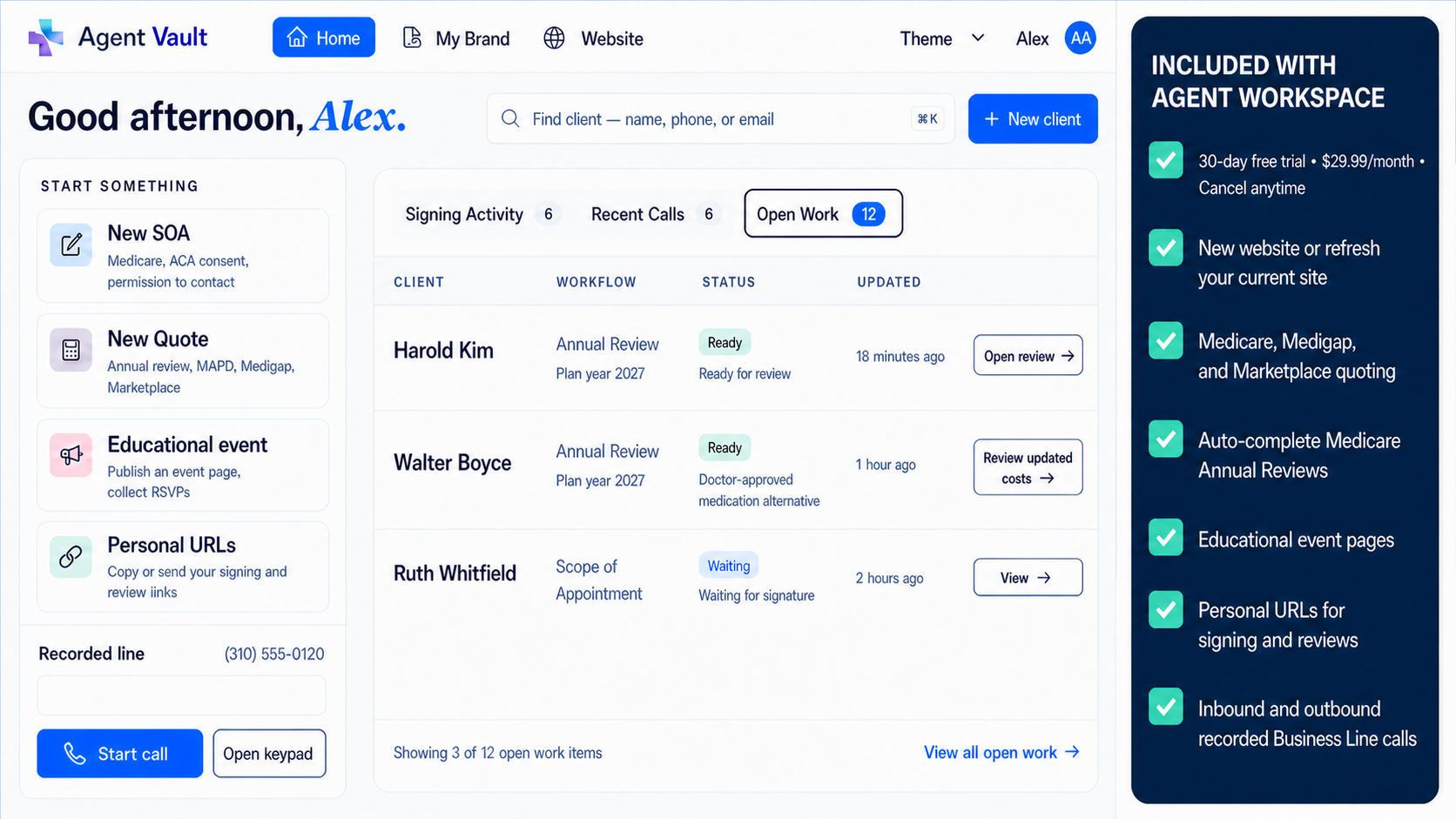
Medicare SEP records inside Agent Workspace
Keep the SEP decision, client record, and next step together.
A SEP case rarely ends with the election-period label. Agent Workspace connects client notes, supporting notices, attestations, electronic SOAs, optional recorded calls, quotes, follow-up, and long-term Agent Vault records around one client.
Use the Workspace to organize and retrieve the record. The licensed agent still applies current CMS guidance and carrier procedures before submitting an enrollment.
Essentials is $29.99/month after a 30-day free trial. Card required at checkout; one trial per NPN. Agent Workspace supports recordkeeping; it does not determine SEP eligibility, choose an election period, or replace CMS, carrier, FMO, agency, or state requirements.
This article is for educational purposes only and is not legal advice. Agents should confirm current CMS guidance, carrier rules, state rules, and agency policies before relying on any single enrollment pathway.
Sources
- CY 2027 Medicare Advantage and Part D Enrollment and Disenrollment Guidance : Centers for Medicare & Medicaid Services Accessed 2026-10-03.
- August 25, 2026 release memorandum for CY 2027 enrollment guidance : Centers for Medicare & Medicaid Services Accessed 2026-10-03.
- Medicare Managed Care Eligibility and Enrollment : Centers for Medicare & Medicaid Services Accessed 2026-10-03.
- CY 2027 Medicare Advantage and Part D final rule : Federal Register Accessed 2026-10-03.
- Temporary 2026 SEP for Incorrect Provider Information in Medicare Plan Finder : Centers for Medicare & Medicaid Services Accessed 2026-10-03.
- 42 CFR 422.62 - Medicare Advantage election periods : Electronic Code of Federal Regulations Accessed 2026-10-03.
- 42 CFR 423.38 - Part D enrollment periods : Electronic Code of Federal Regulations Accessed 2026-10-03.
- 42 CFR 422.66 - MA prior CMS approval : Electronic Code of Federal Regulations Accessed 2026-10-03.
- 42 CFR 423.32 - Part D enrollment and prior CMS approval : Electronic Code of Federal Regulations Accessed 2026-10-03.
- 42 CFR 423.36 - Part D disenrollment and prior CMS approval : Electronic Code of Federal Regulations Accessed 2026-10-03.
- 42 CFR 422.514 - D-SNP enrollment alignment restrictions : Electronic Code of Federal Regulations Accessed 2026-10-03.
Frequently Asked Questions
What should agents check before using a Medicare SEP in 2027?
Identify what changed, the event or notice date, the permitted election, the receiving plan's eligibility rules and who may process the request. An SEP does not override plan eligibility, capacity restrictions or required CMS approval.
Does dual or LIS eligibility allow monthly Medicare Advantage switching in 2027?
The regular monthly dual/LIS SEP permits a standalone PDP election, not unrestricted MA-PD switching. A separate integrated-care SEP allows certain full-benefit dual eligible individuals to enroll in an eligible integrated D-SNP aligned with its affiliated Medicaid MCO. These monthly rights began in 2025.
Does every D-SNP require matching Medicaid MCO enrollment in 2027?
No. The 2027 federal new-enrollment restriction applies to certain D-SNPs with affiliated Medicaid MCOs in overlapping service areas, subject to regulatory conditions and exceptions. For affected plans, the general federal restriction on continuing coverage for unaligned existing members begins in 2030. Check the state contract and receiving plan.
When is the SEP if a Medicare plan does not renew for 2027?
For a qualifying January 1, 2027 nonrenewal or service-area reduction, the SEP is December 8, 2026 through February 28, 2027. Requests in December normally start January 1; January requests start February 1; February requests start March 1. A later election does not ordinarily restore earlier Part D coverage retroactively.
Does a doctor leaving the network automatically create a 2027 SEP?
No. CMS did not finalize the proposed general provider-termination SEP. Check the existing CMS-determined significant-provider-network-change SEP or another applicable CMS-approved pathway. The temporary Plan Finder provider-information remedy was limited to 2026; it is not an established 2027 enrollment right.
Which SEPs require prior CMS approval?
The regulations expressly require prior CMS approval for contract violations, CMS sanctions, inadequate creditable-coverage information and other exceptional circumstances. The 2027 guidance directs beneficiaries to 1-800-MEDICARE; also follow any specific CMS-authorized sanction notice. Other categories, including federal employee error and significant network changes, also require CMS determinations.
Is turning 65 a Medicare SEP?
Usually it is an initial enrollment question. SEP65 is narrower: it lets an eligible person who first elected MA during the Part B initial enrollment period around age 65 return to Original Medicare within 12 months of that MA coverage. A disability beneficiary turning 65 has a separate additional Part D IEP and coordinating MA right.
Does losing SNP eligibility guarantee six extra months in the plan?
No. The plan's deemed continued eligibility policy and the loss-of-SNP-status SEP are different clocks. A plan may use a one-to-six-month deeming period when the member can reasonably be expected to regain eligibility. Check the plan notice, status-change date and actual disenrollment date.
Medicare and ACA Compliance Expert
Christian Rodgers is a Medicare and ACA compliance expert with over 30 years in the healthcare industry, having worked for some of the largest health plans in the United States. He has provided Medicare sales training to hundreds of agents in California and Florida.
Connect on LinkedIn