
Quick answer
CMS now applies a minimum six-year retention framework to Medicare Advantage and Part D marketing and sales calls. Audio is required for years one through three; audio or a complete and accurate transcript may be used for years four through six.
Enrollment records remain subject to a separate 10-year retention track. That distinction matters when one telephone call contains both sales and enrollment portions.
| Record | Current retention treatment |
|---|---|
| MA or Part D marketing and sales call | Record and retain in its entirety for at least six years |
| Years 1-3 | Preserve the audio |
| Years 4-6 | Preserve audio or a complete and accurate transcript |
| Enrollment record | Separate 10-year retention track |
| Telephone enrollment portion | Treat as an enrollment record because it can serve as the enrollment form and evidence of intent |
The operative marketing-call requirements appear in 42 C.F.R. § 422.2274(g)(2)(ii) and 42 C.F.R. § 423.2274(g)(2)(ii). For the broader recording rule rather than retention alone, see the Medicare call-recording requirements guide.
Key dates for Medicare call recording retention
Agents searching for “CMS call recording requirements 2026” need the date answer immediately.
Here are the dates that matter:
| Date | What it means |
|---|---|
| April 6, 2026 | CMS’s CY2027 final rule was published in the Federal Register as 91 FR 17384. |
| June 1, 2026 | The regulations are effective. |
| October 1, 2026 | The new CY2027 marketing and communications policies apply for 2027 plan-year marketing. |
| January 1, 2027 | The rule is applicable to coverage beginning in 2027. |
CMS states that the rule is effective June 1, 2026, applicable to coverage beginning January 1, 2027, and that the new marketing and communications policies apply to CY2027 marketing and communications beginning October 1, 2026.
Why agents are confused about the 10-year rule
For several years, the simple answer was:
Record Medicare sales calls and keep the recordings for 10 years.
That was easy to remember, but it is no longer precise.
CMS explained that MA organizations and Part D sponsors had previously been expected to retain sales and marketing call recordings for 10 years. For CY2027, CMS reduced the retention period for the marketing and sales portions of calls to six years, while keeping enrollment records on their separate 10-year track.
That creates two different risks for agents.
First, some agents may keep saying “10 years” for every call recording, even when the record is only a marketing or sales call. That can lead to unnecessary storage cost, larger archives, more data exposure, and a harder retrieval process.
Second, some agents may hear “10 years is gone” and assume they can relax their entire workflow. That is also wrong. CMS did not eliminate call recording, and it did not eliminate the 10-year enrollment-record requirement.
The better question is not:
How long do I keep every call?
The better question is:
What kind of record is this?
If the recording includes a plan change outside AEP, ask a second question before you file it away: what election period supported the application? For that separate triage step, use the 2027 Medicare Special Election Period guide for agents.
What the CY2027 retention rules mean before AEP
If you’re looking for the broad list of CY2027 call-recording requirements, start with the Medicare call recording requirements guide. This section covers what the retention rules specifically mean before AEP.
Here is the practical answer.
CMS did not eliminate Medicare call recording. CMS finalized that all marketing and sales calls, including the audio portion of calls conducted through web-based technology, must be recorded and retained in their entirety for at least six years.
For independent agents, that means:
- You still need a call recording workflow.
- You still need to preserve audio for the first three years.
- You still need to know whether the call includes an enrollment portion.
- You still need to store the recording with the related SOA, notes, plan discussion, enrollment record, and supporting documents.
- You still need to follow carrier, agency, FMO, state recording-consent, and approved-script requirements.
The CY2027 change is not “no more call recording.”
It is a more specific retention framework.
Years 1-3: keep the audio recording
For the first three years of the marketing and sales call retention period, agents should keep the actual audio.
A CRM note is not enough.
A short summary is not enough.
An AI-generated recap is not enough.
A partial transcript is not enough.
CMS’s final rule says records must be maintained in audio format for the first three years of the retention period.
That means the operational workflow should be:
- Record the applicable Medicare marketing or sales call.
- Store the audio in a system built for long-term retrieval.
- Keep the call with the related SOA, sales notes, plan discussion, and supporting documents.
- Do not replace the audio with a summary during years one through three.
This is where generic phone systems often fall short. Recording the call is only step one. The harder part is preserving the right file with the right context.
Years 4-6: audio or a complete and accurate transcript
For years four, five, and six, CMS allows marketing and sales call records to be maintained either as audio or as a complete and accurate transcript. CMS describes a complete and accurate transcript as one that documents the full recording and reflects all statements made by the participants as they originally occurred.
That matters.
A complete and accurate transcript is not the same thing as:
- A call summary.
- A CRM note.
- A short AI recap.
- A sales checklist.
- A “client agreed” note.
- A partial transcript of only the enrollment section.
If an agent uses transcripts for years four through six, those transcripts should be treated as compliance records. They should be complete, accurate, searchable, tied to the original call, stored with the related file, and exportable if a carrier, agency, FMO, CMS reviewer, or complaint process requires them.
Does the 10-year rule still apply to anything?
Yes.
The 10-year rule still matters for enrollment records.
CMS stated that the CY2027 proposal reduced the retention timeframe for marketing and sales calls while maintaining the requirement that enrollment records be retained for 10 years. CMS also stated that, for phone enrollments, the recording of the enrollment portion serves as the enrollment form and provides proof that the beneficiary attested to the intent to enroll.
That means a Medicare phone call can create more than one record type.
For example, one call may include:
- A greeting.
- A recording notice or consent statement.
- A TPMO disclosure.
- A Scope of Appointment discussion.
- A plan-specific marketing or sales discussion.
- A beneficiary decision.
- A telephonic enrollment portion.
The marketing or sales portion may fit the six-year framework. The enrollment portion may need to be handled as an enrollment record.
That is why agents should not think:
One call, one rule.
A better approach is:
One call may contain multiple record types.
When does a Medicare call become an enrollment record?
This page should not become a full enrollment-recording guide. For that deeper discussion, read when a Medicare call becomes an enrollment recording.
For this retention page, the short answer is enough:
A call becomes an enrollment record when the conversation moves from plan discussion into the actual enrollment request. CMS says the enrollment portion begins when the beneficiary is advised that they are completing an enrollment request, after which they provide the required enrollment information and attest to their intention to enroll.
Talking about premiums is not automatically enrollment.
Comparing networks is not automatically enrollment.
Discussing formularies is not automatically enrollment.
Answering plan questions is not automatically enrollment.
The enrollment portion begins when the beneficiary is told they are completing an enrollment request and then provides the required information and intent-to-enroll attestation.
For the related sales-versus-enrollment distinction, read the guide to marketing call vs. enrollment recording.
What if one call includes both marketing and enrollment?
Classification matters most in these three common scenarios:
| Scenario | Records created | How to label the file |
|---|---|---|
| Sales call with no enrollment | Marketing or sales call record; related SOA and notes if applicable | Marketing/sales; minimum six-year track; audio required for years 1-3 |
| Call starts with sales and ends with telephonic enrollment | Marketing/sales record plus an enrollment portion that can serve as the enrollment form and proof of intent | Identify both portions and the enrollment-record track; do not assume the whole file can be deleted after six years |
| Separate sales and enrollment calls | One marketing/sales call record and one separate enrollment record | Link the records to the same client file while preserving the distinct retention categories |
For mixed calls, CMS expressly distinguishes the marketing and sales portions from the enrollment portion. Tag the portions, link the SOA and supporting documents, and apply any complaint, audit, litigation, carrier, contract, or state-law hold that also governs the file.
Can agents delete marketing and sales recordings older than six years?
Possibly, but not automatically.
CMS stated that the revised six-year requirement would apply to currently retained call recordings, meaning marketing and sales portions of calls older than six years that are currently being retained would no longer need to be retained for that purpose.
But agents should be careful before deleting anything.
Before deleting an older recording, ask:
- Was this only a marketing or sales call?
- Did the call include a telephonic enrollment portion?
- Is the file tied to an enrollment record?
- Is there a complaint, carrier review, audit, legal hold, or dispute?
- Does a carrier, agency, FMO, or contract require longer retention?
- Does state law or another recordkeeping rule apply?
- Is the recording connected to an SOA, ACA consent record, application review record, or other file?
- Can I prove what the file was before deleting it?
The issue is not just:
Can I delete old audio?
The better question is:
Do I know what this record is and whether another rule still applies?
Do all Medicare calls have to be recorded?
No, not every possible call involving a Medicare beneficiary is automatically the same kind of call.
The CY2027 rule language focuses on marketing and sales calls, including the audio portion of web-based calls. Those calls must be recorded and retained in their entirety for at least six years.
But agents should not use that as an excuse to under-record. A call that starts as a simple question may become a plan discussion. A plan discussion may become a sales call. A sales call may move into a telephonic enrollment.
A good workflow should help the agent recognize when the call has moved from ordinary service or scheduling into a recordable Medicare marketing, sales, or enrollment workflow.
When in doubt, follow your carrier, agency, FMO, compliance, state-law, and approved-script process.
Do independent agents have to record sales and marketing calls?
Yes, independent agents are not carved out merely because they are not in a call center.
CMS considered comments suggesting that recording should apply to call centers but not independent agents. CMS rejected that approach and stated that all sales and marketing calls should be recorded, not just those from call centers, because complaints involve both independent agents and call-center agents.
That is important for solo agents and small agencies.
The practical burden may feel heavier for independent agents because their files are often scattered across:
- A personal cell phone.
- A generic VoIP dashboard.
- A CRM.
- An FMO platform.
- A carrier portal.
- Email.
- Google Drive.
- Dropbox.
- Desktop folders.
- Old call recording exports.
The problem is rarely that no record exists.
The problem is that the right record cannot be found quickly when it matters.
What about the Medicare call recording disclaimer or script?
Agents should not confuse three different things:
- Recording notice or consent language.
- TPMO disclaimer language.
- Telephonic enrollment script language.
They are not the same thing.
The CY2027 final rule states that the TPMO disclaimer must be verbally conveyed during sales calls before discussion of any benefits. For the timing specifics, see the CY2027 TPMO disclaimer timing guide.
That is different from a state-law recording notice or consent statement.
It is also different from a plan-approved telephonic enrollment script.
For practical purposes, agents should use approved language from their carrier, agency, FMO, compliance team, and counsel. A blog post should not be the agent’s source of final script language.
The SEO-safe way to handle this section is:
- Answer the search query.
- Do not publish a universal Medicare call recording script.
- Tell agents to use approved scripts.
- Link to your best Medicare agent call recording setup for AEP and state call recording laws for insurance agents pages for workflow detail.
What about state call recording consent laws?
State call recording consent is a separate issue from Medicare retention.
CMS may require certain calls to be recorded, but state law can affect how the recording starts. Some states permit participant recording. Some require notice. Some require all-party consent for private or confidential calls. Our state call recording law page recommends a conservative national workflow: disclose the recording, get clear consent, and keep the consent statement in the recording.
For this article, the key point is simple: retention tells you how long to keep a record, but state recording-consent rules can affect how the recording begins. For the deeper state-law workflow, read state call recording laws for insurance agents.
Why generic phone recording is not enough
A regular phone system may record calls. That does not mean it creates a complete Medicare compliance file.
A Medicare sales file may need:
- Call recording.
- Recording notice or consent statement.
- TPMO disclosure evidence.
- Scope of Appointment.
- Plan discussion notes.
- Enrollment-related record, if applicable.
- ACA consent record, if applicable.
- Eligibility application review record, if applicable.
- Uploaded documents.
- Complaint-response notes.
- Exportable record package.
A generic VoIP dashboard may show a date, time, phone number, duration, and audio file. That may be useful, but it does not automatically connect the call to the SOA, enrollment file, notes, and supporting documents.
Retention is not just about how long the audio exists.
Retention is about whether the file can be found, understood, and produced later.
For related storage pitfalls, see our guide to Google Drive for insurance agent call recordings.
Why Agent Workspace fits the six-year vs. 10-year reality
The CY2027 change makes classification more important.
Agents need to know whether a file is:
- A marketing or sales call recording.
- A telephonic enrollment record.
- A mixed sales-and-enrollment call.
- A telephone SOA record.
- An ACA consent record.
- An eligibility application review record.
- A complaint-response file.
- A supporting sales document.
Agent Workspace is built around that recordkeeping problem. It includes an optional business number for inbound and outbound calls inside the app plus a secure vault for recorded sales calls, electronic SOAs, telephone SOA and voice authorization workflows, ACA consent records, eligibility review documentation, telephonic enrollment records, notes, uploads, and related sales documents.
That matters because the goal is not only to record the call.
The goal is to keep the evidence connected.
A strong Medicare call recording workflow should help answer:
- Is this a marketing or sales call?
- Is there an enrollment portion?
- Is the SOA connected?
- Was recording notice or consent captured?
- Was the TPMO disclaimer handled at the right point?
- Are related documents attached?
- Is the record searchable?
- Can the agent export the file if they change FMOs, agencies, CRMs, phone systems, or enrollment platforms?
Agent Workspace is designed to keep the call recording with the related SOA, ACA record, enrollment-related file, notes, uploads, and supporting documents. The product page also says records can be exported if the agent changes FMOs, agencies, CRMs, phone systems, sales workflows, or decides to leave.
For comparison shoppers, these pages may help: SunFire vs. Informed + Choice for call recording and MedicareCENTER vs. Informed + Choice for agent records.
A practical retention workflow for Medicare agents
1. Record applicable Medicare marketing and sales calls
Do not treat the six-year change as the end of call recording. CMS still requires marketing and sales calls to be recorded and retained in their entirety.
2. Keep audio for the first three years
For marketing and sales call records, keep the audio during years one through three. Do not substitute a summary, CRM note, or incomplete transcript during that period.
3. Decide what to do for years four through six
For years four through six, decide whether your workflow will retain audio or complete and accurate transcripts. If you use transcripts, treat them as formal compliance records.
4. Classify enrollment records separately
Enrollment records are not simply marketing call recordings. If a phone call includes a telephonic enrollment portion, treat that portion carefully because CMS says it serves as the enrollment form and proof of beneficiary intent to enroll. See the deeper guide to telephonic enrollment record storage inside the Agent Workspace workflow.
5. Store the full file together
A call recording is more useful when it stays with the SOA, notes, plan discussion, enrollment record, ACA record, uploaded documents, and complaint-response materials.
For broader storage strategy, see the Essentials record-storage workflow; it is available with Essentials. Essentials is $29.99/month after a 30-day free trial. Card required at checkout; one trial per NPN.
6. Keep exportability in mind
Agents change FMOs, agencies, CRMs, phone systems, and enrollment platforms. Your retention workflow should not trap your records inside a system you may stop using.
7. Avoid deleting based only on age
Before deleting any older recording, classify the record. A six-year-old marketing recording may be treated differently from a six-year-old telephonic enrollment record.
What agents should not do
Avoid these mistakes.
Mistake 1: Saying every Medicare call recording still requires 10 years of audio
That is no longer the best universal explanation for marketing and sales call recordings under the CY2027 framework.
Mistake 2: Saying the 10-year rule disappeared
It did not. Enrollment records remain separate.
Mistake 3: Treating transcripts like summaries
CMS’s transcript option for years four through six applies to complete and accurate transcripts, not short summaries or sales notes.
Mistake 4: Treating every call as one record type
One call may include marketing, sales, SOA discussion, enrollment, and supporting documentation.
Mistake 5: Keeping recordings in a phone dashboard with no related file
A call recording without the SOA, notes, enrollment context, and supporting documents may be difficult to use later.
Mistake 6: Forgetting state recording consent
Retention tells you how long to keep the record. State recording law and approved scripts affect how the recording starts.
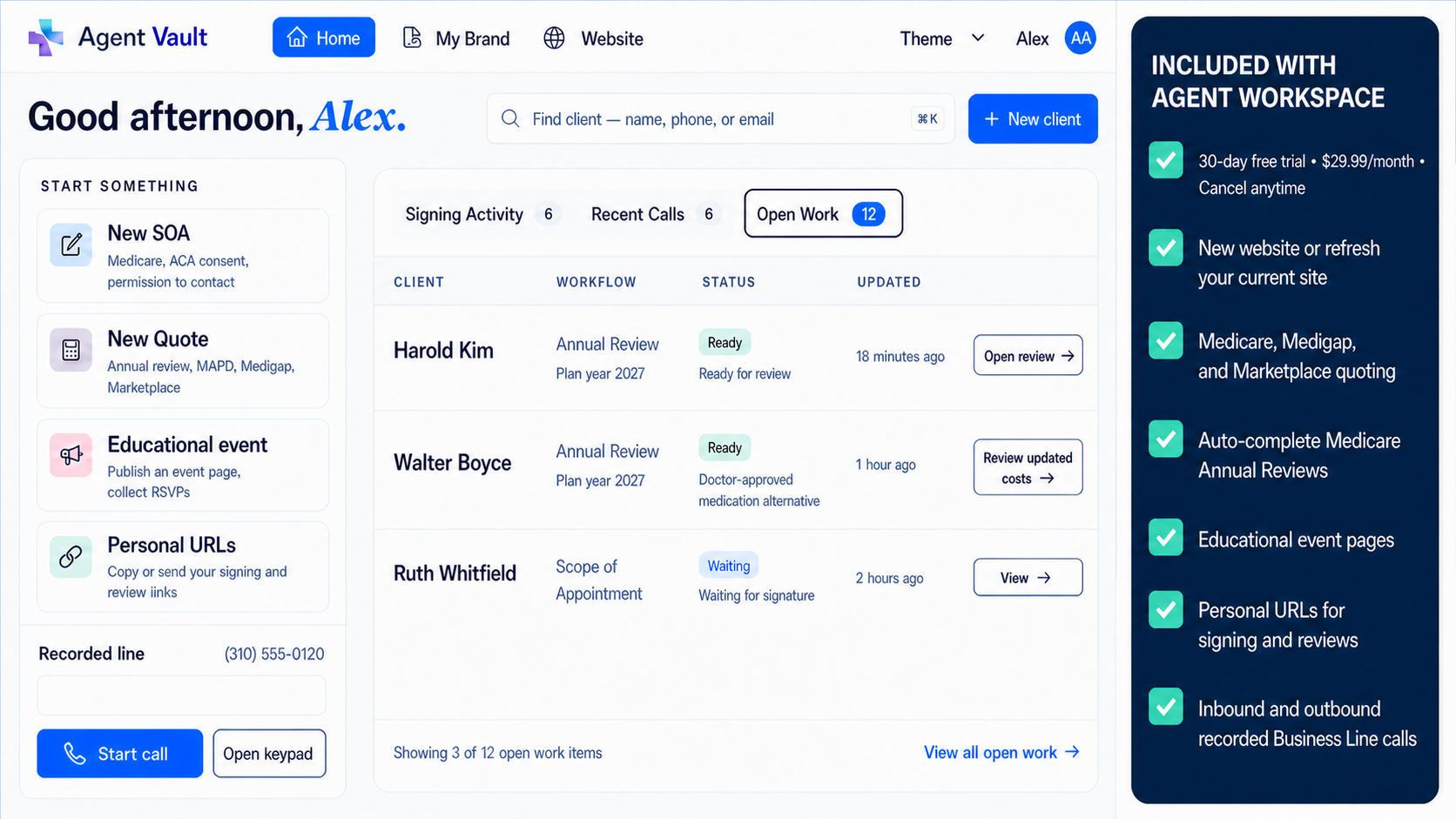
Six-year and 10-year records in one Workspace
Record the call, keep the context, and preserve the right record.
Agent Workspace includes an optional business number for calls made and answered inside the app, with permitted recordings connected to the client, SOA, notes, enrollment-related files, uploads, and long-term Vault records.
The Workspace keeps the evidence together; the agent still determines whether the file follows the six-year marketing-and-sales track, the 10-year enrollment-record track, or another applicable retention or legal-hold requirement.
Business calling is included in Essentials at $29.99/month after a 30-day free trial. Card required at checkout; one trial per NPN. Agent Workspace supports recordkeeping; it does not determine the governing retention period or replace CMS, carrier, FMO, agency, contract, state-law, or legal-hold requirements.
The bottom line
Medicare agents should stop using “10 years” as a one-size-fits-all answer for every Medicare call recording.
For CY2027, Medicare marketing and sales call recordings move to a six-year retention framework. Audio is required for the first three years. For years four through six, agents may retain audio or complete and accurate transcripts.
But enrollment records remain separate. CMS maintained the 10-year retention track for enrollment records, and the phone enrollment portion of a call can serve as the enrollment form and proof of the beneficiary’s intent to enroll.
The practical rule is:
Six years for marketing and sales call recordings. Ten years for enrollment records. Classify mixed calls carefully.
The best workflow is not just to record calls. It is to classify the record, store it with the related SOA and sales documents, preserve enrollment-related records where applicable, and keep everything retrievable and exportable.
That is what Agent Workspace is built to support: an optional business number for recorded calls made and answered inside the app, connected to a compliance vault for Medicare and ACA agents who need call recordings, SOAs, consent records, enrollment-related files, uploads, and supporting sales records in one organized workflow.
This article is for educational purposes only and is not legal, compliance, CMS, carrier, FMO, agency, Marketplace, HIPAA, or state-law advice. Agents should review current CMS guidance, carrier rules, agency procedures, FMO requirements, state recording-consent laws, approved scripts, and qualified compliance or legal advice for their specific workflow.
Sources
- Federal Register, 91 FR 17384: Contract Year 2027 Medicare Advantage and Part D final rule. Accessed 2026-07-13.
- eCFR, 42 CFR 422.2274(g)(2)(ii): Electronic Code of Federal Regulations Accessed 2026-07-13.
- eCFR, 42 CFR 423.2274(g)(2)(ii): Electronic Code of Federal Regulations Accessed 2026-07-13.
- eCFR, 42 CFR 422.504(e)(1)(iv): Electronic Code of Federal Regulations Accessed 2026-07-13.
- eCFR, 42 CFR 423.505(e)(1)(iv): Electronic Code of Federal Regulations Accessed 2026-07-13.
- Agent Workspace: Informed + Choice product page for the recorded business line and compliance vault workflow.
Frequently Asked Questions
Do Medicare agents still need to keep call recordings for 10 years?
Not as a universal rule for every Medicare marketing or sales call recording. For CY2027, Medicare marketing and sales call recordings must be retained for at least six years. Audio is required for the first three years, and audio or a complete and accurate transcript may be used for years four through six. Enrollment records remain on a separate 10-year track.
What are the Medicare call recording retention rules for CY2027?
Marketing and sales calls must be recorded and retained in their entirety for at least six years. The first three years must be maintained as audio. Years four, five, and six may be maintained as audio or as complete and accurate transcripts.
Do Medicare sales calls have to be recorded?
Yes. CMS finalized that Medicare marketing and sales calls, including the audio portion of web-based calls, must be recorded and retained in their entirety for at least six years. CMS also rejected limiting the requirement only to call centers.
Do all Medicare calls have to be recorded?
Not every possible call involving a Medicare beneficiary is automatically the same type of call. The CY2027 rule focuses on Medicare Advantage and Part D marketing and sales calls. Agents should also treat telephonic enrollment portions separately because those can serve as enrollment records.
How long do recorded Medicare Advantage enrollment calls need to be retained?
Enrollment records remain on a separate 10-year track. CMS stated that the CY2027 marketing and sales call retention change maintained the requirement that enrollment records be retained for 10 years.
When can Medicare agents use transcripts instead of audio?
For Medicare marketing and sales call records, transcripts may be used during years four, five, and six of the six-year retention period. During the first three years, the record must be maintained in audio format.
What counts as a complete and accurate transcript?
A complete and accurate transcript should document the full recording and reflect all statements made by the participants as they originally occurred. A call summary, CRM note, or short AI recap is not the same thing.
Can Medicare agents delete old recordings after six years?
Possibly, but not automatically. Agents should first determine whether the file includes an enrollment portion, complaint, audit, carrier requirement, state-law issue, or other retention obligation.
Can independent Medicare agents ignore call recording if they are not in a call center?
No. CMS stated that all sales and marketing calls should be recorded, not just calls from call centers, because complaints involve both independent agents and call-center agents.
What is the Medicare call recording disclaimer?
Agents should distinguish between recording notice or consent language, the TPMO disclaimer, and telephonic enrollment script language. The TPMO disclaimer must be verbally conveyed during sales calls before discussion of any benefits. Agents should use approved carrier, agency, FMO, compliance, and state-law language.
Do state call recording laws still matter?
Yes. Medicare rules may require certain calls to be recorded, but state law can affect how recording starts. A conservative workflow is to disclose the recording, get clear consent, and keep the consent statement in the recording.
Is a regular business phone system enough for Medicare call recording retention?
A regular phone system may record calls, but agents usually need more than audio storage. They need to keep recordings with SOAs, enrollment-related records, ACA records, notes, uploaded documents, and exportable proof files.
Medicare and ACA Compliance Expert
Christian Rodgers is a Medicare and ACA compliance expert with over 30 years in the healthcare industry, having worked for some of the largest health plans in the United States. He has provided Medicare sales training to hundreds of agents in California and Florida.
Connect on LinkedIn