
Quick answer
CMS’s CY 2027 final rule removes the fixed 48-hour waiting period between Scope of Appointment completion and a personal marketing appointment, but it does not remove the SOA requirement. Medicare agents should update six workflows before CY 2027 marketing begins on October 1, 2026: same-day SOA capture, written in-person SOAs, TPMO disclaimer timing, call recording retention, educational-to-marketing event transitions, and SOA collection at educational events.
The rule is effective June 1, 2026. The marketing and communications changes apply to CY 2027 marketing beginning October 1, 2026. Coverage applicability begins January 1, 2027.
The practical takeaway: same-day appointments are back, but same-day documentation still has to be clean.
Reviewed July 17, 2026
Source check: this article was reviewed against the CMS CY 2027 Final Rule Fact Sheet, the Federal Register final rule, the current Part C and Part D event regulations, and California’s current insurance identity-display statutes.
| 2027 workflow change | What changed | What Medicare agents should do by Oct. 1 |
|---|---|---|
| 48-hour SOA wait | Fixed waiting period removed | Collect and record the SOA before the personal marketing appointment; same-day is allowed, but no-SOA is not |
| In-person SOAs | Written SOA required for in-person personal marketing appointments | Use paper or a written electronic SOA before plan-specific discussion starts |
| TPMO disclaimer | No longer required in the first minute; required before benefits discussion | Rewrite call scripts, websites, emails, chat flows, and marketing templates |
| Call recordings | Marketing/sales call retention reduced to 6 years | Keep audio years 1-3; audio or complete transcript years 4-6; keep enrollment records on the longer retention path |
| Educational-to-marketing events | 12-hour separation removed | Clearly announce the transition and give attendees a real chance to leave |
| SOAs at educational events | SOA forms may be collected again | Collect SOAs for future personal marketing appointments, but keep the event educational |
Download the one-page CMS 2027 Medicare Agent Workflow Checklist
Use it to update your SOA process, call scripts, recording retention, educational-event workflow, and file storage before October 1.
Get the checklist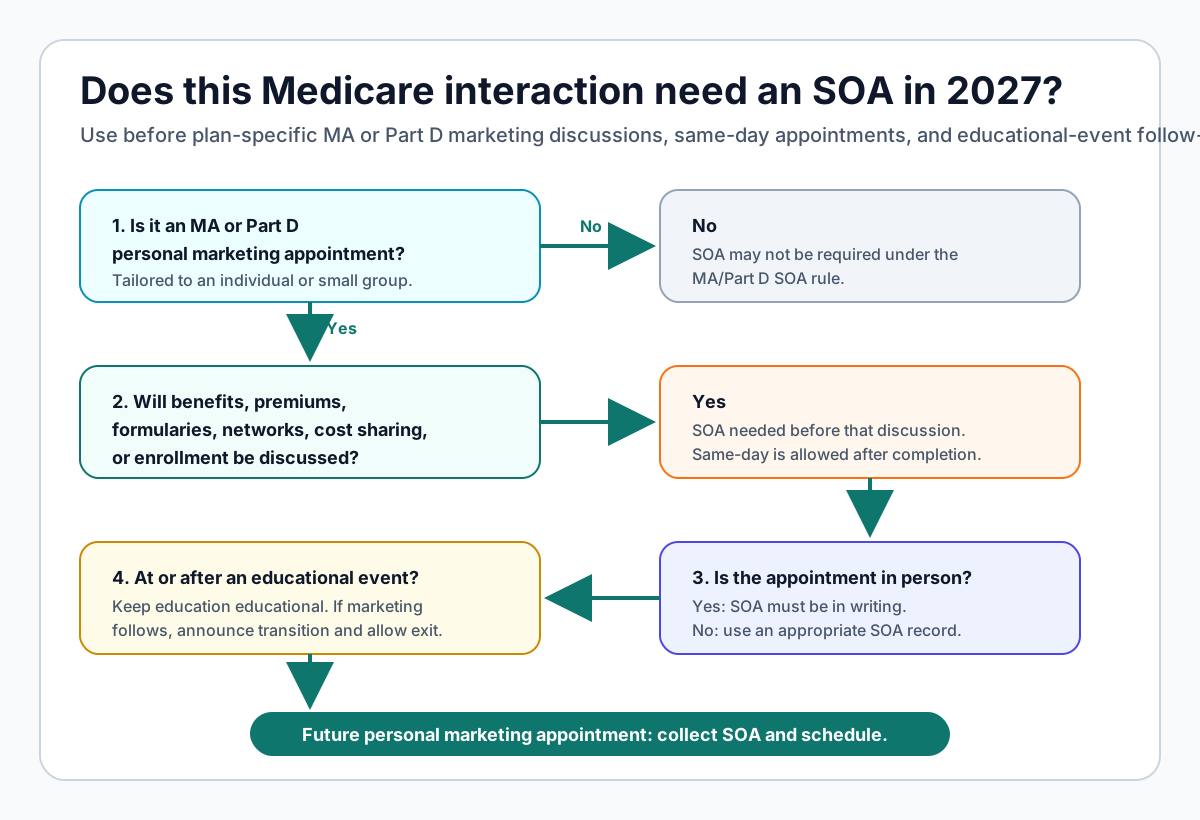
2027 CMS final rule dates for Medicare agents
CMS issued the CY 2027 Medicare Advantage and Part D final rule in April 2026. For Medicare agents, the most important operational date is October 1, 2026, when CY 2027 marketing and communications begin.
Keep these dates separate:
- April 2, 2026: CMS issued the CY 2027 final rule fact sheet.
- June 1, 2026: the regulations are effective.
- October 1, 2026: CY 2027 marketing and communications begin.
- January 1, 2027: CY 2027 coverage begins.
That timing matters because agents, agencies, FMOs, call centers, and sales platforms need updated workflows before AEP activity begins.
If you sell both Medicare and Marketplace coverage, keep the rulebooks separate. The companion 2027 ACA Marketplace final rule guide for agents covers ACA marketing claims, SEP and income verification, failure to reconcile, annual training, and the future HHS consent form.
This article covers marketing, communications, SOA, event, and retention workflow changes. For the separate question of whether a beneficiary can change Medicare Advantage or Part D coverage outside AEP, use the 2027 Medicare Special Election Period guide for agents. For the new GLP-1 weight-management pathway that starts July 1, 2026, keep the Medicare GLP-1 Bridge guide for agents separate from normal Part D plan selection.
If you are preparing for AHIP, carrier certifications, or AEP readiness, use the companion 2027 Medicare agent certification study guide to place these rule changes inside the broader certification topics: Medicare basics, MA and Part D eligibility, election periods, pre-enrollment review, marketing rules, compensation, grievances, appeals, and FWA.
The 48-hour SOA waiting period is gone, but the SOA requirement is not
CMS eliminated the fixed 48-hour waiting period between completing a Scope of Appointment and holding a personal marketing appointment. Same-day Medicare appointments are allowed again.
But this is not the same thing as eliminating the Scope of Appointment. Before the personal marketing appointment begins, the agent, broker, plan, or sponsor still needs to agree upon and record the SOA with the beneficiary.
CMS also clarified that the SOA requirement applies when the interaction becomes a personal marketing appointment, including inbound contacts, walk-ins, unscheduled calls, web chats, and web forms when the discussion is tailored to an individual or small group for Medicare marketing topics. Review the companion guide to same-day SOA and walk-in rules for those inbound scenarios.
The practical rule for agents is simple:
Same-day is allowed. No-SOA is not.
For same-day appointments, build the workflow around immediate SOA capture. For phone or virtual appointments, make sure the SOA record is tied to the contact record. For in-person appointments, make sure the SOA is in writing before the plan-specific discussion starts.
If the appointment starts as Medicare Supplement-only but could pivot into Part D or Medicare Advantage, review our guide to the Medicare Supplement SOA workflow before relying on a Medigap-only file note.
In-person Medicare appointments still need a written SOA
The biggest same-day trap is the in-person appointment.
CMS finalized language stating that the Scope of Appointment must be in writing for in-person personal marketing appointments. A casual verbal agreement is not enough when the appointment is face-to-face.
A written SOA does not necessarily have to mean paper. A properly completed electronic Scope of Appointment may create the written record the agent needs, depending on carrier, FMO, agency, state, and platform requirements. For more detail, use the guide to written Scope of Appointment for in-person appointments.
The operational update:
- remove the old 48-hour timer from your scheduling workflow;
- keep the SOA requirement in place;
- require written SOA documentation before in-person plan-specific discussion;
- store the completed SOA with the rest of the client file.
Need a same-day written SOA workflow?
Use an electronic Scope of Appointment to capture the beneficiary’s agreed product scope before the in-person plan discussion begins.
The TPMO disclaimer timing changed
CMS did not eliminate the TPMO disclaimer. It changed the timing.
The verbal TPMO disclaimer no longer has to be delivered in the first minute of a sales call. Instead, it must be conveyed before any discussion of benefits. CMS explained that a discussion of benefits can include talking about specific plan benefits, cost sharing, Evidence of Coverage content, or benefit structure in a way that may influence a beneficiary’s MA or Part D decision.
This gives agents a more natural opening call flow:
- greet the beneficiary;
- confirm identity and reason for the call;
- understand the basic request;
- deliver the TPMO disclaimer before moving into benefits;
- then discuss plan-specific details.
The script update is not optional. Review call scripts, website copy, email templates, online chat scripts, lead-nurture sequences, printed marketing pieces, and recorded-line prompts. If old SHIP language is hard-coded into standardized disclaimer text, review it before CY 2027 marketing begins.
Medicare marketing and sales call retention drops to six years
CMS finalized a shorter retention period for marketing and sales call recordings. Marketing and sales calls must be retained for at least six years. For the first three years, records must be maintained in audio format. For years four, five, and six, records may be maintained as audio or as complete and accurate transcripts. For a deeper call-recording walkthrough, see the guide to Medicare call recording retention.
But agents should not confuse this with enrollment retention. CMS did not shorten the retention timeframe for enrollment records. The Federal Register notes that the CY 2027 proposal did not address the retention timeframe for enrollment calls and maintained the 10-year enrollment-record framework.
The practical workflow:
- tag marketing/sales portions separately from enrollment portions where possible;
- keep audio for the first three years;
- decide whether years four through six will use audio or complete transcripts;
- keep enrollment records on the longer retention path;
- make sure your system can retrieve the SOA, call record, transcript, and enrollment evidence quickly.
Educational and marketing events can run back-to-back again
CMS eliminated the 12-hour separation rule between an educational event and a marketing event in the same location. A marketing event can directly follow an educational event if beneficiaries are clearly notified that the educational event is ending, told that the marketing event is beginning, and given a sufficient opportunity to leave.
Do not treat this as permission to blur the event types. A clean event workflow should include a slide or announcement that the educational event is ending, a visible transition point, a break or pause, a clear statement that the next portion is a marketing event, a real opportunity for attendees to leave without pressure, and SOA completion before any personal marketing appointment.
Event rule of thumb: education can lead into marketing, but education should not quietly become marketing. Make the transition obvious to the beneficiary.
SOAs can be collected at educational events again
CMS also finalized the return of SOA collection at educational events. CMS explained that collecting an SOA form is not itself a sales or marketing activity because it is an agreement about what products will be discussed in advance of a future personal marketing appointment.
This is a major workflow change for community-based agents. At a Medicare educational event, agents can make SOA forms available and receive completed SOAs. But the educational event still needs to remain educational. Do not turn the presentation into a disguised plan-specific sales appointment.
The clean workflow:
- provide education;
- allow beneficiaries to request future plan-specific discussion;
- collect the SOA;
- schedule or prepare for the personal marketing appointment;
- keep the event record and SOA record organized.
Running events in 2027? Review the dedicated guide to SOAs at Medicare educational events.
Educational-event notices, applications, and accommodations
The same rule that permits SOA collection also draws a firm boundary around educational events.
Allowed at an educational event
- Distribute general communications materials.
- Answer beneficiary-initiated questions while keeping the event educational.
- Distribute business cards.
- Make available and receive contact information and Business Reply Cards.
- Make available and receive SOAs for future personal marketing appointments.
Not allowed at an educational event
- Market specific MA plans, Part D sponsors, or plan benefits.
- Conduct a sales or marketing presentation.
- Distribute plan applications.
- Accept plan applications.
The regulation requires the event to be advertised as educational, but it does not prescribe one fixed CMS educational-event sentence. Do not call your own sentence “CMS standardized content.” A clear company-standard or carrier-approved notice is:
This is an educational event. No sales or marketing presentation of specific Medicare Advantage or Part D plans or benefits will be conducted. No plan applications will be distributed or accepted.
Treat that as company-standard or carrier-approved copy, not CMS standardized content. A carrier or FMO may require different wording or prior approval of the invitation, flyer, presentation, or registration page.
Event advertisements and invitations also need a separate accommodations notice. CMS treats this as model content: the material must convey that accommodations for persons with special needs are available and provide both a telephone number and a TTY number. A straightforward implementation is:
Accommodations for persons with special needs are available. Call [telephone number] (TTY: [TTY number]).
That accommodations content is separate from the educational-event classification notice and separate from any TPMO disclaimer that applies by channel or material type.
TPMO and state rules are separate layers
Calling an event educational does not turn the TPMO disclaimer on or off. For a qualifying TPMO, apply the disclaimer based on TPMO status, the number of represented MA organizations or Part D sponsors, product scope, beneficiary service area, communication channel, and whether the material is marketing.
The practical channel rule is:
- sales call: convey the TPMO disclaimer before discussing benefits;
- email, online chat, or other direct electronic communication: convey it electronically;
- TPMO website or event landing page: display it prominently; and
- TPMO-developed, used, or distributed marketing material: include it.
For count logic, MA-PD, PDP, Medigap, multistate websites, and educational-event invitations, use the expanded 2027 TPMO disclaimer timing and counting guide.
State compliance is another layer. CMS explains that federal MA and Part D communication and marketing standards generally preempt conflicting state marketing standards, while state licensing laws remain outside that preemption. State producer licensing, business-entity licensing, carrier appointments, approved names, license-number display, and advertising identity requirements can still vary. California compliance is not a nationwide safe harbor.
California is a useful example. For an agent or broker advertising and transacting insurance online in California, the website homepage or a prominent homepage link must identify the filed name, state of domicile and principal place of business, California insurance license number, and the word “insurance” in the same-sized type. California separately regulates license-number placement in specified business cards, price quotations, print advertisements, and emails involving licensed activity. An NPN does not replace the California license number.
For multistate work, maintain a state-and-channel registry that records the product family, event and audience states, individual and business-entity licenses, lines of authority, appointments, approved legal name and DBA, required state license identifier, placement and type-size rules, source, effective date, review date, and carrier or FMO approval. Do not represent a 50-state layer as complete until each state has been sourced and reviewed.
Superlatives and Notice of Availability
These secondary changes matter, but they should not compete with the six workflow changes.
CMS relaxed the earlier rule that required supporting documentation for superlatives to appear directly in the marketing material. It did not remove the truth-in-marketing standard. Marketing materials still cannot be misleading, confusing, or materially inaccurate, and CMS may request support during review or complaint investigation.
Agent workflow: keep the substantiation file, identify the data year when older data is used, avoid subjective claims that cannot be supported, and be especially careful with supplemental benefit claims.
CMS also rescinded its own Medicare marketing Notice of Availability requirement, formerly known by many agents as the MLI or multi-language insert. But the rule text ties the CMS Notice of Availability change to separate OCR language-assistance notice requirements, so agents and organizations should not remove every language-access notice without compliance review.
Agent workflow: review Medicare marketing templates, review OCR language-access obligations separately, and do not delete all language-assistance language just because the CMS NoA requirement changed.
What agents should update before October 1, 2026
Before CY 2027 marketing begins, Medicare agents should update six operating workflows.
First, rebuild the SOA workflow around scope capture, not a 48-hour timer. The SOA still needs to be completed before the personal marketing appointment. In-person appointments need written SOA documentation.
Second, retrain anyone who handles walk-ins, inbound calls, web forms, texts, online chats, or appointment requests. Same-day is allowed, but a personal marketing appointment still needs the proper scope record.
Third, rewrite scripts around the new TPMO disclaimer trigger. The disclaimer belongs before benefits discussion, not mechanically inside the first minute.
Fourth, separate marketing/sales recording retention from enrollment-record retention. Marketing and sales calls now follow a six-year retention path, but enrollment records still need longer handling.
Fifth, update educational-event playbooks. If a marketing event follows an educational event, the transition must be clear and beneficiaries need an opportunity to leave.
Sixth, clean up marketing-material review. Superlatives may be easier to use, and the CMS Notice of Availability requirement changed, but misleading claims and language-access obligations did not disappear.
Bottom line: CMS made the workflow faster. It did not make documentation optional.
Pair these workflow updates with the 2027 Medicare Advantage changes by county to identify local plan listings and cost questions worth investigating before AEP appointments.
October 1 readiness inside Agent Workspace
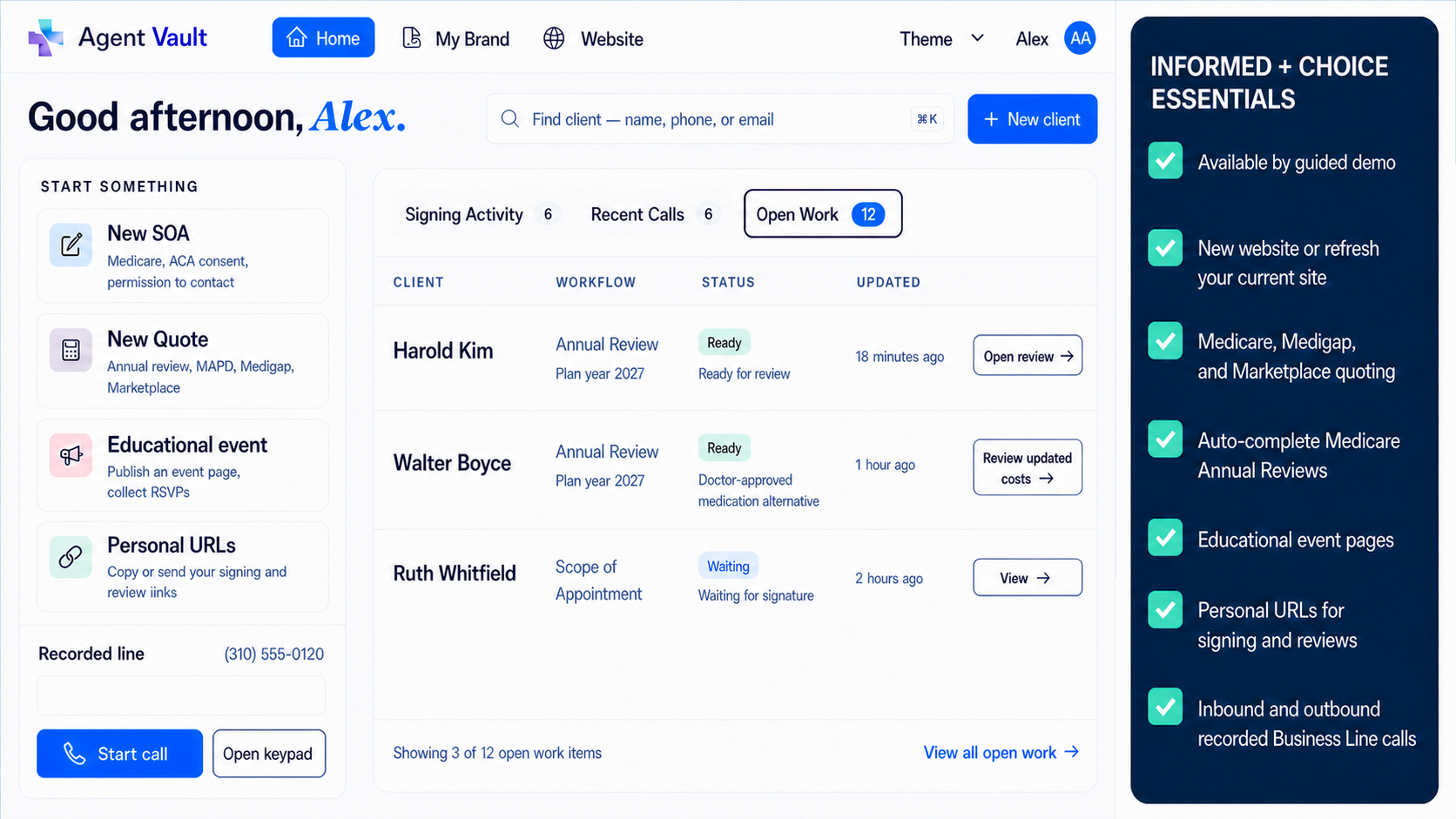
Put the six workflow changes inside one connected agent workspace.
Use electronic SOAs for same-day appointment workflows, make permitted calls through the optional business number, and keep notes, recordings, transcripts, enrollment-related files, and supporting documents connected to the client record. Educational event pages, flyers, QR codes, and RSVP workflows are included too.
Agent Workspace helps run and preserve the workflow. The agent still determines which rule applies, uses carrier- or FMO-approved scripts and disclosures, separates educational and marketing activity, classifies each record correctly, and follows applicable CMS, state, carrier, agency, and legal-hold requirements.
Essentials is available through a guided demo. It has no public price, free trial, or automatic production signup. Agent Workspace supports workflow and recordkeeping; it does not determine regulatory applicability or replace CMS rules, carrier or FMO procedures, state law, approved materials, agency review, or legal advice.
Get the CMS 2027 Medicare Agent Workflow Checklist
CMS removed several old workflow barriers, but agents still need clean documentation before CY 2027 marketing begins.
Use this one-page checklist to update:
- same-day Scope of Appointment capture;
- written SOA procedures for in-person appointments;
- TPMO disclaimer timing;
- Medicare call recording retention;
- enrollment-record retention handling;
- educational-event transitions;
- SOA collection at educational events;
- marketing-material review;
- superlative substantiation files;
- Notice of Availability and language-access review.
Educational resource only. Not legal advice. Agents should confirm current CMS rules, carrier guidance, FMO procedures, state requirements, and agency policies.
This article is for educational purposes only and is not legal advice. Agents should review current CMS guidance, carrier rules, FMO requirements, agency policies, state rules, approved scripts, and qualified legal or compliance guidance for their specific workflow.
Sources
- Contract Year 2027 Medicare Advantage and Part D Final Rule Fact Sheet: CMS Accessed 2026-05-21.
- Medicare Program; Contract Year 2027 Final Rule: Federal Register Accessed 2026-07-17.
- 42 CFR 422.2264 - Beneficiary contact and event rules: eCFR Accessed 2026-07-17.
- 42 CFR 423.2264 - Beneficiary contact and event rules: eCFR Accessed 2026-07-17.
- 42 CFR 422.2267 - Required materials and content: eCFR Accessed 2026-07-17.
- 42 CFR 423.2267 - Required materials and content: eCFR Accessed 2026-07-17.
- California Insurance Code section 1725.5: California Legislative Information Accessed 2026-07-17.
- California Insurance Code section 1726: California Legislative Information Accessed 2026-07-17.
Frequently Asked Questions
What is the CMS 2027 final rule for Medicare agents?
The CMS CY 2027 final rule changes several Medicare Advantage and Part D marketing, communications, Scope of Appointment, call recording, educational-event, and marketing-material workflows. For agents, the most practical deadline is October 1, 2026, when CY 2027 marketing and communications begin.
Is the 48-hour Scope of Appointment rule gone for 2027?
Yes. CMS eliminated the fixed 48-hour waiting period between SOA completion and the personal marketing appointment. Agents still need the SOA completed before the personal marketing appointment begins.
Can Medicare agents hold same-day appointments in 2027?
Yes, if the Scope of Appointment is completed before the personal marketing appointment. Same-day is allowed, but agents should still document the agreed product scope clearly.
Do in-person Medicare appointments need a written SOA?
Yes. CMS finalized language stating that the Scope of Appointment must be in writing for in-person personal marketing appointments.
When does the TPMO disclaimer need to be read in 2027?
The TPMO disclaimer no longer has to be delivered in the first minute of the call. It must be conveyed before any discussion of benefits.
How long do Medicare marketing and sales calls need to be retained?
Marketing and sales calls must be retained for at least six years. The first three years must be audio. Years four through six may be audio or complete and accurate transcripts.
Did CMS reduce enrollment-record retention to six years?
No. CMS reduced the retention requirement for marketing and sales call recordings, not enrollment records. Enrollment records remain on the longer retention path.
Can agents collect SOAs at Medicare educational events?
Yes. CMS finalized that SOA forms may again be made available and received at educational events. But the educational event itself must remain educational and should not become a disguised sales event.
Can a marketing event happen right after an educational event?
Yes, if beneficiaries are clearly told the educational event is ending, told the marketing event is beginning, and given a meaningful opportunity to leave.
Can agents distribute or accept plan applications at an educational event?
No. An educational event may not include a sales or marketing presentation, and plan applications may be neither distributed nor accepted. Agents may make available and receive contact information, Business Reply Cards, and SOAs for future personal marketing appointments.
Is there fixed CMS wording for an educational-event notice?
The current federal rule requires the event to be advertised as educational and restricts what may happen there, but it does not prescribe one fixed educational-event sentence. Use company-standard or carrier-approved wording and do not label it CMS standardized content.
What accommodations notice belongs on a Medicare event invitation?
Every advertisement or invitation to an educational, marketing, or sales event must convey that accommodations for persons with special needs are available and provide both a telephone number and a TTY number. CMS treats this as model content.
Does calling an event educational turn off the TPMO disclaimer?
No. Event classification does not control every TPMO obligation. A qualifying TPMO must apply the channel rules for calls, direct electronic communications, websites, and marketing materials, using the applicable service-area counts.
Does California insurance disclosure compliance satisfy every state?
No. State producer, agency, appointment, approved-name, license-number, and advertising-identity requirements vary. California is one state example, not a nationwide safe harbor, and an NPN does not replace a required state insurance license number.
What should Medicare agents update before October 1, 2026?
Agents should update SOA workflows, in-person written SOA procedures, TPMO disclaimer scripts, call recording retention logic, educational-event playbooks, SOA collection procedures, and marketing-material review processes.
Medicare and ACA Compliance Expert
Christian Rodgers is a Medicare and ACA compliance expert with over 30 years in the healthcare industry, having worked for some of the largest health plans in the United States. He has provided Medicare sales training to hundreds of agents in California and Florida.
Connect on LinkedIn