01
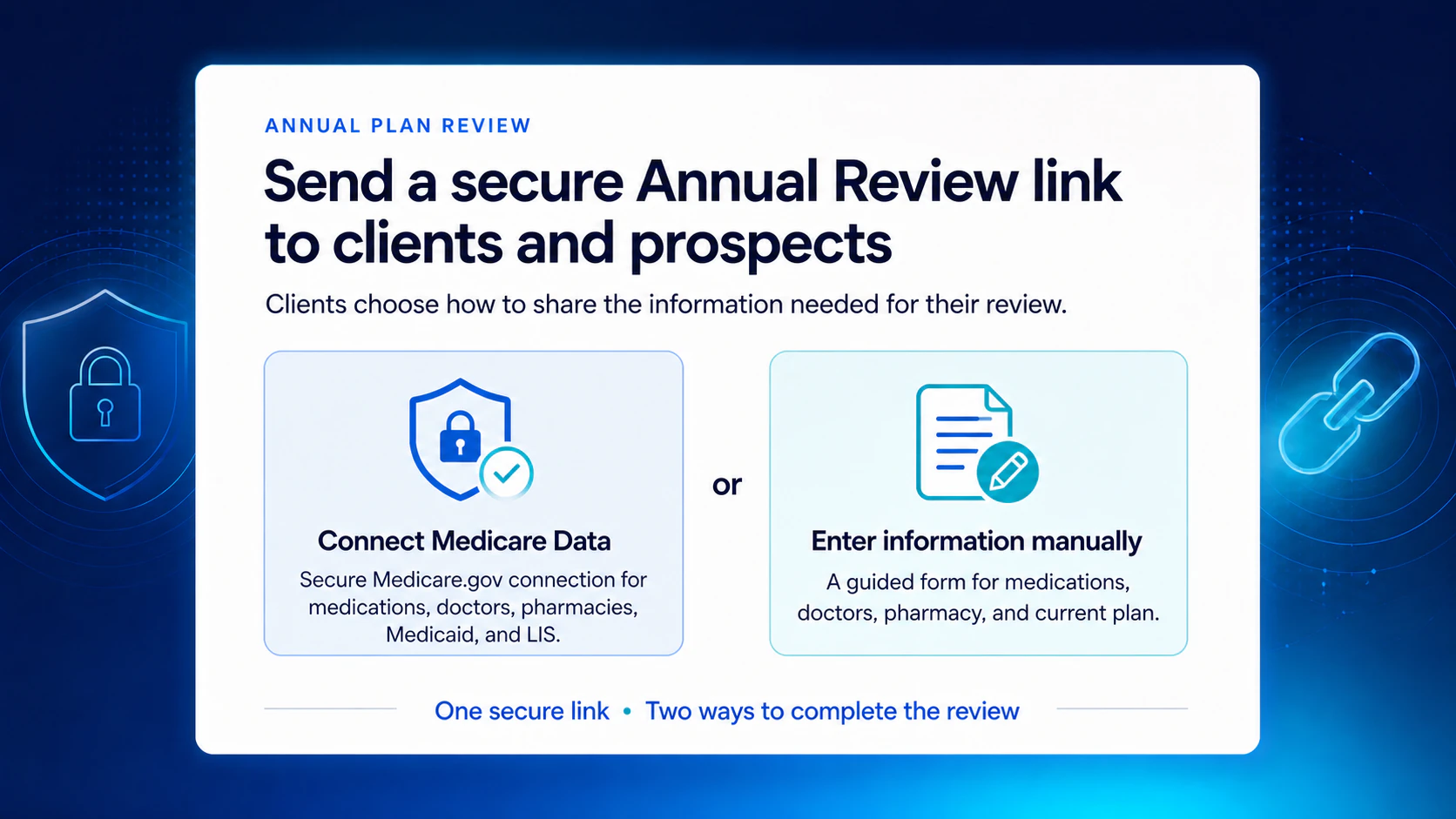
Connect Medicare data
With the client's authorization, import available claim and prescription history so the client does not have to rebuild the starting list from memory.
Fastest path when the client is comfortable connecting Medicare data.
Medicare Annual Review for licensed agents
Collect the client's medications, pharmacy, doctors, current-plan context, and eligibility facts once. Then calculate and organize the eligible plans for a documented agent review.
The system follows defined calculation rules and keeps source evidence, assumptions, missing facts, and tradeoffs visible. It does not use an AI bot to tell you which plan to choose.
Annual Review workbench
2027 • 68 plan rows reviewed
Matched
One gap
Tradeoffs
Unchecked
Plan example 01
$2,148 estimated annual total
All confirmed requirements matched
Plan example 02
$2,276 estimated annual total
Selected pharmacy needs review
Current plan
$2,512 estimated annual total
Pinned as comparison baseline
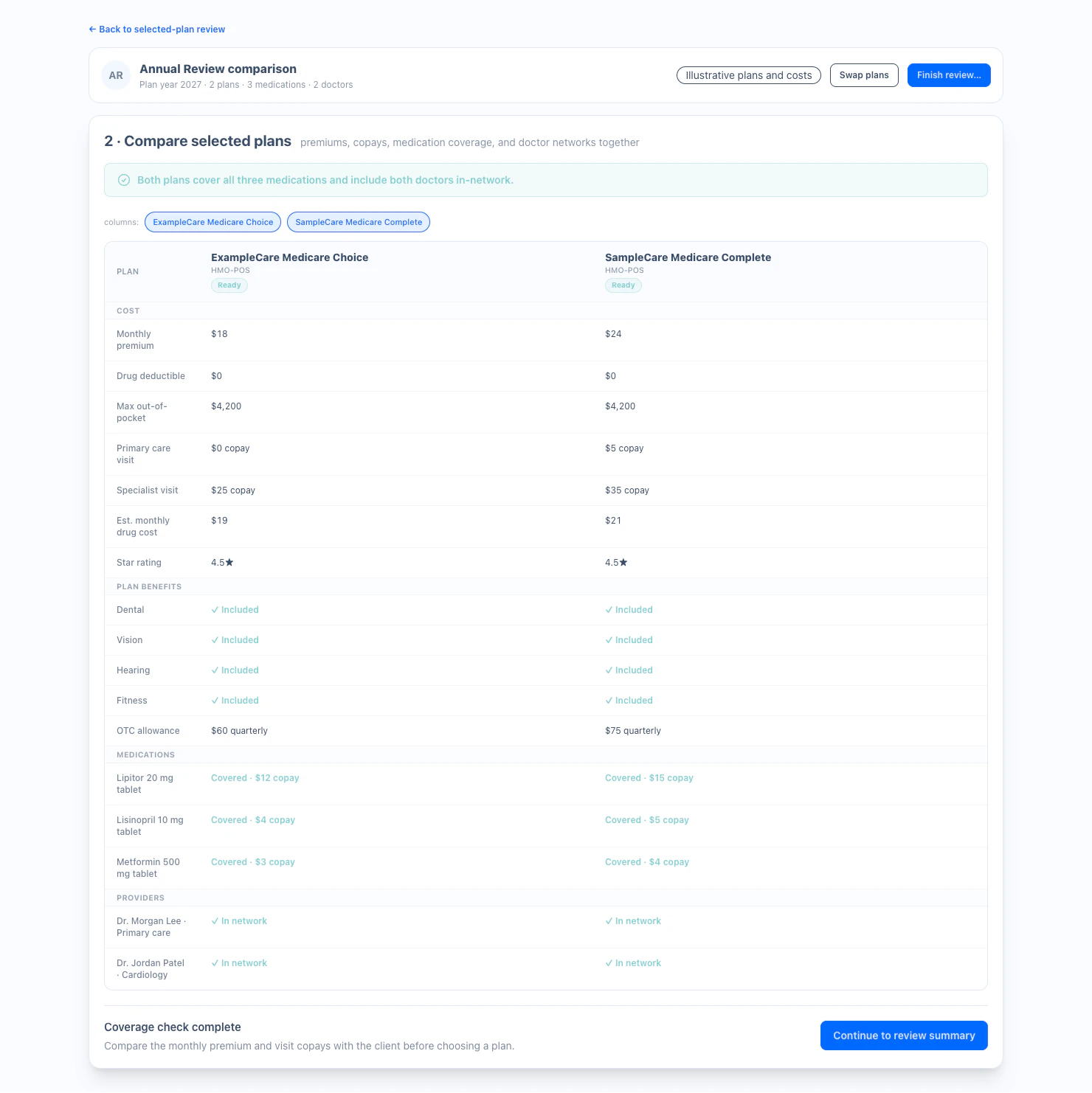
Illustrative product workflow. Estimates depend on source availability, confirmed inputs, geography, year, eligibility, and calculation assumptions.
The agent's time problem
A meaningful review can involve medications, dosages, formularies, tiers, restrictions, pharmacy networks, deductibles, premiums, doctors, facilities, eligibility, current-plan changes, and next-year availability.
Doing that one plan at a time is slow, and a flat quote list can hide the reason one option fits while another needs attention.
Annual Review turns one confirmed client case into a consistent, evidence-backed assessment across the eligible plan set.
Three ways to begin
Every option ends at the same checkpoint: a structured case that the client or agent has confirmed.
01
With the client's authorization, import available claim and prescription history so the client does not have to rebuild the starting list from memory.
Fastest path when the client is comfortable connecting Medicare data.
02
The client can take photos of prescription bottles. Text extraction prepares a structured list for confirmation before the assessment runs.
AI may assist with reading bottle text; it does not calculate or choose the plan.
03
Use a guided workflow to add medications, dosage, frequency, pharmacy, doctors, current plan, and eligibility facts by hand.
A complete fallback when a data connection or photos are not preferred.
The calculation boundary
Inputs are normalized, calculation rules are versioned, and evidence stays attached to the assessment. Unknown source data is not silently converted into a match.
01
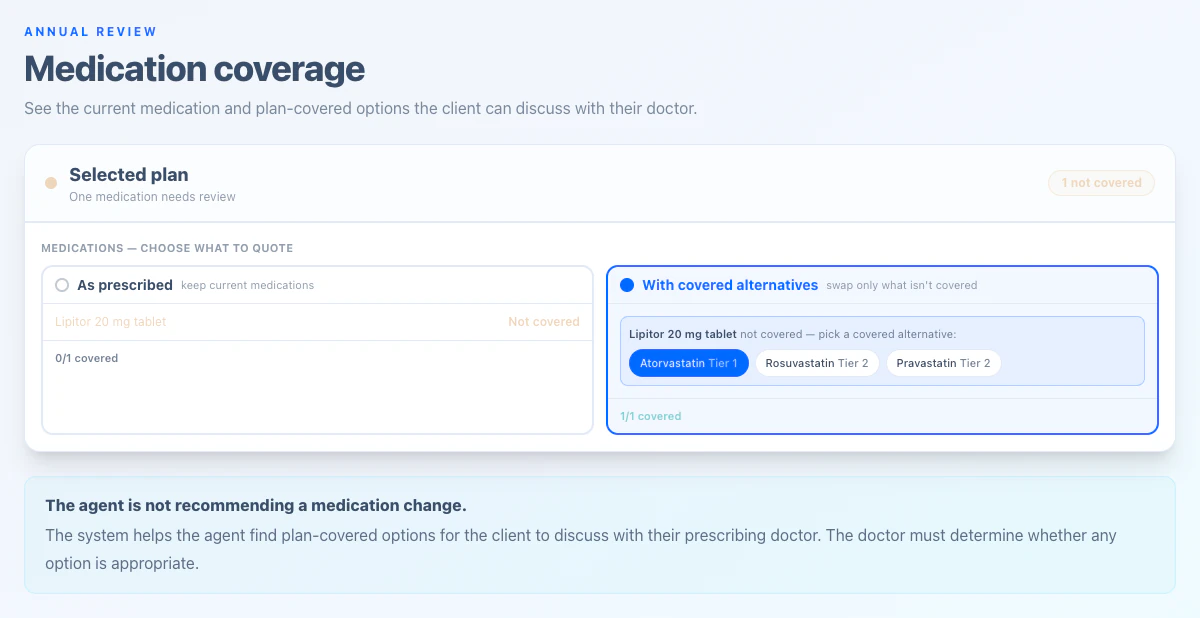
Formulary status, tier, prior authorization, step therapy, quantity limits, and severe unresolved warnings.
02
Plan-specific pricing assumptions, deductible and coverage-phase rules, pharmacy scenario, and applicable insulin or vaccine treatment.
03
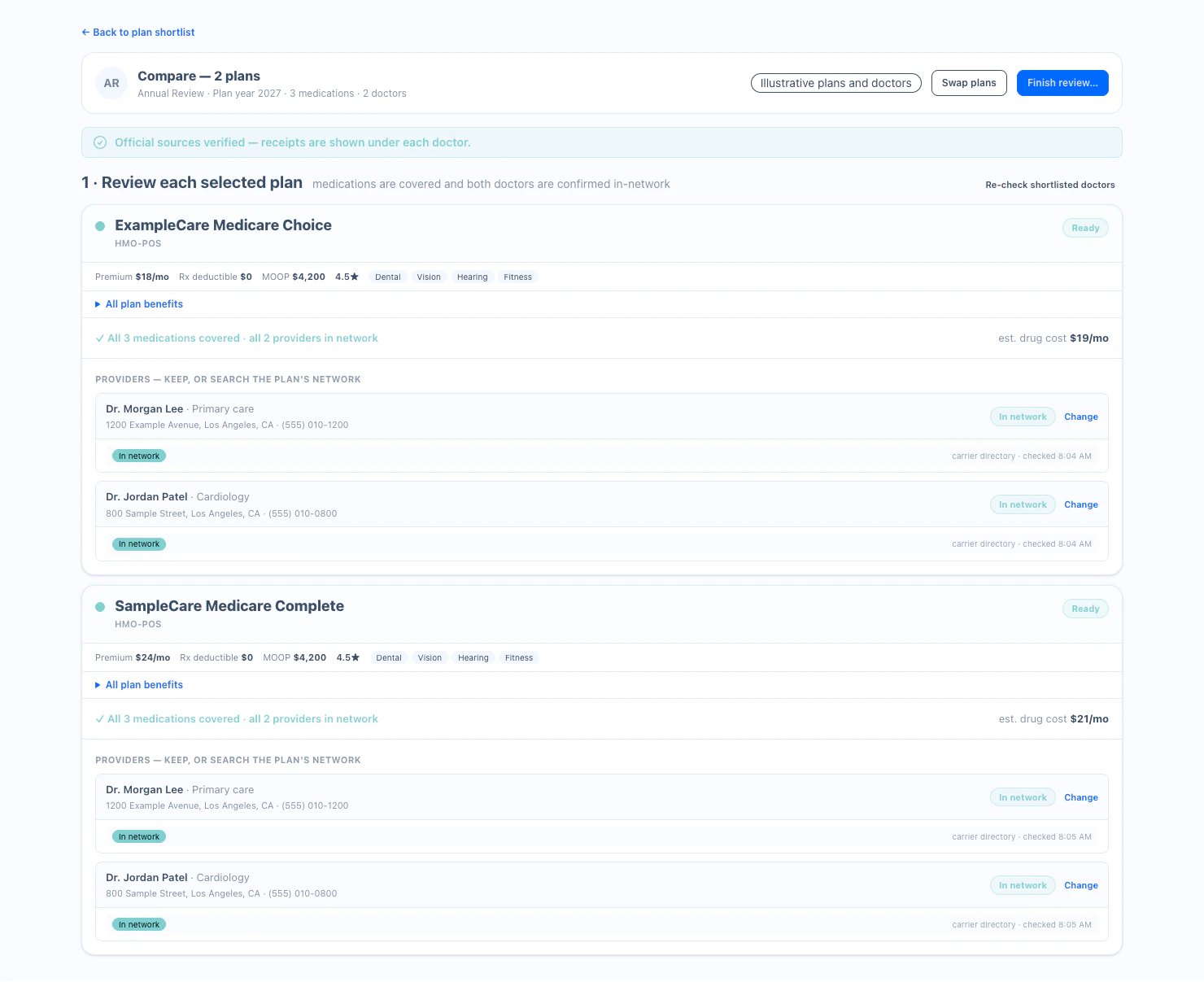
Premium and estimated annual cost under the same confirmed medication and pharmacy assumptions.
04
Whether the selected exact pharmacy is in network and how that assumption affects the comparison.
05
Available source evidence for must-keep doctors and facilities on MA or MAPD plans; unknown results stay unknown.
06
Known Medicare, Medicaid, LIS or Extra Help, geography, year, and plan-type facts used to filter or flag plan rows.
From ranking to review
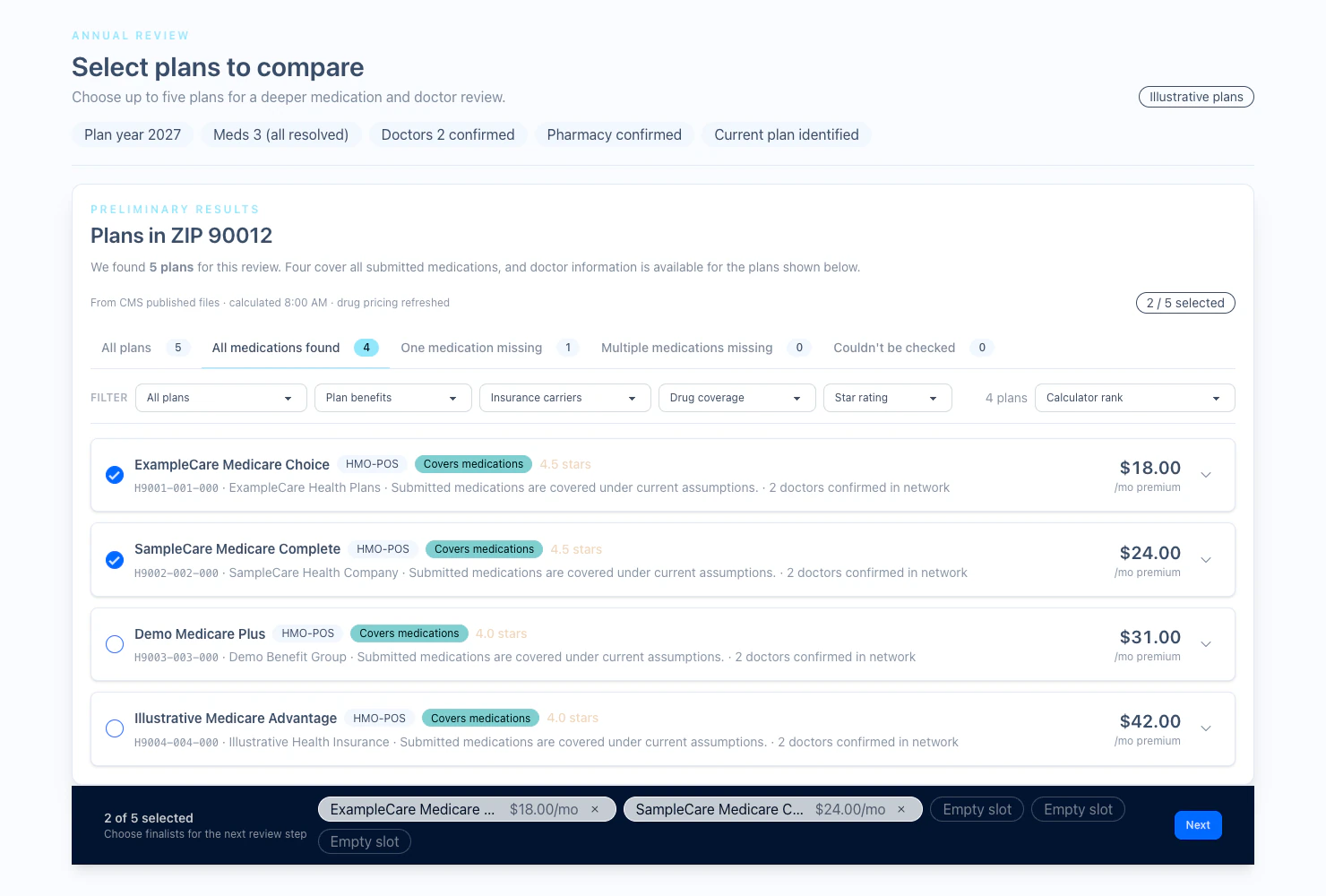
The plan groups are not recommendations. They organize the result by requirement fit so the agent can spend time on the meaningful differences.
Group A
Submitted and confirmed requirements are affirmatively satisfied under the current assessment assumptions.
Group B
One material fit dimension is missing, unknown, or does not match and needs an agent's attention.
Group C
Two or more material fit dimensions need review, but the plan can still be useful for the agent's comparison.
Group D
The plan is unavailable for the selected year or area, conflicts with known facts, or lacks enough source data to assess honestly.
The current plan stays visible as a comparison baseline when available. Costs and signed differences are shown only when the underlying estimates are comparable.
Why this changes the review
Medication collection
Manual:Re-enter each list while the client waits
Annual Review:Connect Medicare data, use bottle photos, or enter manually
Plan review
Manual:Open plans one at a time and rebuild the same checks
Annual Review:Calculate the eligible set from one confirmed case
Cost comparison
Manual:Collect figures from separate plan screens
Annual Review:Use consistent assumptions across plan rows
Missing facts
Manual:Easy to overlook or treat as a negative result
Annual Review:Keep unknown or unavailable evidence visibly unresolved
Plan choice
Manual:Agent interprets scattered screens
Annual Review:Agent reviews grouped plans, evidence, costs, and tradeoffs
Record of the work
Manual:Notes, screenshots, and downloads in separate places
Annual Review:Versioned assessment and evidence connected to the client record
Two ways to use Annual Review
The Annual Review workflow is the same. Choose based on whether you also want the CRM, phone, personal forms, website, events, quoting, and 10-year Vault connected throughout the year.
Best value for ongoing client work
$39.99/month
Annual Review plus CRM, recorded Business Line, Medigap and Marketplace quoting, personal website and educational events, personal SOA and ACA links, MFA, and the searchable 10-year Vault.
Start Agent Workspace - $39.99/monthAvailable now. Month-to-month individual account.
Keep your current technology stack
$99.99/month
Get Blue Button, prescription-photo and manual intake, automatic drug-cost calculations, provider search, plan evidence, and the rules-based review workflow without moving your CRM or phone.
Choose Standalone Annual ReviewAvailable today. Month-to-month.
Annual Review FAQ
No. An AI bot does not calculate the assessment and does not choose a plan. The calculation follows defined rules using plan, formulary, drug-pricing, pharmacy-network, provider, benefit, geography, year, and eligibility facts. AI-assisted text extraction may help read a prescription bottle photo, but the medication list is confirmed before the rules-based assessment runs.
No. It calculates and organizes the evidence for licensed-agent review. Plans are grouped by how the submitted and confirmed requirements fit, with costs, assumptions, warnings, and unresolved evidence kept visible. The licensed agent reviews the choices and makes the decision with the client.
They can use prescription bottle photos or complete the guided medication and provider workflow manually. All three paths converge on the same confirmed case before the assessment runs.
No. Photo text extraction prepares a structured medication candidate. The client or agent confirms the medication details before they become calculation inputs.
The workflow does not turn an unknown result into a positive match. Missing or unavailable evidence stays visible, and plans can move into a needs-review or could-not-be-evaluated group depending on the material gap.
Yes. Medicare Annual Review is included in the available $39.99-per-month Agent Workspace with CRM, recorded calling, agent website and events, electronic forms, and long-term record storage.
Yes. Standalone Medicare Annual Review is available for $99.99 per month. It includes Blue Button, prescription-photo and manual intake, automatic prescription-drug calculations, provider search, plan evidence, and the rules-based review workflow without requiring you to move your CRM or phone system.
Agent Workspace is the best-value path for agents who want an ongoing CRM-centered system. The $99.99 standalone option is for agents who want the intensive Annual Review workflow while keeping their existing CRM, phone, website, and forms. Both options are month-to-month.
No. Annual Review supports intake, assessment, comparison preparation, and recordkeeping. Agents still use the official, carrier, quoting, and enrollment tools required for their licensed sales workflow.
Prepare for the next review season
Let the system collect and calculate the repeatable facts. Keep the licensed agent responsible for the conversation, the evidence, and the decision.
Estimates depend on confirmed inputs, source availability, geography, year, eligibility, and calculation assumptions. Informed + Choice does not sell insurance or make the licensed agent's plan decision.