
Quick answer
Before telling a client to use CMS-40B and CMS-L564, ask whether the client already has Part A. A client with Part A usually fits the Part B-only SEP workflow. A client with neither Part A nor Part B may need a Part A and Part B Medicare claim with Working Aged SEP evidence, requested effective-date language, and a clean record of employer coverage.
Most Medicare-after-65 retirement cases look simple at first.
The client is 66, 67, or 70. They have been working. Employer coverage is ending. They want Medicare to begin when the job-based coverage ends. Agents often reach for the familiar Part B forms: CMS-40B and CMS-L564.
That works in many cases, but not all of them.
The workflow changes when the client does not already have Part A. It also changes when the employer is small, when the client has no printer, when the employer will not complete CMS-L564, when the client needs coverage within days, or when Medicare coverage was terminated for nonpayment.
The safer agent workflow is to triage the case before discussing forms.
The three questions to ask first
Before recommending a form or filing route, ask:
- Does the client already have Medicare Part A?
- Was the employer coverage based on current employment?
- What Medicare effective date is needed?
Those three answers usually determine the correct enrollment path.
SSA distinguishes between people who are signing up for Part B only and people who are applying for Medicare Part A and Part B. SSA’s public enrollment page says people age 65 or older can enroll online for Part A and Part B, or Part A only. The separate Part B-only page is for people who already have Part A and need to add Part B during a valid enrollment period.
That distinction is the center of this article.
This is an agent education guide, not legal advice, tax advice, SSA representation, or a substitute for current SSA, CMS, Medicare.gov, carrier, state, or employer-plan instructions. Before submitting an application, verify the client’s entitlement status, employment history, group health coverage, requested effective date, and available evidence.
For broader Medicare election-period screening, keep this article next to the 2027 Medicare SEP field guide for agents. For prescription drug timing and creditable-coverage questions after Medicare starts, use the 2026 Medicare Part D changes guide.
Do not start with “which form?” Start with “which enrollment pathway?”
The core rule: the Working Aged Part B SEP
A person age 65 or older may generally delay Part B without a late-enrollment penalty when they have employer group health plan coverage based on their own current employment or a spouse’s current employment.
The Working Aged Special Enrollment Period lets the person enroll while still covered by that current-employment group health plan, or during the eight-month period after the employment or group health plan coverage ends, whichever happens first.
That “current employment” piece is essential.
COBRA and retiree coverage do not extend the Medicare Part B SEP the same way. Medicare.gov warns that once active employment ends, the Medicare sign-up clock is running even if some other coverage continues. A client who had COBRA, retiree coverage, Marketplace coverage, an individual reimbursement arrangement, or a reimbursement-only setup may need a different analysis.
If the same household is comparing Marketplace coverage because job-based coverage is ending, keep that as a separate screen. The 2026 ACA SEP guide for health insurance agents covers Marketplace loss-of-coverage timing, COBRA traps, Medicaid/CHIP loss, and state marketplace documentation.
Agents should also confirm whether the client had current-employment group health coverage when first eligible for Medicare, or otherwise had qualifying coverage or Part B continuously enough to preserve SEP rights. A client who had a gap after turning 65 may need a more careful penalty and eligibility review.
The most common agent mistake
The recurring confusion is not really “which form do I use?”
It is which Medicare enrollment pathway applies before the form is selected.
When the client already has Part A, the familiar workflow is straightforward: use the Part B-only process, usually with CMS-40B plus employer evidence such as CMS-L564.
When the client has neither Part A nor Part B, the case is not merely a CMS-40B case. SSA’s POMS says that when a beneficiary has no prior Medicare entitlement and is filing for Supplementary Medical Insurance, or for Hospital Insurance and Supplementary Medical Insurance together, the Working Aged/GHP SEP is processed through SSA’s Modernized Claims System. POMS also says that if a beneficiary files for Part A and Part B after the Initial Enrollment Period, SSA processes the Part B award as part of the monthly benefit claim or Part A claim.
That means the agent should not assume the only answer is: apply for Part A online first, wait for Part A, then upload CMS-40B and CMS-L564.
That path can work in some premium-free Part A cases, especially when there is plenty of time. But it is not the only route and may not be the cleanest route when the client needs a specific Part B effective month.
| Client status | Agent workflow |
|---|---|
| Client already has Part A | Use the Part B-only SEP workflow and gather CMS-40B plus CMS-L564 or other acceptable employer evidence. |
| Client has no Part A and no Part B | Think initial Medicare claim with Working Aged SEP evidence, requested Part B effective date, and SSA processing for Part A and Part B together when appropriate. |
| Client must buy Part A | Treat this as higher risk. Premium Part A has stricter enrollment-period rules and generally requires Part B. |
What if the client has neither Part A nor Part B?
For a client over 65 who has no Part A and no Part B, first determine whether the client qualifies for premium-free Part A or must buy Part A.
Most people qualify for premium-free Part A based on their own or a spouse’s work record. CMS explains that people who are not already receiving Social Security or Railroad Retirement Board benefits must apply for Medicare through SSA. CMS also notes that premium-free Part A can be retroactive for up to six months when someone applies after age 65.
That retroactive Part A rule matters for clients who are contributing to an HSA. CMS and Medicare materials warn that people with HSAs need to be careful because retroactive Part A can create tax problems. Agents should flag the issue and tell the client to consult a tax professional.
If the client must buy Part A, the rules are stricter. CMS explains that premium Part A generally requires a valid enrollment period and that the person must also have or enroll in Part B. Premium Part A can also have its own late-enrollment penalty if the person misses the applicable enrollment window.
Practical workflow for no Part A and no Part B
For a 67-year-old retiring in November who has had current-employment group health coverage since age 65:
- Confirm whether Part A will be premium-free.
- Confirm that the employer coverage was based on current employment.
- Rule out COBRA, retiree coverage, Marketplace coverage, ICHRA, reimbursement-only, and individual coverage as the basis for the Part B SEP.
- Get employer proof now, preferably CMS-L564, but an acceptable employer letter or secondary evidence may work if the form cannot be completed.
- Contact SSA or use the appropriate SSA Medicare application route for Part A and Part B.
- Make the requested Part B start month explicit.
- Warn about HSA contributions if Part A will be retroactive.
- Keep submission proof and follow up on the Medicare effective dates.
SSA’s POMS says the enrollment request for a Working Aged SEP should include this statement when the person files while still covered under the employer group health plan or during the first month after that coverage ends:
I want Part B coverage to begin MM/YYYY.
That sentence is operationally important. It helps separate a generic enrollment request from a request tied to a specific effective month.
The small-employer trap
Small-employer cases create a lot of confusion.
For coordination of benefits, employer size matters. Medicare.gov and CMS explain that when a person age 65 or older has group health coverage through current employment and the employer has fewer than 20 employees, Medicare generally pays primary and the employer plan pays secondary. Medicare.gov also warns that job-based coverage from a company with fewer than 20 employees might not pay if the person does not have Medicare Part A and Part B.
That is a claims-payment problem and a client-risk problem.
It does not mean the person automatically loses the Working Aged Part B SEP.
SSA’s POMS specifically notes that for an aged beneficiary, a group health plan may be “of any size.” SSA’s evidence rules also say the GHP evidence does not need to state the employer’s size or whether the plan was primary to Medicare.
Agent takeaway
For a 67-year-old with active coverage through a 15-employee employer, do not say, “No SEP because the employer was under 20.” The better answer is: “Medicare may have been primary while you were working, so there may be claims exposure, but the Part B SEP may still be available if the coverage was based on current employment and the other SEP requirements are met.”
Employer size can change who pays first. It does not, by itself, answer whether SSA will accept the Working Aged SEP.
Timing: when should the client file?
Do not build the workflow around the last two weeks.
Medicare.gov advises people working past 65 to sign up before employer coverage ends. SSA’s effective-date rules for GHP SEP enrollments are more flexible when the person files while still covered by the group health plan, or during the first full month after that coverage ends. In that situation, coverage may begin the first day of the month of enrollment or, at the person’s option, the first day of any of the following three months. If the person enrolls during the remaining seven months of the SEP, coverage begins the first day of the month after enrollment.
For agents, the ideal timing is usually:
- Start gathering employer proof 60 to 90 days before retirement.
- File approximately one month before employer coverage ends.
- State the desired Part B effective month clearly.
- Keep proof of submission.
- Confirm the Medicare effective dates before submitting Medicare Advantage, Part D, or Medigap applications that depend on those dates.
This is also a recordkeeping issue. Agents should retain a clean timeline of dates, evidence, client instructions, and submissions. If your agency stores SOAs, call recordings, enrollment notes, and supporting files in separate places, this is a good use case for an approved Essentials record-management workflow.
Do not overbuild around one upload tool
Agents should avoid writing client instructions that depend on one specific upload or signature tool.
SSA’s current public guidance supports several durable points:
- People with Part A can apply for Part B during a valid enrollment period.
- People who qualify for the Working Aged SEP can apply online.
- The online Part B SEP process requires the beneficiary’s eSignature.
- Fax and mail options remain available using CMS-40B and CMS-L564 or other evidence when needed.
That matters because many clients do not have printers, scanners, or comfort with upload flows.
The practical process note for agents is simple: prepare the documents, but do not have the agent sign or submit as if they are the beneficiary. The beneficiary should sign their own Medicare enrollment request or use SSA’s eSignature process. If the client cannot complete the online route, fax, mail, or local SSA office submission may still be the cleaner path.
No printer? CMS-L564 evidence is more flexible than many agents realize
CMS-L564 is the familiar proof form, but it is not the only possible evidence.
SSA’s evidence rule says CMS-L564 Section B is evidence of employer group health plan coverage. For Section B, a wet signature is not required. SSA may accept electronic, stylus, rubber-stamp, or other signatures. SSA may also accept a letter, fax, or email from the employer, group health plan, or large group health plan if it includes the needed information and comes from an appropriate company official.
If the employer or plan cannot provide complete evidence, SSA may consider secondary proof such as income tax returns showing health insurance premiums, W-2s showing pre-tax medical contributions, pay stubs showing premium deductions, health insurance cards with effective dates, explanations of benefits, or receipts showing payment of health insurance premiums.
This gives agents a practical no-printer solution.
Ask HR or the benefits administrator to either complete CMS-L564 electronically or send a signed employer letter/email confirming employment dates, group health plan coverage dates, and that coverage was based on current employment.
A Part D creditable coverage notice is useful for Part D analysis, but by itself it is not the same as proof of employer group health plan coverage based on current employment for the Part B SEP.
Birth certificate issue: when might SSA ask?
When a client already has Part A, SSA has usually already resolved age and Medicare entitlement.
When the client has no Part A and no Part B, the case may be an initial Medicare claim. SSA may ask for proof of age, citizenship, or lawful status depending on its records.
SSA says it may request an original birth certificate, a copy certified by the issuing agency, or other proof of age. SSA also says it cannot accept photocopies or notarized copies for those documents. SSA’s regulation describes preferred age evidence as a birth certificate or hospital birth record recorded before age 5, or a religious record showing date of birth recorded before age 5. If preferred evidence is not available, SSA can ask for other convincing evidence.
Agent takeaway
For a Part B-only case, a birth certificate is not usually the operational bottleneck. For a no-Part-A/no-Part-B case, it is reasonable to tell the client to be ready with an original or certified proof-of-age document if SSA requests it.
Late-enrollment penalty risk
If the client qualifies for the Working Aged SEP, Part B can generally be added without a Part B late-enrollment penalty.
If the client misses the Initial Enrollment Period and does not qualify for an SEP, the General Enrollment Period runs January 1 through March 31, and Part B coverage generally begins the month after enrollment. The Part B late-enrollment penalty is generally 10% for each full 12-month period the person could have had Part B but did not enroll, and it can last as long as the person has Part B.
For premium Part A, the penalty can be 10% of the premium, paid for twice the number of years the person delayed enrollment. Most clients qualify for premium-free Part A, but agents should not assume that without verifying work history or SSA eligibility.
Part D is separate. Medicare.gov explains that a person may avoid the Part D penalty if they do not go more than 63 days without creditable drug coverage. Agents should obtain and keep the employer’s creditable coverage notice because that is a different proof issue from the Part B SEP employer proof.
Quick answers to common message-board scenarios
1. He is 67, had small-employer insurance, and has neither Part A nor Part B. How does he enroll without an LEP?
Do not treat this as a Part B-only CMS-40B case. If he has no prior Medicare entitlement, SSA can process the Part A and Part B enrollment together as an initial Medicare claim using the Working Aged/GHP SEP evidence.
He should gather CMS-L564 or acceptable employer proof and make the requested Part B effective month clear. The small employer creates a Medicare-primary coordination issue, but SSA’s SEP rules for aged beneficiaries do not require the employer to have 20 or more employees.
2. Should spouses with no A or B apply for Part A now, then upload CMS-40B and CMS-L564 later?
That can be workable when both qualify for premium-free Part A and there is enough time, but it is not the only path.
If they need both Part A and Part B by a known retirement date, the cleaner approach is usually to handle the matter as a Medicare Part A and Part B application with SEP evidence through SSA. If they apply for Part A-only first, warn them about retroactive Part A and HSA contributions, and do not wait to gather the employer evidence.
3. Can a client without a printer still complete the Part B SEP process?
Yes. Use the online eSignature process when appropriate, or use fax, mail, or local SSA office options.
For employer evidence, SSA does not require a wet signature on CMS-L564 Section B, and it may accept electronic signatures, employer letters, faxes, emails, or secondary evidence when the employer cannot complete the form.
4. Could SSA require a certified birth certificate?
Yes, especially when the client has neither Part A nor Part B and SSA is processing an initial Medicare claim.
SSA may request an original birth certificate, certified copy, or other proof of age. If SSA already has proof from a prior claim, it may not be required again.
5. If Medicare or an MA plan terminates for nonpayment, can paying back premiums restore coverage?
First identify what was not paid.
If Part B/SMI premiums were not paid and Part B terminated, SSA has a separate good-cause and past-due premium process. If the issue is Medicare Advantage or Part D plan-premium nonpayment, that is a different CMS plan process.
This topic is better handled as a separate short blog or FAQ because it is not the same issue as the Working Aged Part B SEP. For this article, the operational point is to separate nonpayment reinstatement from after-65 employer-coverage SEP enrollment.
Agent tool: Medicare A/B after-65 intake checklist
Use this before recommending CMS-40B, CMS-L564, or an online application route.
Medicare status
- Does the client already have Medicare Part A?
- Does the client already have Medicare Part B?
- Is Part A premium-free or premium Part A?
- Is the client already receiving Social Security or Railroad Retirement benefits?
- Has the client ever refused, withdrawn, or terminated Part B?
Employment and coverage
- Whose employment created the coverage: client, spouse, or another family member?
- Was the person actively employed when they first became eligible for Medicare?
- Was the coverage an employer group health plan?
- Was the coverage COBRA, retiree, Marketplace, ICHRA, reimbursement-only, or individual coverage?
- What date did employment and group coverage end or will they end?
Small employer review
- How many employees does the employer have?
- Did the employer plan pay primary or secondary?
- Were any claims denied or unpaid because Medicare should have been primary?
- Does the client understand the claims risk if Medicare should have been primary?
Effective-date planning
- Desired Part B effective month
- Employer coverage end date
- Target SSA filing date
- Last day of the eight-month SEP
- Submission proof and follow-up date
Evidence
- CMS-L564 completed or requested
- Employer letter, email, or fax if CMS-L564 is unavailable
- Pay stubs showing health deductions
- W-2 showing pre-tax medical contributions
- Health insurance card, EOBs, receipts, or premium statements
HSA warning
- Does the client or spouse contribute to an HSA?
- Is the client applying for Part A after age 65?
- Has the client been warned that Part A may be retroactive for up to six months?
- Has the client consulted a tax professional if HSA contributions may overlap Medicare entitlement?
Employer proof request email
Agents can adapt this when HR or a benefits administrator needs a simple request.
Subject
Medicare Employer Coverage Verification Needed
Hi [HR/Benefits Contact],
[Client Name] is applying for Medicare based on the end of employer group health coverage. SSA may request proof that the client had employer group health plan coverage based on current employment.
Please either complete Section B of CMS-L564 or reply with an employer verification letter/email confirming:
- Employee name
- Employee dates of employment
- Beneficiary covered under the employer group health plan
- Group health coverage start date
- Group health coverage end date or expected end date
- Confirmation that coverage was based on current employment
- Employer or plan contact name, title, phone number, and date
An electronic, stylus, stamped, or similar signature may be acceptable for CMS-L564 Section B under SSA evidence guidance.
Thank you,
[Agent Name]
CMS-40B remarks language
When the client is using the Working Aged SEP and needs a specific effective date, use clear language in the remarks section:
I want Part B coverage to begin MM/YYYY.
That is not magic language. It is a practical way to make the requested effective month visible and consistent with SSA’s POMS instructions for SEP enrollment requests.
Suggested packet for agencies
This article can also become a practical internal packet:
- A/B after-65 intake checklist
- Employer proof request email
- CMS-40B remarks language
- CMS-L564 backup evidence checklist
- Small-employer Medicare-primary warning
- HSA retroactive Part A warning
- Part D creditable coverage reminder
- Nonpayment reinstatement issue-spotter
The real value is not that every client gets the same form. The value is that agents stop routing every after-65 employer-coverage case through the same mental shortcut.
Ask the three questions first. Then choose the pathway.
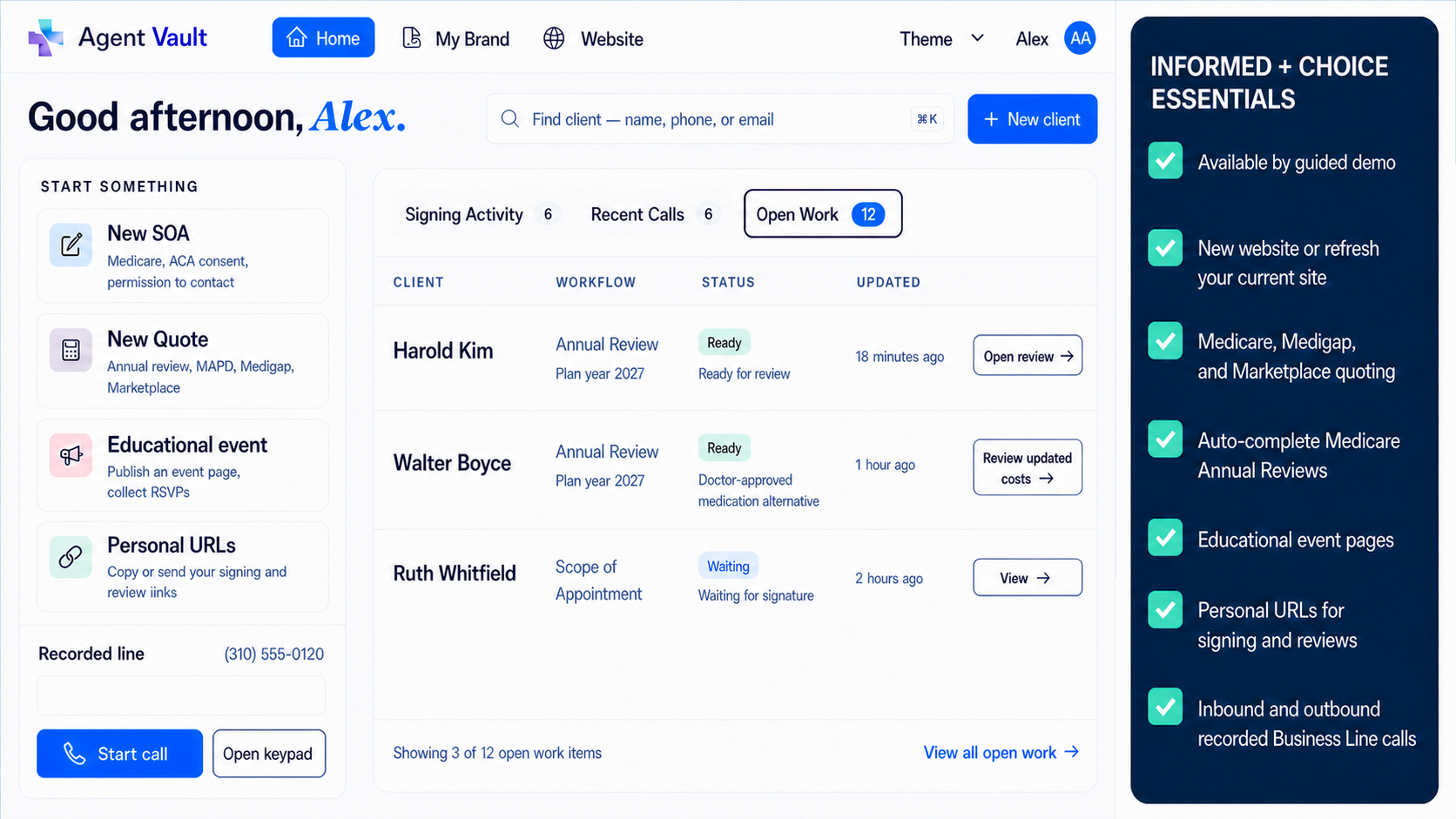
Carry the retirement case from intake through follow-up
Keep the effective-date plan, employer evidence, forms, notes, and follow-up on one client record.
Agent Workspace connects CRM work, electronic SOA, secure files, recorded Business Line calls, tasks, Annual Review, and long-term Vault records around the client. The status and next action stay visible from the first employer-coverage intake through the Medicare plan review that follows.
Essentials is available through a guided demo. It has no public price, free trial, or automatic production signup.
Sources
- Sign up for Medicare: Social Security Administration Accessed 2026-06-30.
- Sign up for Part B only: Social Security Administration Accessed 2026-06-30.
- 42 CFR 407.20 - Special enrollment period related to coverage under group health plans: Electronic Code of Federal Regulations Accessed 2026-06-30.
- Processing Special Enrollment Period enrollments: Social Security Administration POMS Accessed 2026-06-30.
- Evidence of GHP or LGHP coverage based on current employment status: Social Security Administration POMS Accessed 2026-06-30.
- Original Medicare Part A and Part B eligibility and enrollment: Centers for Medicare & Medicaid Services Accessed 2026-06-30.
- Working past 65: Medicare.gov Accessed 2026-06-30.
- Medicare Secondary Payer: Centers for Medicare & Medicaid Services Accessed 2026-06-30.
- What documents will you need when you apply?: Social Security Administration Accessed 2026-06-30.
- 20 CFR 404.716 - Type of evidence of age to be given: Social Security Administration Accessed 2026-06-30.
- Avoid late enrollment penalties: Medicare.gov Accessed 2026-06-30.
Frequently Asked Questions
Does a client with no Part A and no Part B use CMS-40B only?
Usually no. If the client has no prior Medicare entitlement and needs both Part A and Part B, agents should think of the case as an initial Medicare claim with Working Aged SEP evidence, not only a Part B-only CMS-40B upload.
What are the first questions agents should ask before choosing the Medicare enrollment route?
Ask whether the client already has Part A, whether employer coverage was based on current employment, and what Medicare effective date is needed. Those answers usually determine whether the case is Part B-only or a Part A and Part B enrollment.
Does a small employer eliminate the Working Aged Part B SEP?
No. A small employer may create Medicare-primary coordination and claims-payment risk, but SSA guidance says a group health plan for an aged beneficiary may be of any size. Employer size alone does not decide whether the Working Aged SEP is available.
How long is the Working Aged Part B SEP after employer coverage ends?
The Working Aged Part B SEP generally runs while the client is covered by a current-employment group health plan and for 8 months after employment or that group health plan coverage ends, whichever happens first.
Does COBRA, retiree, or Marketplace coverage extend the Part B SEP?
No. COBRA, retiree coverage, Marketplace coverage, ICHRA, reimbursement-only, and individual coverage should not be treated as current-employment group health plan coverage for the Working Aged Part B SEP. They may matter for other coverage decisions, but agents should not use them to extend the Part B clock.
Can employer evidence replace CMS-L564 if HR will not complete the form?
SSA treats CMS-L564 Section B as standard evidence, but SSA guidance also allows employer letters, faxes, emails, and secondary evidence when the form cannot be completed, as long as the evidence supports current-employment group health plan coverage.
Should agents warn clients about HSAs when Part A starts after age 65?
Yes. Premium-free Part A may be retroactive for up to six months when a person applies after age 65, so agents should flag the HSA issue and tell clients to consult their tax professional before contributions overlap Medicare entitlement.
When should a retiring client file for Part B after working past 65?
The safer workflow is to start evidence collection 60 to 90 days before retirement and file about one month before employer coverage ends, rather than waiting until the final week.
Medicare and ACA Compliance Expert
Christian Rodgers is a Medicare and ACA compliance expert with over 30 years in the healthcare industry, having worked for some of the largest health plans in the United States. He has provided Medicare sales training to hundreds of agents in California and Florida.
Connect on LinkedIn