
A Medicare Scope of Appointment is generally valid for 12 months from the beneficiary’s signature date or initial request for information.
But there is an important catch: the SOA is only valid for the product scope the beneficiary agreed to discuss.
That means the 12-month rule is not a free pass to discuss any Medicare product at any later appointment. If the conversation stays inside the original agreed scope, the existing SOA may still support follow-up contact. If the conversation moves outside that scope, the agent should collect a new SOA before continuing the plan-specific discussion.
In simple terms:
The date controls how long the SOA can remain active. The scope controls what you can discuss.
What is a Scope of Appointment?
A Scope of Appointment (SOA) is the record documenting which Medicare product types a beneficiary has agreed to discuss before a personal marketing or sales appointment. Under CMS’s Medicare Advantage and Part D marketing rules, an agent may not discuss plan-specific products beyond the scope the beneficiary agreed to and that is documented in the SOA.
At minimum, the SOA identifies the type of product(s) to be discussed — for example, Medicare Advantage, MA-PD, or a stand-alone Part D plan. CMS does not publish a single mandatory SOA template, and it has said that Business Reply Cards, online forms, and other written requests identifying the product types can function as an SOA.
In plain terms: the SOA is the beneficiary’s documented permission, captured before the appointment, that defines what the agent is allowed to discuss. The rest of this guide covers how long that permission stays valid and when a new SOA is required.
How long does a Scope of Appointment last?
For Medicare Advantage and Part D marketing workflows, a Scope of Appointment can generally remain valid for 12 months.
During that 12-month window, the agent or plan may contact the beneficiary about the product types already documented in the SOA. CMS has also said a signed SOA can be used for multiple telephonic or in-person contacts or appointments, as long as the discussion stays within the agreed scope and the beneficiary has not asked not to be contacted.
So one SOA may support more than one call or meeting.
But it does not support every possible Medicare conversation.
If the beneficiary originally agreed to discuss Medicare Advantage plans, that does not automatically authorize a later conversation about a different product category. If the product scope changes, the SOA should change too.
What does the 12-month SOA rule actually cover?
The 12-month SOA rule covers the scope already documented in the record.
Think of it as a time window around a specific permission.
For example, if the SOA documents that the beneficiary agreed to discuss Medicare Advantage or MA-PD options, the agent can stay within that lane. But if the conversation shifts to a different product type, a new SOA is the cleaner workflow.
The same logic applies to Business Reply Cards, voicemails, online forms, and other requests for information. CMS has said those can function as SOAs when they include the type of product or products to be discussed. But they still need to define the scope clearly enough to support the later contact.
When do agents need a new Scope of Appointment?
Agents should collect a new Scope of Appointment when the discussion moves outside the original product scope.
That can happen when:
- the beneficiary wants to discuss a different product type;
- the prior SOA is vague or incomplete;
- the appointment moves into a different contract year;
- the original SOA cannot be found;
- the prior record does not clearly show what the beneficiary agreed to discuss.
The safest practical rule is this:
If you cannot clearly explain why the existing SOA covers the next conversation, collect a fresh SOA.
That is easier under the 2027 rule because CMS removed the fixed 48-hour waiting period between SOA completion and the personal marketing appointment. Agents still need the SOA before the appointment, but they no longer need to wait a mandatory 48 hours before discussing plan products.
For the separate timing change, see the Scope of Appointment 48-hour rule change.
Does a 2026 SOA cover a 2027 plan discussion?
Usually, no - not if the original SOA was for contract year 2026 plans and the new conversation is about contract year 2027 plans.
CMS specifically gives this kind of contract-year change as an example of a discussion outside the original scope. In other words, an SOA to discuss 2026 plans does not automatically carry over into a 2027 plan discussion just because the form is still less than 12 months old.
This page is about the broader validity rule. For the full contract-year breakdown, see Does a 2026 SOA Cover a 2027 Plan Discussion?.
Can one SOA cover multiple calls or appointments?
Yes, one SOA can support multiple calls or appointments during the 12-month period if the discussion stays within the agreed product scope.
That is useful for real agent workflows. A beneficiary may need a follow-up call, a second meeting, or additional time to review options. A new SOA is not automatically required just because there is another contact.
The key question is not only, “Is the SOA still within 12 months?”
The better question is:
Is this next conversation still inside the product scope the beneficiary already agreed to discuss?
If yes, the original SOA may still apply. If no, collect a new one.
Does the 12-month SOA rule apply to Medigap-only appointments?
Not in the same way.
The 12-month SOA validity rule is part of the Medicare Advantage and Part D Scope of Appointment framework. If the appointment is truly Medicare Supplement-only, the federal MA/Part D SOA rule is generally not the rule that drives the appointment.
But if a Medigap conversation moves into stand-alone Part D, Medicare Advantage, or MAPD plan-specific discussion, the agent should collect or update the SOA before discussing those products. For the product-pivot examples, see our guide to Medigap SOA rules.
What about in-person appointments?
For in-person Medicare personal marketing appointments, CMS says the Scope of Appointment must be in writing. CMS also explains that for non-in-person personal marketing appointments, an audio, audio-visual, or electronic record may suffice as an SOA record.
That means agents should treat the appointment format separately from the validity period.
A valid SOA may still need to be documented in the correct format for the appointment type. For face-to-face meetings, make sure the SOA is written before the plan-specific discussion begins.
For the separate written-documentation issue, see the article on written Scope of Appointment for in-person Medicare appointments.
How long do you need to keep the completed SOA?
SOA validity and SOA retention are different questions.
Validity asks how long the SOA can support later contact about the agreed product scope.
Retention asks how long the completed record should remain available for carrier, agency, CMS, complaint, audit, or compliance review.
Agents should follow current CMS rules, carrier contracts, FMO procedures, agency policies, and state-law requirements. Operationally, completed SOAs should be stored somewhere searchable, exportable, and durable.
Do not leave important SOA records scattered across text messages, old CRMs, carrier portals, email inboxes, desktop folders, or phone vendor accounts.
For the storage workflow, see Scope of Appointment storage.
Bottom line
A Scope of Appointment can generally remain valid for 12 months, but only for the product scope the beneficiary agreed to discuss.
The 12-month rule does not let agents expand the conversation into new product categories, unclear topics, or a different contract year without collecting a new SOA.
So the practical rule is simple:
If the scope stays the same, the SOA may still apply. If the scope changes, get a new SOA.
And when you collect the new SOA, store it with the rest of the client file so the timeline is easy to explain later.
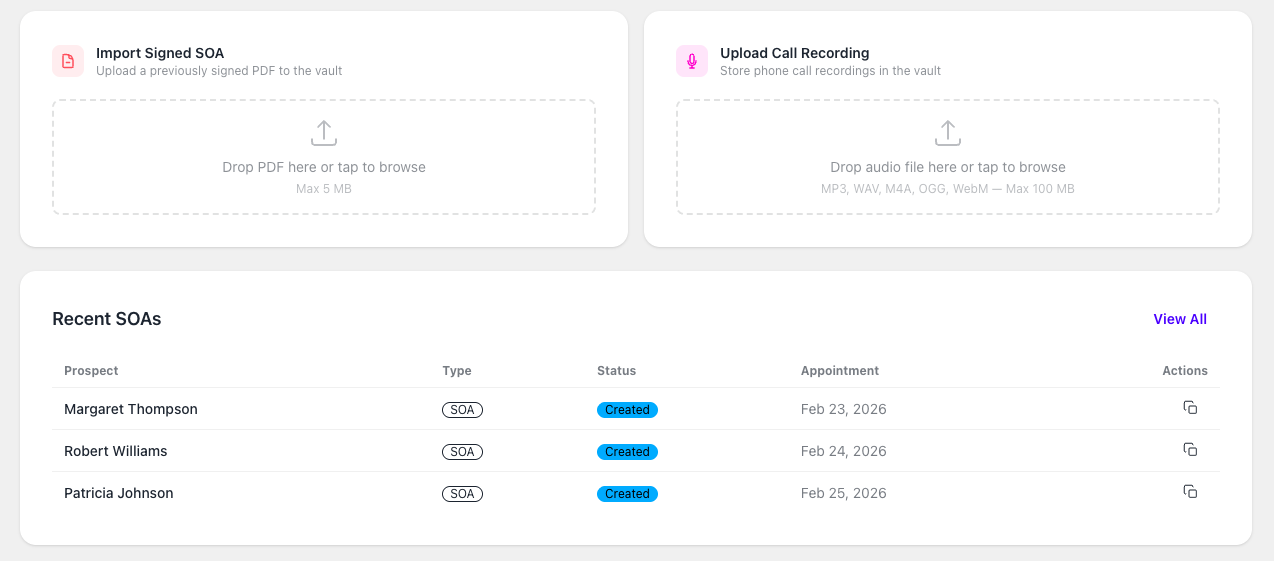
Make the SOA timeline easy to retrieve
Keep the active scope, replacement SOAs, signed PDFs, and related records together.
Agent Workspace includes electronic SOA and Vault records around the client, including new signing links, signed-status tracking, historical imports, recorded Business Line calls, and searchable long-term storage.
Electronic SOA is $9.99/month. First payment is due at secure checkout. No introductory trial.
This article is for educational purposes only and is not legal advice. Agents should review current CMS guidance, carrier rules, and agency policies, and consult qualified counsel or compliance professionals for specific requirements.
Sources
- Federal Register, 91 FR 17384: Contract Year 2027 Medicare Advantage and Part D Final Rule Accessed May 20, 2026.
Frequently Asked Questions
What is a Scope of Appointment?
A Scope of Appointment (SOA) is the record documenting which Medicare product types a beneficiary has agreed to discuss before a personal marketing or sales appointment. It must identify, at minimum, the type of product or products to be discussed, and CMS marketing rules prohibit discussing plan-specific products beyond the documented scope.
How long is a Medicare Scope of Appointment valid?
A Medicare Scope of Appointment is generally valid for 12 months from the beneficiary's signature date or initial request for information, but only for the product scope agreed upon and documented in the SOA.
Does the 12-month SOA rule let me discuss any Medicare product later?
No. The 12-month window does not create blanket permission to discuss any Medicare product. If the discussion moves outside the documented scope, the agent should collect a new SOA.
Can one SOA cover multiple calls or appointments?
Yes, one SOA can support multiple contacts or appointments during the 12-month period if the discussion stays within the agreed product scope and the beneficiary has not asked not to be contacted.
Do I need a new SOA for a different contract year?
Yes, if the original SOA was for one contract year and the new conversation is about a different contract year. CMS specifically gives the example that a 2026 plan discussion does not automatically cover a 2027 plan discussion.
Is SOA validity the same as SOA retention?
No. Validity is about how long the SOA can support contact within the agreed product scope. Retention is about how long the completed record should remain available for compliance, carrier, agency, complaint, or audit review.
Medicare and ACA Compliance Expert
Christian Rodgers is a Medicare and ACA compliance expert with over 30 years in the healthcare industry, having worked for some of the largest health plans in the United States. He has provided Medicare sales training to hundreds of agents in California and Florida.
Connect on LinkedIn