
Quick answer
The best way to prepare for 2027 Medicare agent certification is to study scenarios, not trivia. AHIP or another Medicare and FWA course may cover the general rules, but the questions usually test whether you can recognize the client’s coverage, identify the right election period, explain plan limits, follow Scope of Appointment and marketing rules, review required pre-enrollment topics, and avoid a complaint.
Every year, Medicare agents start certification season with the same basic goal: get through AHIP or another Medicare and Fraud, Waste, and Abuse training, complete carrier certifications, and be ready to sell for the next plan year.
But the agents who do best do not treat certification like a box-checking exercise. They understand what the training is really testing.
The test is not just asking whether you can remember Medicare trivia. It is testing whether you can sit with a beneficiary, recognize the type of coverage they have, explain how a plan works, avoid prohibited marketing conduct, review the required pre-enrollment items, use the correct election period, and avoid creating a complaint.
That is the purpose of this primer.
This is not an AHIP answer key. It is not a shortcut around the training. It is a practical study guide for agents who want to understand the rules well enough to pass certification and avoid real-world mistakes with clients.
AHIP says its 2027 Medicare training launches on June 22. CMS’s 2027 Agent and Broker Training & Testing Guidelines also make clear that MA, MA-PD, PDP, and cost plan organizations, along with TPMOs acting on their behalf, must ensure agents and brokers are trained and tested annually on Medicare rules, regulations, and the specific benefits of the plans they sell.
If you are studying because you need to be ready for AEP, keep three related resources nearby:
Medicare SEP scenarios
Use this when a certification question or real client case turns on whether a valid election period exists.
2027 final-rule changes
Use this for the workflow changes behind same-day SOA, event transitions, disclaimer timing, and call retention.
Written SOA rules
Use this when a certification question turns on in-person appointments and what has to be in writing.
The certification mindset: learn scenarios, not just definitions
Most agents do not struggle because they cannot memorize “Part A is hospital” and “Part B is medical.” They struggle because certification questions often come in scenarios.
A beneficiary is enrolled in an MA HMO and wants to see a specialist. A client enrolled in an MA-PD wants to add a standalone PDP. A beneficiary attended an educational event and wants to schedule a plan appointment. A full-benefit dual wants to switch plans midyear. A client thinks an MA plan is just a dental, vision, or hearing rider. A prospect walks into the office and asks for plan-specific benefits.
Those are the situations certification is trying to make agents handle correctly.
The best way to study is to organize the material into practical buckets.
| Study area | What the test is really checking |
|---|---|
| Medicare basics | Do you understand Parts A, B, C, D, Original Medicare, MA, PDP, Medigap, cost plans, PACE, and plan types? |
| Eligibility | Do you know who can enroll in MA, Part D, D-SNP, C-SNP, I-SNP, and other plan types? |
| Election periods | Do you know when someone can enroll, switch, or disenroll? |
| Part D | Do you understand formularies, tiers, pharmacy networks, prior authorization, step therapy, TrOOP, and 2027 benefit parameters? |
| Marketing rules | Do you know the difference between educational events, marketing events, and personal marketing appointments? |
| SOA and call recording | Do you know when a Scope of Appointment is required and which calls must be recorded? |
| Pre-enrollment review | Do you know what CMS expects agents to discuss before enrollment? |
| Beneficiary protections | Do you understand grievances, appeals, nondiscrimination, QMB protections, network limits, and complaints? |
| FWA and compliance | Do you know what fraud, waste, abuse, and general compliance issues look like? |
| Compensation | Do you understand initial vs. renewal compensation, like vs. unlike plan types, and rapid disenrollment recoupment? |
CMS’s 2027 guidelines specifically identify Medicare basics, enrollment and disenrollment, marketing and communications requirements, agent and broker responsibilities, compensation, required pre-enrollment topics, and sample test categories as training and testing areas.
First: what certification actually means
For Medicare Advantage and Part D sales, an agent generally needs more than one thing to be ready to sell.
| Requirement | Practical meaning |
|---|---|
| State license and appointment | You must meet state licensing and appointment rules where applicable. |
| Annual Medicare training and testing | You must complete annual Medicare rules and product training/testing. |
| Passing score | Federal rules require agents and brokers representing MA organizations and Part D sponsors to be trained and tested annually and achieve 85 percent or higher. |
| Carrier certifications | Even after AHIP or another Medicare and FWA course, carriers usually require plan-specific certifications. |
| Plan-specific benefit knowledge | CMS expects training on the specific plan benefits the agent sells, not just general Medicare rules. |
| Compliance documentation | Plans must maintain evidence of training/testing completion and make it available to CMS upon request. |
The regulation at 42 C.F.R. 422.2274 requires agents and brokers who represent MA organizations to be licensed and appointed under state law if required, trained and tested annually with an 85 percent or higher score, and to secure and document a Scope of Appointment before a personal marketing appointment. CMS’s 2027 guidelines also say organizations must maintain information on their training/testing programs, including tools, exams, policies, procedures, and evidence of completion.
Agent takeaway: AHIP may get you through the general Medicare and FWA piece, but it does not automatically make you ready to sell for every carrier or product.
What changed or matters most for 2027
The 2027 certification season has several high-yield areas agents should not gloss over.
| 2027 focus area | Why agents should study it |
|---|---|
| SOA rules | CMS’s 2027 training guidelines include new rules removing the 48-hour waiting period, defining personal marketing appointments, clarifying SOA requirements, and requiring written SOA for in-person personal marketing appointments. |
| Educational-to-marketing event flow | CMS allows an SOA form to be collected at educational events and removed the 12-hour delay requirement between an educational event and a marketing event in the same location, if beneficiaries are clearly told the educational event is ending, a marketing event will begin, and they have a real chance to leave. |
| Call recording retention | TPMO marketing and sales calls must be recorded and retained for six years; audio must be maintained for the first three years, and audio or complete accurate transcripts may be used for years four through six. |
| Dual/LIS enrollment rules | CMS training specifically calls out the monthly dual/LIS SEP for Part D, the integrated-care SEP for full-benefit duals, and restrictions for potential at-risk or at-risk individuals. |
| 2027 Part D parameters | The standard Part D deductible is $700 and the annual out-of-pocket threshold is $2,400 for 2027. |
| Required pre-enrollment discussion | CMS expects agents to discuss provider networks, pharmacies, prescriptions, premiums, cost sharing, dental/vision/hearing limits, other coverage effects, and other beneficiary-specific needs before enrollment. |
For a deeper operational walkthrough of the first-rule changes, read the related CMS 2027 final rule checklist for Medicare agents. This primer stays focused on what to study before AHIP, carrier certifications, and AEP.
Part 1: Medicare basics agents should know cold
The basics are easy to skim and easy to underestimate. Certification questions often start with a simple Medicare fact and then turn it into a client scenario.
| Part | Practical explanation |
|---|---|
| Part A | Hospital insurance. Think inpatient hospital, skilled nursing facility care in certain circumstances, hospice, and some home health. |
| Part B | Medical insurance. Think doctors, outpatient care, preventive services, lab tests, durable medical equipment, and medically necessary services. |
| Part C | Medicare Advantage. A private-plan way to receive Part A and Part B benefits, usually with networks, plan rules, and a maximum out-of-pocket limit for covered Part A/B services. |
| Part D | Prescription drug coverage, either through a standalone PDP or an MA-PD plan. |
CMS’s 2027 training guidelines list Medicare Parts A, B, C, and D, eligibility requirements and premiums, Medigap, Original Medicare, MA-PD, MA-only, cost plans, PFFS, MSA, and other coverage options as expected training topics.
Eligibility basics
| Product | Basic eligibility rule |
|---|---|
| Medicare Advantage | Generally requires entitlement to Part A, enrollment in Part B, residence in the plan service area, U.S. citizenship or lawful presence, and completion of a valid election method. |
| Standalone Part D PDP | Generally requires entitlement to Part A or enrollment in Part B, residence in the PDP service area, U.S. citizenship or lawful presence, and no enrollment in another Part D plan. |
| MA-PD | Combines MA eligibility with Part D drug coverage through the MA plan. |
| D-SNP | Requires Medicare and Medicaid eligibility, but the exact Medicaid category can depend on the specific D-SNP. |
| C-SNP | Requires the qualifying chronic condition served by that C-SNP. |
| I-SNP | Requires institutional status or institutional level-of-care criteria, depending on the plan type. |
The MA eligibility regulation requires Part A entitlement and Part B enrollment, residence in the service area, completion of an election method, agreement to plan rules, and U.S. citizenship or lawful presence. The Part D eligibility regulation requires Part A entitlement or Part B enrollment, residence in the Part D plan service area, and U.S. citizenship or lawful presence.
High-yield Medicare basics traps
| Trap | Correct answer |
|---|---|
| ”Once someone joins an MA plan, they no longer owe the Part B premium.” | False. The beneficiary generally must keep paying the Part B premium unless another program pays it. |
| ”Medicare Advantage is just an add-on rider for dental, vision, or hearing.” | False. An MA plan is a full Medicare health plan. CMS’s required pre-enrollment topics specifically include explaining that the plan is not a hearing/dental/vision rider. |
| ”Medigap works with Medicare Advantage the same way it works with Original Medicare.” | False. Agents need to understand the Medigap/MA anti-duplication issue and the practical effect of leaving Medigap to enroll in MA. |
| ”A client can enroll in both a normal MA-PD and a standalone PDP.” | Usually no. A Part D eligible individual enrolled in an MA-PD generally must get drug coverage through that MA-PD, with exceptions for certain PFFS and MSA situations. |
Part 2: Plan types agents should recognize
Certification questions often test whether the agent understands the practical difference between plan types.
| Plan type | What to remember |
|---|---|
| HMO | Usually requires network providers and may require PCP referrals for specialists, except emergencies and certain exceptions. |
| PPO | Has a network but may allow out-of-network care at higher cost. |
| RPPO | Regional PPO structure. Similar network concepts but regional rather than local. |
| PFFS | Private Fee-for-Service. Provider acceptance rules matter. Some PFFS plans have networks; some do not. |
| MSA | Medical Savings Account plan. Combines a high-deductible MA plan with a medical savings account. Cannot include Part D, so the beneficiary may need a standalone PDP. |
| PDP | Standalone prescription drug plan. Works with Original Medicare, certain PFFS plans without drug coverage, certain MSA plans, and some cost plan situations. |
| MA-PD | Medicare Advantage plan with integrated Part D coverage. |
| D-SNP | Dual Eligible Special Needs Plan. Requires Medicare and Medicaid eligibility under the plan’s rules. |
| C-SNP | Chronic Condition SNP. Requires the covered chronic condition. |
| I-SNP | Institutional SNP. Requires institutional status or level of care. |
| EGWP | Employer Group Waiver Plan, usually employer/union-based Medicare coverage. |
| Cost plan | Older Medicare health plan structure, still present in some markets. |
| PACE | Program of All-Inclusive Care for the Elderly. Often more relevant to specialized markets, but still appears in training. |
CMS’s 2027 training guidelines require a high-level description of coordinated care plans such as HMOs, PPOs, RPPOs, SNPs, PFFS plans, MSA plans, employer group waiver plans, cost plans, and optional PACE plans.
SNP-specific traps
Use the D-SNP, C-SNP and I-SNP eligibility guide for Medicare agents for the full Medicaid-category, chronic-condition verification, institutional-status, and election-period scenarios behind these certification questions.
| Question | Practical answer |
|---|---|
| Does Extra Help alone make someone eligible for a D-SNP? | Not necessarily. D-SNP eligibility depends on the specific D-SNP’s dual-eligibility criteria. |
| Can someone enroll in a C-SNP just because they take many prescriptions? | No. The person must have the severe or disabling chronic condition served by that C-SNP. |
| Can someone enroll in an I-SNP just because they are older or frail? | No. I-SNP eligibility is tied to institutional status or institutional level-of-care criteria. |
| Can a full-benefit dual use the integrated-care SEP every month for any MA-PD? | No. CMS describes the integrated-care SEP as tied to aligned enrollment into a FIDE SNP, HIDE SNP, or AIP D-SNP with the affiliated Medicaid MCO. |
Part 3: Part D topics agents should study carefully
Part D can be deceptively hard because the exam may ask about plan design, formularies, drug tiers, pharmacies, coverage rules, LIS, TrOOP, and how Part D interacts with MA.
For 2027, the standard Part D deductible is $700, and the annual out-of-pocket threshold is $2,400. CMS’s 2027 Rate Announcement also shows the continuing simplified Part D structure after the Inflation Reduction Act changes: deductible phase, initial coverage phase, and catastrophic phase, without the old coverage gap framework.
For current-year field prep, keep the 2026 Medicare Part D changes for agents nearby for deductible, out-of-pocket threshold, insulin, vaccine, selected-drug, and Medicare Prescription Payment Plan explanations. If a quoting tool shows insulin like ordinary tiered coinsurance, use the narrower guide to covered insulin products and the $35 Medicare cap before giving the client a final explanation.
| Part D concept | What agents should know |
|---|---|
| Deductible | The amount the member may pay before the plan begins paying, depending on plan design and drug tier. |
| Initial coverage phase | The phase after the deductible, where cost sharing applies. |
| Catastrophic phase | After the annual out-of-pocket threshold, the beneficiary has no cost sharing for covered Part D drugs under the redesigned benefit. |
| Formulary | The plan’s covered drug list. A drug being “covered by Medicare” is not enough; it must be checked against the plan formulary. |
| Drug tiers | Tiers affect cost sharing. |
| Prior authorization | The plan may require approval before covering the drug. |
| Step therapy | The plan may require trying another drug first. |
| Quantity limits | The plan may limit the amount covered over a period. |
| Pharmacy network | Preferred vs. standard network pharmacies can affect member cost. |
| TrOOP | True out-of-pocket costs; relevant to how Part D spending accumulates. |
| LIS / Extra Help | Helps with Part D premiums and cost sharing, but it is not the same thing as Medicaid or D-SNP eligibility. |
CMS’s 2027 training guidelines specifically list Part D standard benefit, TrOOP, formularies, protected class drugs, drug tiers, prior authorization, quantity limits, step therapy, and pharmacy networks as Part D training topics.
Agents should also be ready for GLP-1 questions that do not fit neatly into ordinary formulary review. CMS’s temporary Medicare GLP-1 Bridge starts July 1, 2026 and operates outside normal Part D payment for certain weight-management prescriptions. The agent’s job is to separate Bridge use from Part D-coverable medical indications, not to decide clinical eligibility.
Agents should also understand the Medicare Prescription Payment Plan. Medicare.gov explains that it is a payment option that can spread out-of-pocket prescription drug costs across the calendar year. The key agent explanation is simple:
The Medicare Prescription Payment Plan is a payment option, not a discount program. It can spread Part D out-of-pocket costs across the year, but it does not lower the drug’s total cost or replace Extra Help.
Part 4: Enrollment periods agents must separate
Enrollment-period questions are some of the most important certification questions because they mirror real field problems.
CMS lists six types of election periods for MA and Part D work: Part D IEP, ICEP, AEP, MA OEP, OEPI, and SEPs.
| Election period | Practical explanation |
|---|---|
| Part D IEP | Initial Enrollment Period for Part D. First opportunity to enroll in Part D. |
| ICEP | Initial Coverage Election Period for Medicare Advantage. First opportunity to enroll in MA. |
| AEP | Annual Election Period, October 15 through December 7, for coverage generally effective January 1. |
| MA OEP | Medicare Advantage Open Enrollment Period. For people already in MA, generally January 1 through March 31. |
| OEPI | Open Enrollment Period for Institutionalized Individuals. A separate MA election period for institutionalized MA-eligible individuals. |
| SEP | Special Election Period. Triggered by specific events such as move, plan termination, Medicaid/LIS change, loss of coverage, or other CMS-recognized situations. |
MA OEP is one of the biggest traps. During MA OEP, a person already enrolled in MA may make one election during the first three months of the year to enroll in another MA plan or disenroll to Original Medicare, with a coordinating Part D election if applicable. MA OEP does not let a person in Original Medicare newly join MA.
For actual field screening, use the Medicare SEP documentation workflow for agents. This certification primer is about the study map. The SEP guide is where to practice the “what changed?” analysis and see how common client statements map to possible election rights.
SEPs: know the common ones first
Agents do not need to memorize every obscure SEP before understanding the big ones. Start with the scenarios you will actually hear from clients.
| Client says… | Check for… |
|---|---|
| ”I moved.” | Permanent residence change SEP. |
| ”My plan is ending.” | Plan termination or non-renewal SEP. |
| ”I lost employer or union coverage.” | Employer/union SEP and/or loss of creditable coverage SEP. |
| ”I lost drug coverage.” | Involuntary loss of creditable drug coverage SEP. |
| ”I got Medicaid or Extra Help.” | Medicaid/LIS change SEP or monthly PDP-focused dual/LIS SEP. |
| ”I moved into or out of a nursing home.” | Institutionalized SEP or OEPI-related rights. |
| ”I qualify for a C-SNP.” | C-SNP SEP. |
| ”A disaster kept me from enrolling.” | Government-declared disaster or emergency SEP, if they missed another valid election period because of the disaster. |
Do not study from an old dual/LIS cheat sheet. CMS’s 2027 training guidelines specifically call out the monthly dual/LIS SEP for Part D, the integrated-care SEP for full-benefit duals, and additional restrictions for potential at-risk or at-risk individuals.
Agent translation: dual/LIS does not automatically mean broad monthly MA switching. Know the difference between the monthly PDP-focused dual/LIS SEP and the narrower integrated-care SEP for aligned integrated D-SNP enrollment.
Part 5: Enrollment process and the pre-enrollment discussion
Certification will often test the difference between “selling the plan” and “properly enrolling the beneficiary.”
CMS expects agents to understand enrollment procedures, approved enrollment mechanisms, required acknowledgments and consent, call recording, enrollment effective dates, notifications, nondiscrimination, and the requirement to review the Pre-Enrollment Checklist before completing the enrollment request.
The pre-enrollment discussion is not optional. CMS’s 2027 guidance says plans must ensure that agents and brokers discuss CMS-developed required topics during marketing and sale of an MA or Part D plan before the enrollment process begins.
| Topic | Agent question or explanation |
|---|---|
| Current doctors | ”Who are your primary care doctor and specialists? We need to check whether they are in network.” |
| Preferred hospital/facilities | ”Is there a hospital, clinic, or facility you want to keep using?” |
| Pharmacy | ”Which pharmacy do you use? We need to check if it is preferred, standard, or out of network.” |
| Prescriptions | ”Let’s check every medication, dosage, and frequency against the formulary.” |
| Prior authorization / step therapy / quantity limits | ”Some drugs may have coverage rules even if they are on the formulary.” |
| Premiums | ”You may still owe your Part B premium, plus any plan premium.” |
| Medical cost sharing | ”Let’s review PCP, specialist, hospital, outpatient, DME, and other likely copays.” |
| Dental, vision, hearing | ”These benefits often have limits, networks, maximums, or frequency rules.” |
| Out-of-network care | ”This plan may not cover out-of-network providers except in emergency or urgent situations, depending on plan type.” |
| Other coverage | ”This enrollment may affect other coverage, including another MA plan, a PDP, employer coverage, or Medigap.” |
| Not a rider | ”This is a full Medicare health plan, not just a dental/vision/hearing add-on.” |
| Calendar-year changes | ”Benefits can change January 1.” |
| EOC controls | ”The Evidence of Coverage contains the full plan rules.” |
| Complaints and cancellation right | ”Here is how to file a complaint, and here is when and how you can cancel this enrollment request.” |
Agent takeaway: the pre-enrollment discussion is your protection and the client’s protection. Do not reduce enrollment to “sign here.”
Part 6: Marketing rules agents need to know for 2027
Marketing rules are one of the highest-risk areas for agents because mistakes can lead to complaints, secret shoppers, corrective action, chargebacks, or termination.
The practical unsolicited-contact rule: do not cold-call, door-knock, text, voicemail, social-media DM, or approach people in common areas for Medicare sales unless a valid exception or prior permission applies.
Educational events vs. marketing events
This distinction is heavily tested because it comes up constantly in the field.
| Event type | What you can do | What you cannot do |
|---|---|---|
| Educational event | Teach generally about Medicare, distribute communications materials, answer beneficiary-initiated questions, distribute business cards, and make available or receive contact information, BRCs, and SOAs. | Do not market specific MA plans or benefits. Do not conduct sales presentations. Do not distribute or accept plan applications. |
| Marketing/sales event | Provide marketing materials, conduct plan presentations, distribute and accept applications, and collect SOAs for future personal marketing appointments. | Do not require sign-in or contact information as a condition of attendance. Do not conduct health screenings or cherry-picking activities. Do not misuse raffle or drawing information. |
| Personal marketing appointment | Discuss plan-specific benefits with an individual or small group after SOA. Provide marketing materials, applications, and individualized review. | Do not discuss products outside the SOA. Do not market non-health products such as annuities. |
CMS’s 2027 training guidelines say new rules allow SOA forms to be collected at educational events and remove the 12-hour delay requirement between an educational event and a marketing event in the same location, provided beneficiaries are told the educational event is ending, a marketing event will begin shortly, and they are given a sufficient opportunity to leave before the marketing event starts.
Practical event script:
“That concludes the educational portion of today’s meeting. We are now going to begin a marketing presentation about specific Medicare plan options. You are not required to stay, and you may leave now if you do not want to attend the marketing portion.”
That kind of clear transition matters. For a deeper workflow article, use the guide to SOA collection at educational events.
Scope of Appointment for 2027
The SOA rules are another major certification topic.
For 2027 training purposes, CMS says agents should understand that the 48-hour waiting period between SOA completion and a personal marketing appointment was removed; “personal marketing appointment” was defined; SOA is required for all appointments meeting that definition; and SOA must be in writing for in-person marketing appointments.
| Scenario | SOA needed? | Why |
|---|---|---|
| Public marketing event | No | It is not a personal marketing appointment. |
| Scheduled home appointment to discuss MA plans | Yes | Personal marketing appointment. |
| Walk-in asks about specific MA plan benefits | Yes | Tailored discussion of marketing topics. |
| Beneficiary calls agent to compare plan-specific benefits | Yes | Beneficiary-initiated contact still can become a personal marketing appointment. |
| Educational seminar only | No for the seminar itself | But SOA can be collected for future appointments. |
For field workflow details, use the guide to how long a Scope of Appointment is valid, the guide to written Scope of Appointment for in-person appointments, and the guide to same-day SOA and walk-in rules.
Meals, snacks, and sign-in sheets
At marketing events, meals are prohibited. Light snacks may be allowed if they are not effectively bundled into a meal. Sign-in sheets are also a trap. The practical rule is that sign-in or contact information must be optional, not required as a condition of attending.
Agent translation: optional sign-in is okay. Required sign-in is not. Snacks are okay. Meals are not. Education is not marketing. SOA is not an application.
Call recording
CMS’s 2027 guidance reminds organizations that TPMOs operating on their behalf must record all marketing, sales, and enrollment calls, including the audio portion of web-based technology calls, in their entirety. Calls other than marketing, sales, and enrollment do not have to be recorded. The current eCFR requires TPMO marketing and sales calls to be recorded and retained for six years, with audio maintained for the first three years and either audio or complete accurate transcripts for years four through six.
For a more detailed field explanation, see the guide to Medicare call recording requirements for agents in CY2027.
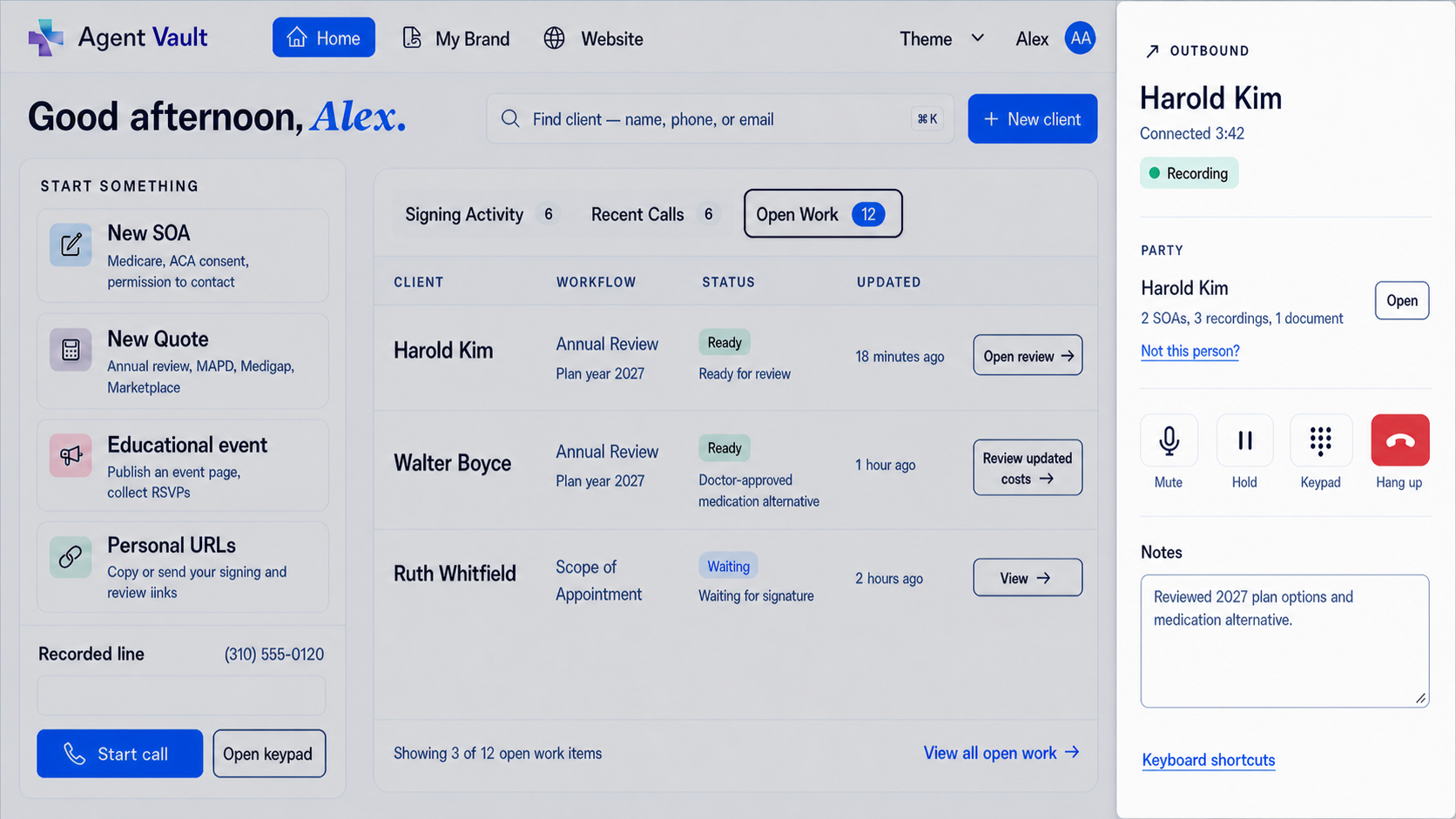
From certification topics to the field workflow
Put a connected field workflow behind the knowledge you renew each year.
Agent Workspace keeps the Medicare and ACA client record connected to Annual Review, quoting workflows, electronic SOA, recorded Business Line calls, notes, consent records, supporting files, and follow-up.
Essentials is available through a guided demo. It has no public price, free trial, or automatic production signup.
Part 7: Compensation concepts that show up on certification
Agents do not need to become actuaries, but they should know the vocabulary.
| Term | Meaning |
|---|---|
| Initial compensation | Compensation for the first enrollment year. |
| Renewal compensation | Compensation in later years or when the beneficiary remains in or moves to a like plan type. |
| Like plan type | PDP to PDP, MA/MA-PD to MA/MA-PD, or cost plan to cost plan. |
| Unlike plan type | MA/MA-PD to PDP or cost plan, PDP to cost plan or MA/MA-PD, or cost plan to MA/MA-PD/PDP. |
| Enrollment year / plan year | January 1 through December 31. |
| Rapid disenrollment | Generally a plan change within the first three months of enrollment, subject to exceptions. |
| Chargeback / recoupment | Recovery of compensation when the member is not enrolled for the period compensated. |
Practical takeaway: do not study compensation as just “how much do I get paid?” Study it as a compliance system: eligibility, plan type, enrollment year, renewal year, like/unlike changes, and recoupment.
Part 8: Beneficiary protections, grievances, and appeals
Certification often tests whether the agent understands where the beneficiary goes when something goes wrong.
| Issue | Usually means |
|---|---|
| Grievance | Complaint about service, treatment, operations, disrespect, wait times, or similar non-coverage issues. |
| Appeal | Challenge to a coverage decision or payment decision. |
| Coverage determination / organization determination | The plan’s decision on whether an item, service, or drug is covered or payable. |
| Redetermination / reconsideration | Later steps in the appeal process. |
| Complaint to Medicare | May be appropriate for enrollment, marketing, or plan conduct issues. |
| FWA report | Fraud, waste, abuse, or compliance issue that should be escalated through the proper channel. |
QMB is a frequent test topic because agents can create serious problems by misunderstanding cost sharing. Do not tell a QMB client they are responsible for Medicare-covered cost sharing without verifying the rule. QMB billing protections are a major beneficiary-protection issue.
Part 9: FWA and general compliance
Fraud, waste, and abuse questions usually test whether the agent recognizes red flags and knows to report through the correct channel.
| Term | Practical explanation |
|---|---|
| Fraud | Intentional deception or misrepresentation to obtain unauthorized benefit or payment. |
| Waste | Overuse or misuse of resources that results in unnecessary cost. |
| Abuse | Practices inconsistent with sound fiscal, business, or medical practices that may result in unnecessary costs or improper payment. |
| General compliance | Following laws, regulations, plan policies, privacy rules, training requirements, and reporting obligations. |
Practical FWA examples agents should recognize include enrolling someone without consent, saying a doctor is in network without checking, offering cash or improper gifts to enroll, falsifying an address to access a plan, coaching a beneficiary to give false SEP information, using someone’s Medicare number without permission, or ignoring a beneficiary complaint.
Do not investigate FWA yourself beyond preserving facts. Report through the plan, carrier, FMO, compliance hotline, or other required channel.
High-yield traps to study before taking the test
| Trap | Correct way to think about it |
|---|---|
| ”MA means no Part B premium.” | Usually false. The beneficiary generally keeps paying Part B unless another program pays it. |
| ”MA is just a dental/vision/hearing rider.” | False. It is a full Medicare health plan. |
| ”Original Medicare clients can use MA OEP to join MA.” | False. MA OEP is for people already in MA. |
| ”Dual/LIS means monthly MA switching.” | Outdated. The current training focus separates the monthly PDP-focused dual/LIS SEP from the integrated-care SEP. |
| ”Extra Help means D-SNP eligible.” | Not necessarily. D-SNP eligibility depends on the plan’s dual-eligibility criteria. |
| ”Educational events can include plan-specific benefits.” | No. Educational events are for general Medicare education, not plan marketing. |
| ”Educational events can accept applications now.” | No. SOAs/contact info can be collected, but applications cannot be accepted at educational events. |
| ”The 48-hour SOA waiting period still applies.” | CMS’s 2027 training guidance says the 48-hour waiting period was removed. SOA must still be completed before the personal marketing appointment. |
| ”SOA is not needed if the beneficiary initiates the call.” | Wrong if the interaction is a personal marketing appointment tailored to the beneficiary or small group. |
| ”Marketing event attendees must sign in.” | No. Contact information must be optional. |
| ”Meals are okay if the event is free.” | Meals are prohibited at marketing events. Light snacks may be allowed. |
| ”A PDP enrollment always disenrolls someone from MA.” | Not always. CMS distinguishes MSA and PFFS without drug coverage from coordinated care MA/MA-PD situations. |
| ”Provider directories are enough.” | Provider, pharmacy, drug, and hospital checks should be beneficiary-specific and documented. |
| ”An out-of-network doctor always creates an SEP.” | Usually no. Check the actual SEP facts. |
| ”AEP applications can be collected before October 15 and held.” | Do not accept, collect, or take possession of completed AEP enrollment forms before October 15. |
How to study: a practical plan
If you have one day, divide the work into six blocks: Medicare basics, plan types, election periods, marketing rules, Part D, and beneficiary protections/FWA. If you have three days, put the basics and plan types on day one, enrollment periods and SNP/dual rules on day two, and marketing, SOA, call recording, compensation, grievances, appeals, and FWA on day three.
If you have one week, use this order.
| Day | Focus |
|---|---|
| Day 1 | Medicare basics and coverage options. |
| Day 2 | MA and Part D eligibility, plan types, SNPs. |
| Day 3 | Part D benefit design, formulary, pharmacy, LIS, Medicare Prescription Payment Plan. |
| Day 4 | Election periods and effective dates. |
| Day 5 | Marketing, communications, events, SOA, call recording. |
| Day 6 | Enrollment process, PECL, beneficiary protections, grievances and appeals. |
| Day 7 | Compensation, FWA, sample scenario review, carrier-specific certification prep. |
The mistake is trying to memorize every sentence. The better approach is to ask: what fact pattern is this question testing?
Practice scenarios to reason through
These are not AHIP questions. They are study-style scenarios to help you practice the reasoning.
Scenario 1: MA HMO and specialist referral
A beneficiary enrolled in an MA HMO wants to see a specialist. What should the agent explain?
The agent should explain that HMO rules may require the beneficiary to work through the PCP and obtain a referral before seeing a specialist, except in emergencies or other plan-specific exceptions.
Scenario 2: MA plan premium and Part B premium
A beneficiary says, “I joined a zero-premium MA plan, so I do not have to pay Part B anymore.”
The agent should correct that. The beneficiary generally still owes the Part B premium unless another program pays it.
Scenario 3: Original Medicare client wants MA in February
A person in Original Medicare calls in February and wants to join an MA plan because they heard about MA OEP.
MA OEP does not allow someone in Original Medicare to newly join MA. It applies to people already enrolled in MA.
Scenario 4: Educational event turns into plan discussion
An agent is hosting an educational event and starts comparing specific plan premiums and benefits.
That is a problem. Educational events are for general Medicare education and cannot include plan-specific marketing.
Scenario 5: SOA at a walk-in appointment
A beneficiary walks into the office and asks for help comparing two specific MA plans.
That is likely a personal marketing appointment because the discussion is tailored to an individual and involves marketing topics. SOA should be completed before the discussion.
Scenario 6: Snacks at a marketing event
An agent wants to provide food at a marketing event.
Light snacks may be permissible; meals are not.
Scenario 7: D-SNP eligibility
A beneficiary has Extra Help and asks to enroll in a D-SNP.
Extra Help alone does not automatically establish D-SNP eligibility. The person must meet the D-SNP’s specific dual-eligibility criteria.
Scenario 8: Full-benefit dual wants monthly regular MA-PD switch
A full-benefit dual wants to switch from one regular MA-PD to another regular MA-PD midyear and says, “I can switch every month because I have Medicaid.”
Be careful. CMS’s current training focus distinguishes the monthly dual/LIS SEP for PDP/Original Medicare coordination from the integrated-care SEP for aligned FIDE/HIDE/AIP D-SNP enrollment. The monthly integrated-care SEP is not a general monthly switch into any regular MA-PD.
Scenario 9: PDP enrollment and current MA plan
A beneficiary in an MA-PD enrolls in a standalone PDP.
For many MA coordinated care plans, enrolling in a standalone PDP will automatically disenroll the beneficiary from the MA plan. But an MSA or MA-PFFS plan without drug coverage may work differently, so agents should not memorize a one-size answer.
Scenario 10: Application before AEP
At an October 5 sales event, a beneficiary completes an AEP application and the agent says, “I’ll hold it until October 15.”
That is a problem. Agents should not accept, collect, or take possession of completed AEP enrollment forms before October 15.
Final exam-prep checklist
Before taking AHIP or a carrier certification, make sure you can answer these without guessing.
Certification is not just about passing the test
A good agent should pass certification. But the bigger goal is to avoid mistakes with real beneficiaries.
Certification topics show up later as complaints: the doctor was not in network, the drug was not on formulary, the client thought the plan was only dental coverage, the client did not understand they still owed Part B, the agent used the wrong election period, the agent discussed products outside the SOA, the agent accepted an application too early, the client was dual eligible but the agent misunderstood what kind of midyear change was allowed, the call was not recorded, or the event was advertised as educational but became a sales presentation.
That is why the test matters.
The goal is not to memorize enough to scrape by. The goal is to understand the rules well enough that the right answer becomes obvious in the field.
For 2027, study the fundamentals, but spend extra time on the practical areas: MA vs. PDP eligibility, election periods, dual/LIS rules, Part D changes, SOA, educational vs. marketing events, call recording, pre-enrollment checklist topics, and FWA.
That is the material that helps you pass certification and, more importantly, helps you protect your clients and your book of business.
Sources
- AHIP Medicare Training: AHIP Accessed 2026-06-10.
- CY2027 Agent/Broker Training & Testing Guidelines: Centers for Medicare & Medicaid Services Accessed 2026-06-10.
- Announcement of CY 2027 Medicare Advantage Capitation Rates and Part C and Part D Payment Policies: Centers for Medicare & Medicaid Services Accessed 2026-06-10.
- Contract Year 2027 Medicare Advantage and Part D Final Rule Fact Sheet: Centers for Medicare & Medicaid Services Accessed 2026-06-10.
- Medicare Program; Contract Year 2027 Final Rule: Federal Register Accessed 2026-06-10.
- 42 C.F.R. 422.2274 - Agent, broker, and other third-party requirements: Electronic Code of Federal Regulations Accessed 2026-06-10.
- 42 C.F.R. 423.2274 - Agent, broker, and other third-party requirements: Electronic Code of Federal Regulations Accessed 2026-06-10.
- 42 C.F.R. 422.50 - Eligibility to elect an MA plan: Electronic Code of Federal Regulations Accessed 2026-06-10.
- 42 C.F.R. 423.30 - Eligibility and enrollment: Electronic Code of Federal Regulations Accessed 2026-06-10.
- Medicare Prescription Payment Plan: Medicare.gov Accessed 2026-06-10.
Frequently Asked Questions
When does 2027 AHIP Medicare training launch?
AHIP's Medicare training page says the 2027 Medicare training launches on June 22. Agents should still confirm carrier-specific certification opening dates because each carrier controls its own ready-to-sell process.
Is AHIP enough to make a Medicare agent ready to sell?
Usually no. AHIP or another Medicare and FWA course may satisfy the general training piece, but carriers typically require product-specific certifications, appointments, and proof of completion before an agent is ready to sell.
What score do Medicare agents need on CMS-required training and testing?
Federal MA and Part D agent and broker rules require annual training and testing, and CMS rules reference an 85 percent or higher score for the testing requirement.
What should agents study first for 2027 certification?
Start with Medicare Parts A, B, C, and D; MA and Part D eligibility; election periods; Part D plan design; Scope of Appointment rules; marketing-event rules; call recording; pre-enrollment topics; compensation; grievances, appeals, and FWA.
What 2027 topics are most likely to trip up Medicare agents?
High-risk areas include same-day SOA rules, written SOA for in-person personal marketing appointments, educational-to-marketing event transitions, dual/LIS SEP limits, MA OEP limits, Part D benefit changes, provider and drug checks, and call recording retention.
Does dual or LIS status mean broad monthly MA switching in 2027?
No. CMS's 2027 training guidelines distinguish the monthly dual/LIS SEP for Part D from the narrower integrated-care SEP for certain full-benefit dual eligible individuals aligned with integrated D-SNP enrollment.
What is the 2027 Medicare Part D deductible and out-of-pocket threshold?
CMS's 2027 Rate Announcement lists a $700 standard Part D deductible and a $2,400 annual out-of-pocket threshold for the 2027 defined standard benefit.
How should agents use this certification primer?
Use it to organize study time around scenarios, not memorized trivia. Then confirm details in AHIP, carrier certification modules, CMS guidance, carrier job aids, and the specific plans the agent is appointed to sell.
Medicare and ACA Compliance Expert
Christian Rodgers is a Medicare and ACA compliance expert with over 30 years in the healthcare industry, having worked for some of the largest health plans in the United States. He has provided Medicare sales training to hundreds of agents in California and Florida.
Connect on LinkedIn