
A Medicare call becomes an enrollment recording when the beneficiary is told they are completing an enrollment request, agrees to the recording, provides the required enrollment information, and verbally attests to the intent to enroll. Until that point, the call is still the marketing and sales portion of the conversation.
A lot of compliance content makes this question sound more mysterious than it really is.
Agents hear that CMS now treats the marketing and sales portion of a call differently from the enrollment portion, and suddenly it sounds like every phone conversation is a trap. It is not. A Medicare phone call does not become a telephonic enrollment just because you talked about plans for 20 minutes. The line is much more specific than that.
And that line matters more now because CMS’s 2027 final rule reduced retention for the marketing and sales portion of calls to 6 years, while keeping enrollment records on the 10-year track. CMS also said the rule’s new marketing and communications policies apply to contract year 2027 marketing beginning October 1, 2026.
So let’s answer the real question plainly.
The practical answer
A call becomes an enrollment recording when the conversation moves from selling and explaining to completing the enrollment request.
CMS says that for enrollments completed over the phone, the recording of the enrollment portion of the call serves as the enrollment form and shows that the beneficiary attested to the intent to enroll. CMS also says the enrollment portion begins when the beneficiary is advised that they are completing an enrollment request, after which they provide the required information and attest to their intention to enroll.
That is the key distinction.
Talking about premiums is not enrollment.
Comparing networks is not enrollment.
Answering drug questions is not enrollment.
Even recommending a plan is not, by itself, the enrollment.
The call crosses the line when you intentionally begin the actual enrollment request.
The enrollment transition is deliberate
A telephonic enrollment follows an intentional sequence. CMS’s enrollment guidance says the applicant must be advised that they are completing an enrollment request, must agree to be recorded, and must verbally attest to the intent to enroll during the call.
That is why the handoff matters so much.
There is a real difference between:
“We’re still talking through your options,”
and
“We’re now completing your enrollment request by phone.”
That second moment is when the call changes function.
Why agents should actually care about this
Because telephonic enrollment can be a very good tool.
Used correctly, it can save drive time, cut gas costs, reduce scheduling friction, and help agents close business more efficiently when a beneficiary is ready to move forward by phone. It is not a shortcut around the rules. It is a legitimate enrollment mechanism with a defined structure.
The mistake is not using telephonic enrollment.
The mistake is using it without a clean workflow for when the sales conversation turns into the enrollment record.
What that transition sounds like in real life
The exact wording should come from the plan-approved script, not from a random blog post. CMS says scripts for completing an enrollment request by phone must be developed by the plan and submitted to CMS for review and approval.
But in practical terms, the transition usually sounds something like this:
“Based on what we discussed, it sounds like you want to move forward. We’re now going to complete your enrollment request by phone, and this portion of the call is being recorded for that purpose.”
Then the beneficiary clearly confirms they want to enroll, and the required enrollment information is collected through the approved process.
That is why this does not happen by accident. There is supposed to be a recognizable handoff from discussion to enrollment. CMS’s own framework requires that the applicant be told they are completing an enrollment request and that they verbally attest to the intent to enroll.
Can enrollment happen on any outbound call?
Not exactly.
CMS guidance says plans generally may accept telephone enrollment requests through an incoming call to a plan representative or agent. CMS also allows organization-initiated outreach where there is an existing business relationship and the individual expresses a desire to enroll. For applicants without an existing business relationship, enrollment requests can only be accepted during an incoming call from the applicant.
That is another reason accidental telephonic enrollment is not really the issue people make it out to be. The process has guardrails.
What about a call that starts as marketing and ends as enrollment?
This is where agents need practical guidance, not fantasy workflow advice.
Yes, CMS now distinguishes between the marketing and sales portion of calls and the enrollment portion. Yes, the retention periods are different. But in the real world, one call often contains both. CMS itself received comments saying that sales, marketing, and enrollment calls are often combined, and that separating them is difficult and burdensome. CMS did not change enrollment-call retention in the 2027 rule; it finalized the 6-year rule for the marketing and sales portion of calls while leaving enrollment retention alone.
That leads to the common-sense operational answer:
If a call includes a completed telephonic enrollment, treat that call like an enrollment-related record and store the full call accordingly.That is a workflow recommendation, not new CMS text. But it is the cleaner, more defensible approach for most agents and agencies. Once the call contains the part that serves as the enrollment form and proof of intent, trying to carve one conversation into artificial retention buckets usually creates more risk and more work than it solves. The rule distinguishes the categories; your storage process still needs to function in the real world.
A simple workflow agents can actually follow
Keep it simple.
Start the call in sales mode. Answer questions. Explain the plan. Compare options.
When the beneficiary is ready to move forward, make the transition explicit. Move into the plan-approved enrollment script. Make sure the beneficiary is advised that they are completing the enrollment request, agrees to the recording, and verbally confirms the intent to enroll.
Then store the call in a way that reflects what it became.
That is the real takeaway here: the value is not just recording calls. The value is having a workflow that makes the important calls easy to identify, easy to retain, and easy to produce later if you ever need them.
Why this matters for your business
The agents who benefit most from telephonic enrollment are often the same agents who get burned by sloppy recordkeeping.
A phone-based workflow is faster. It is cheaper. It is more scalable. But it also puts more pressure on your storage process. Once a call can start as a normal Medicare conversation and end as a real enrollment record, you need a system that treats that transition seriously.
That is where a centralized vault starts to make sense.
You do not want important recordings, SOAs, and enrollment-related records scattered across phones, inboxes, carrier tools, and random folders. You want one place where the records tied to real business activity can be stored consistently, found quickly, and retained with the right mindset when a call turns into an enrollment.
Keep the enrollment handoff on the client record
Make the call, mark the transition, and keep the recording with the file.
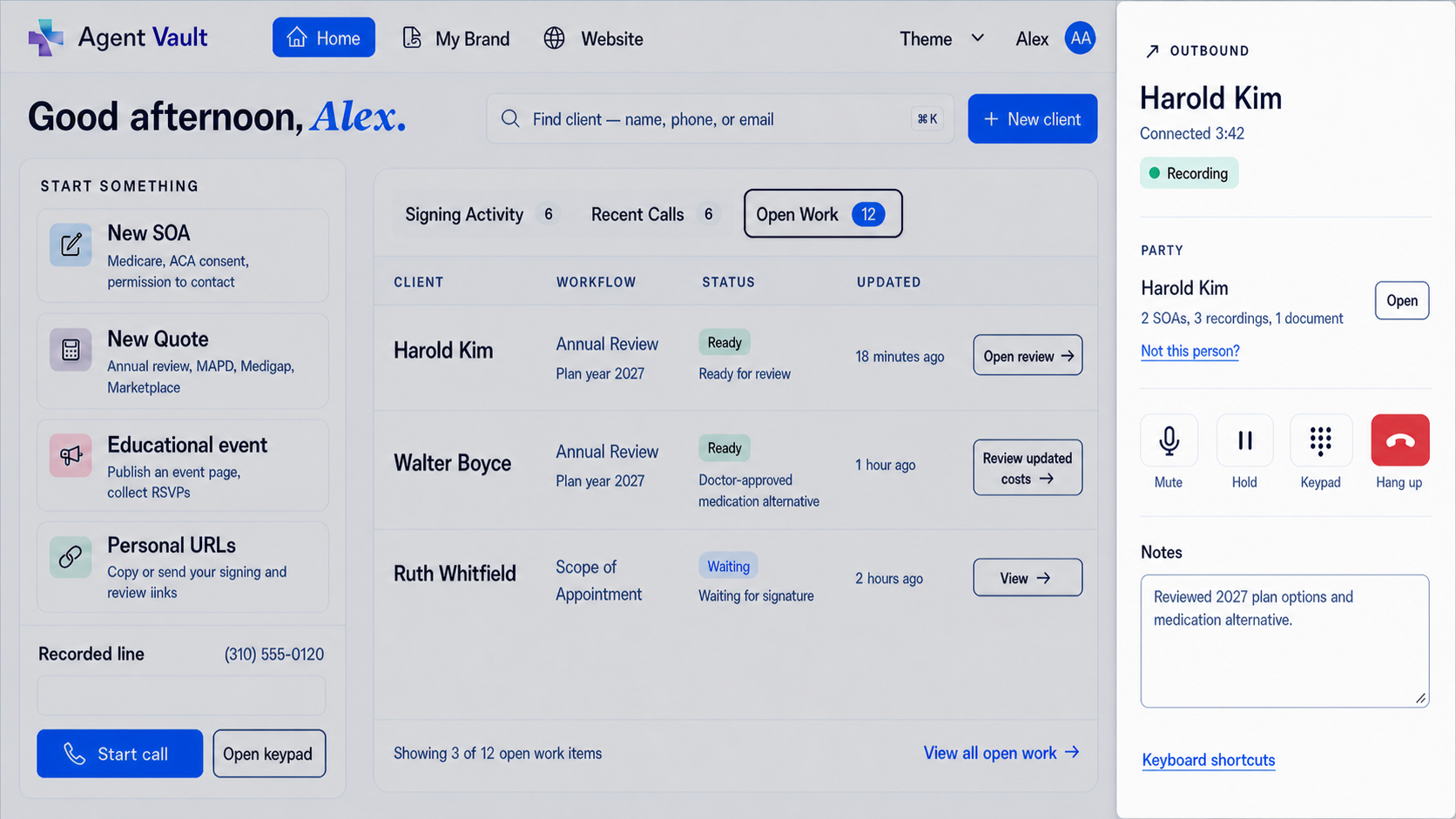
Agent Workspace gives licensed Medicare and ACA agents an in-app Business Line connected to the client record. During the call, the recording status, client file, related SOAs, prior recordings, documents, and notes stay in view, so the sales-to-enrollment handoff can be documented without rebuilding the file later.
Business calling is included in Essentials at $29.99/month after a 30-day free trial. Card required at checkout; one trial per NPN.
Bottom line
A Medicare call does not become an enrollment recording just because you discussed plans.
It becomes an enrollment recording when the beneficiary is told they are completing an enrollment request, agrees to the recording, provides the required information, and attests to the intent to enroll. That is the point where the recording is serving as the enrollment form, not just documenting a sales conversation.
And when one call includes both the sales conversation and the completed telephonic enrollment, the practical move is usually to retain the full call like an enrollment-related record rather than trying to split a single conversation into separate compliance fragments. That is not overkill. That is just a workflow that matches how real calls actually happen.
This article is for educational purposes only and is not legal advice. Agents should review current CMS guidance, carrier rules, and agency policies, and consult qualified counsel or compliance professionals for specific requirements.
Frequently Asked Questions
Does talking about a Medicare plan make the call an enrollment recording?
No. A Medicare call becomes an enrollment recording when the beneficiary is advised that they are completing an enrollment request, agrees to the recording, provides the required information, and attests to the intent to enroll.
Can a telephonic enrollment happen by accident?
Usually no. Telephonic enrollment is a deliberate process that requires the applicant to be told they are completing an enrollment request, to agree to the recording, and to verbally attest to the intent to enroll.
Can I accept a telephonic enrollment on an outbound call?
Only in limited cases. CMS guidance allows organization-initiated outreach when there is an existing business relationship and the individual expresses a desire to enroll. Otherwise, the enrollment request must come through an incoming call from the applicant.
Do I need a carrier or plan-approved script?
Yes. Scripts for completing an enrollment request by phone must be developed by the plan and submitted to CMS for review and approval.
What should I do if one call contains both sales discussion and the final enrollment?
A practical approach is to store the full call like an enrollment-related record once the call includes a completed telephonic enrollment, rather than trying to split one conversation into separate retention categories.
Medicare and ACA Compliance Expert
Christian Rodgers is a Medicare and ACA compliance expert with over 30 years in the healthcare industry, having worked for some of the largest health plans in the United States. He has provided Medicare sales training to hundreds of agents in California and Florida.
Connect on LinkedIn