
Quick answer
Medicare call recording did not go away for CY2027. CMS finalized a six-year retention framework for Medicare Advantage and Part D marketing and sales calls: keep audio for years 1-3, then keep audio or a complete and accurate transcript for years 4-6. Enrollment records remain separate.
Medicare agents have spent the last few years working under a simple rule of thumb: record the call and keep it for 10 years. For CY2027, that shortcut is no longer precise.
CMS did not eliminate Medicare call recording. In the Contract Year 2027 final rule, CMS finalized a new retention framework for Medicare Advantage and Part D marketing and sales calls. Those calls must be recorded and retained for at least six years, with audio required for the first three years and either audio or a complete and accurate transcript allowed for years four through six. Enrollment records remain separate and were not folded into that shorter marketing and sales call-retention framework. You can review the published rule in the Federal Register and the related CMS final rule fact sheet.
For the evergreen rule reference, use our Medicare call recording requirements for agents. For the narrower retention question, see our guide to whether Medicare agents still need to keep call recordings for 10 years.
That distinction matters. Agents should not read “six years” and assume every Medicare record now has the same retention rule. The practical compliance issue is no longer just “Do I record calls?” It is: can you identify what type of record this is, store it properly, retrieve it quickly, and prove what happened if a beneficiary, carrier, agency, FMO, or regulator asks?
That is where a dedicated recorded business line for Medicare agents and an Essentials record-storage workflow become more useful than a generic phone recorder.
The short version for agents
For CY2027, Medicare agents should understand five practical points.
- Marketing and sales calls still need to be recorded. CMS states that all marketing and sales calls, including the audio portion of web-based calls, must be recorded and retained in their entirety.
- The retention period for marketing and sales call records is now a six-year framework. CMS finalized the reduction from the prior 10-year shorthand to six years for these records.
- Audio is required for the first three years. Agents should not assume a transcript is enough during years 1-3.
- For years 4-6, CMS allows audio or a complete and accurate transcript. CMS describes that transcript as one that documents the full recording and reflects all statements made by the participants as originally occurred.
- Enrollment records remain separate. CMS maintained the separate 10-year retention requirement for enrollment records and said comments asking it to reduce the enrollment-call timeframe were outside the scope of this rulemaking.
What changed from the old Medicare call recording rule?
Before the CY2027 final rule, many compliance summaries used a broad “10-year call recording” explanation. That was understandable, but it is now too blunt.
CMS acknowledged the cost and burden of storing large audio files for 10 years and explained that call recordings tend to be most useful when reviewed close to the time of a complaint. The final CY2027 approach creates a more practical retention ladder.
| Record type | CY2027 practical rule |
|---|---|
| Medicare marketing and sales calls | Record and retain in entirety for at least six years |
| Years 1-3 of marketing/sales retention | Keep the audio recording |
| Years 4-6 of marketing/sales retention | Keep audio or a complete and accurate transcript |
| Enrollment records | Separate retention track; not reduced by the CY2027 marketing/sales call change |
| SOA records | Still need to be completed and stored according to applicable CMS, carrier, agency, and workflow requirements |
The key takeaway: agents need a system that can handle record type, record age, and retrieval, not just a phone app that saves audio files.
Does the rule apply only to call centers?
No. CMS considered comments suggesting that call centers presented greater concerns than independent agents, but CMS did not create a call-center-only rule. CMS stated that all sales and marketing calls should be recorded, not just calls from call centers, because complaints involve both independent agents and call-center agents.
For independent agents, that means the compliance workflow still matters even if you are a solo producer, a small agency, or an agent using your own CRM, quoting platform, FMO tools, and carrier portals.
A small book of business is not a substitute for clean records. If a complaint, dispute, plan-review issue, or carrier request comes up later, the question will be simple: can you produce the file?
Which Medicare calls must be recorded?
The requirement applies to marketing, sales, and enrollment calls — not every conversation with a beneficiary. CMS training guidance indicates that calls outside marketing, sales, and enrollment do not have to be recorded, though agents should still follow carrier, agency, privacy, and state requirements.
Record the call when it involves any of the following:
- Discussing Medicare Advantage, Part D, or MA-PD plan options.
- Comparing plan benefits, premiums, drug coverage, providers, networks, or formularies.
- Recommending or discussing a plan fit.
- Moving into a Medicare enrollment request, including a phone enrollment.
- Conducting any of the above through web-based audio, such as Zoom, Teams, screen-share, or a web meeting.
Calls that may fall outside the requirement include scheduling an appointment, confirming an address, confirming receipt of a welcome packet, or providing non-sales customer service — as long as no plan marketing, comparison, sales discussion, or enrollment request occurs. The moment a service call drifts into plan discussion, treat it as a recordable call. For the marketing-versus-enrollment line specifically, see marketing call vs. enrollment recording.
What counts as a complete and accurate transcript?
CMS did not say that any rough summary or AI-generated call recap is enough. For years four through six, a transcript can replace audio only if it is complete and accurate. CMS explained that a complete and accurate transcript must document the full recording and reflect all statements made by the participants as the conversation originally occurred.
A short call summary is useful for notes. A CRM activity log is useful for follow-up. A meeting recap may help you remember what happened. But those are not the same thing as a complete transcript of the call.
Agents who plan to rely on transcripts in years 4-6 should think through:
- Who creates the transcript?
- Is it complete, or only summarized?
- Can it be tied back to the original call?
- Can it be exported?
- Is there an audit trail showing when the record was created or stored?
- Is the transcript stored with the related SOA, plan discussion, enrollment file, or sales documentation?
The transcript option can reduce long-term storage burden, but only if the transcript is reliable enough to serve as a record.
What did not change for Medicare agents?
The CY2027 final rule changed the retention structure for marketing and sales call records. It did not remove the need for a compliant sales workflow.
Agents still need to use the right disclosures, follow carrier and agency procedures, respect state recording-consent laws, and document the file in a way that can be retrieved later. Agent Workspace is designed around that real-world workflow: an optional business number for inbound and outbound calls inside the app, permitted automatic recording, electronic Scope of Appointment for Medicare agents, telephone SOA and voice authorization recordkeeping, ACA consumer consent and eligibility review tools, uploaded sales documents, and record export.
The point is not simply to record more calls. The point is to keep the right records together.
A Medicare sales file may involve a call recording, an SOA, plan documents, notes, beneficiary acknowledgments, a telephonic enrollment record, and follow-up documentation. If those records are scattered across a phone dashboard, email inbox, FMO portal, CRM, personal drive, and carrier site, retrieval becomes the weak link.
Related CY2027 SOA change: the 48-hour delay is gone, but the SOA is not
CY2027 also changed the timing rule for Scope of Appointment workflows. CMS finalized elimination of the 48-hour waiting period between SOA completion and a personal marketing appointment. That means the beneficiary may be able to complete the SOA and discuss plan products without waiting 48 hours.
But that does not mean agents can skip the SOA. CMS kept the requirement that, before a personal marketing appointment, the plan or agent/broker must agree upon and record the Scope of Appointment with the beneficiary. For in-person personal marketing appointments, the SOA must be in writing. CMS also clarified that SOA records remain required for personal marketing appointments, including telephonic and walk-in appointments.
In practice, this makes workflow speed more important. Agents need a way to capture an electronic SOA, telephone SOA, or voice-signature-style record quickly, then keep that record with the call and related sales file. For more detail, see our guides on the eliminated 48-hour SOA rule and telephone Scope of Appointment workflows.
Why a generic phone system is usually not enough
Many business phone systems can record calls. That does not mean they solve the Medicare compliance recordkeeping problem.
A generic phone system usually treats the recording as a standalone call log. It may tell you the number dialed, call duration, and recording file. That is helpful, but it does not automatically solve the bigger record question: where is the SOA, what plan was discussed, which documents were sent, what enrollment process was used, and can the full packet be exported if needed?
Business Telephone is built for the insurance-agent phone workflow. It gives licensed Medicare and ACA agents a dedicated business number for inbound and outbound calls inside the app, permitted recording, call history, and related storage. Business calling is included in Essentials at $29.99/month after a 30-day free trial. Card required at checkout; one trial per NPN. Electronic SOA remains a separate $9.99/month self-service product.
That difference matters during AEP and OEP. When the phone is busy, the compliance system needs to be simple enough to use every day. When the season is over, the records need to remain accessible.
A practical Medicare call recording checklist for CY2027
Before the next selling season, agents should review their workflow with these questions in mind.
1. Do you have a dedicated recorded business line?
Using a personal cell phone for Medicare sales calls creates practical problems. Calls, texts, voicemails, and records can become mixed with personal communications. A dedicated recorded line gives you a cleaner operating boundary.
2. Are required notices and consent workflows built into your process?
CMS rules are only part of the picture. Agents also need to follow applicable state recording-consent laws, carrier scripts, agency procedures, and any required disclosure language.
3. Can you separate marketing/sales calls from enrollment records?
The CY2027 six-year framework applies to marketing and sales calls. Enrollment records remain separate. Your storage system should make that distinction clear.
4. Are audio recordings preserved for the first three years?
For Medicare marketing and sales calls, years 1-3 require audio. Do not rely only on a summary or transcript during that period.
5. Do you have a transcript policy for years four through six?
If you plan to use transcripts instead of audio after year three, make sure the transcripts are complete, accurate, and stored in a way that can be retrieved.
6. Are SOAs stored with the related call records?
A call recording without the related SOA can create unnecessary backtracking. Keep the SOA, call, notes, plan documents, and supporting records together.
7. Can you export records if your workflow changes?
Agents change FMOs, agencies, CRMs, phone systems, and enrollment tools. Your long-term compliance records should not be trapped in a system you may stop using.
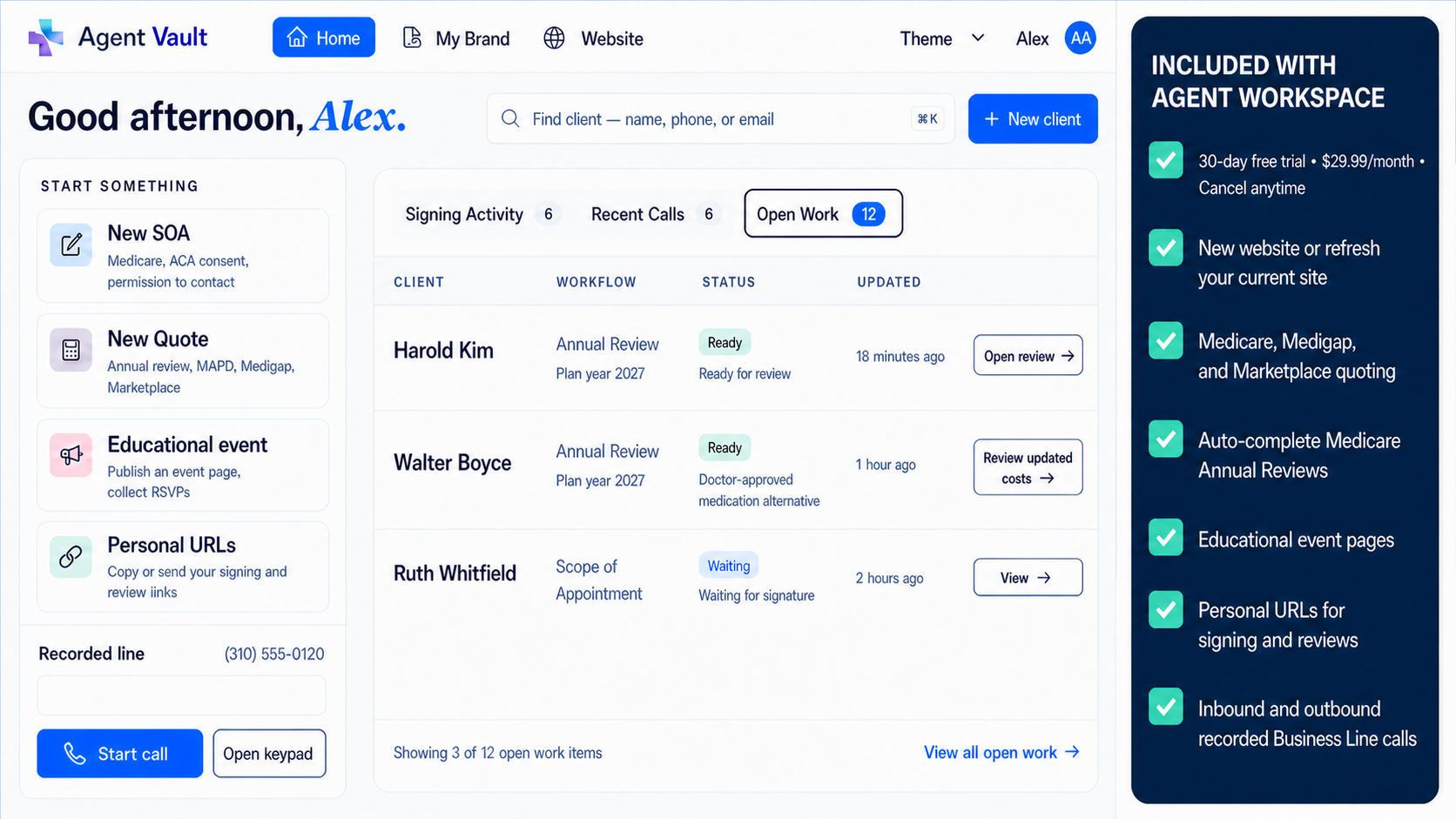
Recorded Business Line inside Agent Workspace
Recording the call is only the first step. Keep the complete sales record together.
Agent Workspace includes an optional business number for calls made and answered inside the app. Where recording is permitted and any required notice or consent is complete, the call can stay connected to the client, SOA, notes, transcript, enrollment-related file, and supporting documents.
The agent still determines which calls must be recorded, which retention track applies, and which CMS, carrier, FMO, agency, contract, state-law, and legal-hold requirements govern each record.
Business calling is included in Essentials at $29.99/month after a 30-day free trial. Card required at checkout; one trial per NPN. Agent Workspace supports calling, recordkeeping, retrieval, and export; it does not replace regulatory analysis, approved scripts, carrier or FMO procedures, state recording-consent law, or legal advice.
How Agent Workspace helps
Agent Workspace is designed for agents who want CRM, recorded calling, electronic forms, Annual Review, and compliance records connected in one system.
Use Agent Workspace for pipeline and client relationship management. Continue using required quoting, enrollment, carrier, and FMO tools where they apply. Keep the connected compliance records in a place you control.
With Agent Workspace, agents can:
- Use the business number included with Agent Workspace for Medicare and ACA calls made and answered inside the app.
- Automatically record supported app calls when recording is permitted and required notice or consent is complete.
- Store call recordings in a secure vault.
- Send and store electronic Scope of Appointment records.
- Support telephone SOA and voice-signature-style workflows.
- Store telephonic enrollment-related records when your approved process allows.
- Keep ACA consent and eligibility review records with related files.
- Upload supporting sales documents.
- Export records if your workflow changes.
- Start an Essentials 30-day free trial when you need a storage-focused record workflow beyond Electronic SOA.
Business calling is included in Essentials at $29.99/month after a 30-day free trial. Card required at checkout; one trial per NPN. Electronic SOA is available separately for $9.99/month. See the current product paths.
The bottom line
The CY2027 Medicare call recording change is good news for agents, but it is not a reason to loosen your recordkeeping.
The old “keep every Medicare call recording for 10 years” shorthand is no longer precise for marketing and sales calls. CMS moved those records to a six-year framework: audio for years 1-3, then audio or a complete and accurate transcript for years 4-6. But Medicare marketing and sales calls still need to be recorded and retained in their entirety, independent agents are still included, and enrollment records remain on a separate retention track.
The best agent workflow is simple: record the call when required, capture the SOA, keep the supporting documents together, and make sure the file can be retrieved later.
That is the job of Agent Workspace: a recorded business line and compliance vault built for Medicare and ACA agents who need their calls, SOAs, consent records, enrollment records, and sales documents in one organized place.
Sources
- Federal Register, 91 FR 17384: Contract Year 2027 Medicare Advantage and Part D final rule.
- CMS Contract Year 2027 final rule fact sheet: CMS summary of the final rule.
- Agent Workspace: Informed + Choice product page for the recorded business line and compliance vault workflow.
Frequently Asked Questions
Did CMS eliminate Medicare call recording for CY2027?
No. CMS did not eliminate Medicare call recording. CMS finalized a new retention framework for marketing and sales calls, but those calls still must be recorded and retained in their entirety.
How long do Medicare agents need to keep marketing and sales call recordings?
For CY2027, Medicare marketing and sales calls must be retained for at least six years. Audio must be kept for the first three years. For years four through six, the record may be maintained as audio or as a complete and accurate transcript.
Can I replace audio with a transcript immediately?
No. For the first three years of the retention period, CMS requires records to be maintained in audio format. The transcript option applies to years four, five, and six.
What makes a transcript complete and accurate?
CMS describes a complete and accurate transcript as one that documents the full recording and reflects all statements made by the participants as they originally occurred. A summary or call note is not the same thing as a full transcript.
Do independent Medicare agents still need to record calls?
Yes. CMS rejected the idea of limiting the recording requirement to call centers. CMS stated that all sales and marketing calls should be recorded because complaints involve both independent agents and call-center agents.
Did the CY2027 rule change enrollment record retention?
The CY2027 change addressed marketing and sales call retention. CMS stated that enrollment records remain subject to separate retention requirements and that comments asking CMS to reduce the retention timeframe for enrollment calls were outside the scope of the rulemaking.
Is a regular VoIP phone system enough?
A regular VoIP system may record calls, but Medicare agents usually need more than a recording file. They need SOAs, call recordings, telephone authorizations, enrollment-related records, ACA documents, notes, and supporting files organized in a retrievable record.
Does Agent Workspace include a CRM or replace my enrollment platform?
Agent Workspace includes a Medicare and ACA-specific CRM, recorded business line, electronic forms, Annual Review, and connected compliance vault. It does not replace required carrier, FMO, quoting, or enrollment platforms.
Medicare and ACA Compliance Expert
Christian Rodgers is a Medicare and ACA compliance expert with over 30 years in the healthcare industry, having worked for some of the largest health plans in the United States. He has provided Medicare sales training to hundreds of agents in California and Florida.
Connect on LinkedIn