
Quick answer
For CY2027, Medicare marketing and sales call recordings move to a six-year retention framework. Telephonic enrollment recordings are different: the enrollment portion can serve as the enrollment form and proof of intent, so agents should treat it as an enrollment record and keep it with the related SOA, plan documents, notes, and supporting file.
The biggest Medicare call-recording mistake agents can make after the CY2027 rule change is treating every recorded call the same way.
CMS reduced the retention requirement for Medicare Advantage and Part D marketing and sales call recordings. CMS did not reduce the separate retention framework for enrollment records. That means one Medicare phone call may create two different record categories: a marketing or sales record, and an enrollment record.
That distinction matters because many sales conversations do not fit neatly into one bucket. A call may start with plan discussion, move into benefit questions, continue into a Scope of Appointment issue, and end with a telephonic enrollment. If the agent treats the entire file as “just a sales call,” they may mishandle the enrollment record. If the agent treats every call as a 10-year audio obligation, they may overstore marketing recordings and add storage cost, cybersecurity exposure, and workflow clutter.
The practical rule is simple: classify the record before deciding how to retain it.
This page focuses on telling the two record types apart. For the full list of CY2027 call-recording rules, see the Medicare call recording requirements guide; for how long each record type must be kept, see Medicare call recording retention.
The short answer
For CY2027, Medicare agents should think about call retention this way:
| Call or record type | Practical retention treatment |
|---|---|
| Medicare marketing and sales calls | Record and retain in entirety for at least six years |
| Marketing or sales call records, years 1-3 | Keep the audio recording |
| Marketing or sales call records, years 4-6 | Keep audio or a complete and accurate transcript |
| Telephonic enrollment portion of a call | Treat as an enrollment record |
| Enrollment and disenrollment records | Separate current contract period plus 10 prior periods retention track |
| Calls with both sales and enrollment content | Identify and preserve both record types |
| SOA, notes, plan documents, and supporting files | Store with the related call and enrollment file |
CMS’s CY2027 final rule states that marketing and sales calls, including the audio portion of web-based calls, must be recorded and retained in their entirety for at least six years. CMS also states that the first three years must stay in audio format, while years four through six may be maintained as audio or as complete and accurate transcripts. You can review the final rule in the Federal Register.
But when the call becomes an enrollment request, a different recordkeeping issue begins.
What is a Medicare marketing or sales call?
A Medicare marketing or sales call is the part of the conversation where the agent discusses plan options, benefits, premiums, networks, formularies, suitability, comparisons, or other plan-related information before the beneficiary completes an enrollment request.
This is the portion of the call CMS addressed in the CY2027 retention change. CMS finalized a reduction from the prior 10-year expectation to a six-year framework for the marketing and sales portion of calls. For agents, the key takeaway is this: marketing and sales calls still need to be recorded. They just no longer follow the same broad 10-year audio-retention shorthand that many agents were taught.
The updated framework is:
- Years 1-3: keep the audio.
- Years 4-6: keep the audio or a complete and accurate transcript.
- After six years: the marketing or sales portion is no longer retained for that purpose, unless another rule, contract, complaint, audit, dispute, legal hold, or record category applies.
Agents should still be careful before deleting anything. The same recording may contain an enrollment portion or may be subject to another retention obligation.
What is a Medicare enrollment recording?
A Medicare enrollment recording is different. It is the part of a phone call where the beneficiary is actually completing an enrollment request.
CMS explained that, for enrollments completed by phone, plans are still required to record the enrollment portion because that recording functions as the enrollment form and proof that the beneficiary attested to the intent to enroll. CMS also explained that the enrollment portion begins when the beneficiary is advised that they are completing an enrollment request, after which they provide the required enrollment information and attest to their intention to enroll.
Before the beneficiary is completing an enrollment request, you are likely in the marketing or sales portion. Once the beneficiary is advised that they are completing an enrollment request and begins providing enrollment information and intent-to-enroll attestation, you are in the enrollment portion.
The enrollment recording is not just another sales call. It may be the record that proves the beneficiary intended to enroll. That is why it needs to be handled more carefully and stored with the related enrollment file, SOA, plan documents, and supporting records.
Why the distinction matters
The marketing and sales recording helps show what was said during the plan discussion. It can help resolve complaints about inaccurate benefits, misleading statements, pressure, steering, network confusion, drug-cost representations, or whether the agent properly explained plan information.
The enrollment recording serves a different function. In a telephone enrollment, the recording can operate as the enrollment form and proof of the beneficiary’s intent to enroll. CMS maintained the separate retention requirement for enrollment records, and the current MA and Part D regulations refer to enrollment and disenrollment records for the current contract period and 10 prior periods. See 42 C.F.R. 422.504(e)(1)(iv) and 42 C.F.R. 423.505(e)(1)(iv).
For agents, that means the same phone call may need two labels:
- Marketing/sales record: what was discussed before the enrollment request.
- Enrollment record: the actual enrollment request, required information, and beneficiary attestation.
When those labels are missing, retention gets messy.
One call can create multiple records
A typical Medicare sales call might look like this:
| Call segment | Record category |
|---|---|
| Greeting and recording notice | Call record / consent workflow |
| Scope of Appointment confirmation | SOA record |
| Plan discussion and benefit comparison | Marketing/sales call recording |
| Beneficiary says they want to enroll | Transition point |
| Agent advises beneficiary they are completing an enrollment request | Enrollment portion begins |
| Beneficiary provides required enrollment information | Enrollment record |
| Beneficiary attests to intent to enroll | Enrollment record |
| Agent completes wrap-up and next steps | Supporting call record |
This is why “call recording retention” is not precise enough by itself. The better question is: what happened during the call?
If the call only involved marketing and sales discussion, the CY2027 six-year marketing/sales framework may apply. If the call included a phone enrollment, the enrollment portion should be treated as an enrollment record. If the call included an SOA discussion, the SOA record should be stored with the file. If there was a complaint, audit, carrier review, state issue, or agency request, deletion should be paused until the matter is resolved.
Do agents need to split the call into separate audio files?
Not necessarily. The rule distinction does not mean every agent must physically cut a recording into multiple audio files. In many workflows, the more practical approach is to keep the full recording and tag the file so the enrollment portion is identifiable.
For example, the agent’s file might include:
- Full call recording.
- Timestamp where the enrollment portion begins.
- Completed SOA.
- Plan discussed.
- Enrollment confirmation or submission details.
- Notes identifying whether the call included a marketing/sales portion, an enrollment portion, or both.
- Supporting documents sent to the beneficiary.
- Carrier or agency workflow reference.
The point is not to create extra administrative work. The point is to avoid losing the distinction between the sales conversation and the enrollment request. A simple timestamp note can be valuable: “Enrollment portion begins at 32:14 after beneficiary is advised they are completing an enrollment request.”
What changed for marketing and sales recordings?
CMS finalized a more practical retention structure for marketing and sales calls. Instead of a flat 10-year audio-retention expectation for sales and marketing call recordings, CMS finalized a six-year retention period. For the first three years, the record must remain in audio format. For years four through six, the record may be maintained either as audio or as a complete and accurate transcript.
CMS also clarified that a complete and accurate transcript must document the full recording and reflect all statements made by the participants as they originally occurred. A summary, short AI recap, CRM note, or enrollment attestation is not the same thing as a complete transcript.
That distinction is especially important for agents using AI transcription tools. A transcript may be useful, but it should not be treated as a compliance substitute unless it is complete, accurate, tied to the original call, and stored with the correct file.
What did not change for enrollment records?
The enrollment side did not receive the same reduction.
CMS stated that the CY2027 proposal modified retention requirements for the marketing and sales portions of calls while maintaining the requirement that enrollment records be retained for 10 years. CMS also stated that comments asking CMS to reduce the retention timeframe for enrollment calls were outside the scope of the rulemaking.
For agents, the practical takeaway is clear: Do not assume the enrollment recording became a six-year record just because the marketing/sales retention rule changed.
The transition point matters
The most important moment in a combined sales-and-enrollment call is the transition point. CMS described the enrollment portion as beginning when the beneficiary is advised that they are completing an enrollment request, after which they provide the required enrollment information and attest to their intention to enroll.
That means agents should be deliberate when moving from discussion to enrollment. A clean transition helps everyone understand what is happening.
Use your approved carrier, agency, FMO, and plan scripts. The exact words may vary. The point is to make the shift from plan discussion to enrollment request clear and recordable.
Why a generic phone recorder is not enough
A basic phone system can record audio. That does not mean it can manage Medicare enrollment recording retention.
The issue is not just whether a recording exists. The issue is whether the agent can later answer:
- Was this a marketing call, an enrollment call, or both?
- Was the Scope of Appointment completed?
- Where does the enrollment portion begin?
- Was the beneficiary advised that they were completing an enrollment request?
- Is the enrollment recording stored with the related SOA and sales file?
- Can the record be exported if the agent changes FMOs, CRMs, phone systems, or agencies?
- Is the file organized enough to respond to a carrier, agency, CMS reviewer, compliance team, or beneficiary complaint?
Agent Workspace is built around that real-world workflow. It gives licensed Medicare and ACA agents an optional business number for inbound and outbound calls inside the app, permitted automatic recording, electronic SOA workflows, telephone SOA and voice authorization recordkeeping, telephonic enrollment record storage, ACA consent storage, uploaded sales documents, and exportable records.
That is the difference between having recordings and having a usable compliance file.
How Agent Workspace helps
Agent Workspace gives agents one place to keep the call and the related record together.
A marketing/sales file may include:
- Call recording.
- Recording notice or consent statement.
- Electronic or telephone Scope of Appointment.
- Notes on plan discussion.
- Supporting plan documents.
- Beneficiary follow-up records.
An enrollment file may include:
- The enrollment portion of the call.
- Timestamp or notation identifying where the enrollment portion begins.
- Beneficiary attestation or voice-signature-style authorization when applicable.
- Enrollment-related documents.
- Related SOA.
- Supporting plan and sales records.
The recorded business line for Medicare agents can help capture telephone SOA, voice signature, and telephonic enrollment workflows when the agent’s process allows it, then store recordings, SOAs, ACA records, enrollment-related files, notes, and uploaded documents together.
A practical Medicare enrollment recording workflow
- Use a dedicated business number. Keep Medicare and ACA sales activity separate from personal calls by making and answering calls inside Agent Workspace.
- Capture the required recording notice or consent. Follow applicable CMS rules, carrier procedures, agency policies, state recording-consent laws, privacy requirements, and approved scripts.
- Complete and store the SOA. If the call involves a personal marketing appointment, keep the Scope of Appointment with the related call record.
- Record and classify the marketing/sales portion. If the call includes Medicare plan discussion, classify that portion as a marketing/sales recording.
- Make the enrollment transition clear. Before beginning a telephone enrollment request, make the transition obvious.
- Preserve the enrollment portion as an enrollment record. If the beneficiary completes enrollment over the phone, treat that portion as an enrollment record.
- Store the complete file together. Keep the call recording, SOA, enrollment record, sales documents, notes, and supporting files in one organized location.
- Make the record exportable. Agents change FMOs, agencies, CRMs, and phone systems. The compliance file should remain accessible.
Common retention mistakes to avoid
Mistake one: calling everything a marketing call
If the beneficiary completed a telephone enrollment request, the enrollment portion should not be treated as only a marketing/sales record. CMS specifically distinguishes the enrollment portion of the call and explains that it can serve as the enrollment form and proof of intent.
Mistake two: assuming every recording is still a 10-year audio file
For marketing and sales call recordings, CY2027 created a six-year framework, not a blanket 10-year audio rule. Audio is required for the first three years, and complete and accurate transcripts may be used for years four through six.
Mistake three: assuming enrollment retention was reduced
Enrollment records remain separate. CMS maintained the separate enrollment record retention requirement, and the MA and Part D regulations continue to reference enrollment and disenrollment records for the current contract period and 10 prior periods.
Mistake four: relying on summaries instead of records
A summary can help an agent remember what happened, but it is not the same thing as the required audio during the first three years of marketing/sales retention or the enrollment recording that documents a telephone enrollment.
Mistake five: scattering the file
A recording in a phone dashboard, an SOA in an e-signature tool, enrollment notes in a CRM, and documents in an email inbox may technically exist, but they are not easy to retrieve. The stronger workflow is to keep the evidence connected.
Record category first, storage second
Agents often start with the wrong question: “How long do I keep this recording?”
The better first question is: “What kind of record is this?”
| Question | Why it matters |
|---|---|
| Did the call include plan marketing or sales discussion? | CY2027 six-year marketing/sales framework may apply |
| Did the beneficiary complete a phone enrollment request? | Enrollment record retention track may apply |
| Is there a Scope of Appointment? | SOA should be stored with the call and file |
| Did the call include both sales and enrollment? | Tag both portions and keep the full context |
| Is there a complaint, audit, dispute, or carrier review? | Do not delete casually |
| Can the file be exported? | Prevents record lock-in if your workflow changes |
How Essentials keeps records accessible after AEP
Retention does not stop when the selling season slows down.
Essentials includes business calling with a dedicated business number, permitted recorded calling, call history, and related storage. Essentials is $29.99/month after a 30-day free trial. Card required at checkout; one trial per NPN. Electronic SOA remains available separately for $9.99/month. See the current product paths.
The same monthly Essentials subscription keeps supported records accessible throughout the year, including after AEP and OEP. Keep the subscription active for ongoing access to the workspace and its supported storage and retrieval tools.
The bottom line
The CY2027 rule change did not make Medicare call recording simple. It made record classification more important.
Marketing and sales call recordings now follow a six-year retention framework: audio for the first three years, then audio or a complete and accurate transcript for years four through six. But telephone enrollment recordings are different. When a beneficiary completes an enrollment request over the phone, the enrollment portion of the call can serve as the enrollment form and proof of intent to enroll, and enrollment records remain on a separate current contract period plus 10 prior periods retention track.
For agents, the practical answer is not to keep every call the same way. The answer is to build a workflow that can identify the record type, preserve the right evidence, keep the SOA and enrollment file together, and retrieve or export the record when needed.
Keep both record categories on one client timeline
A mixed sales-and-enrollment call should not become a scavenger hunt later.
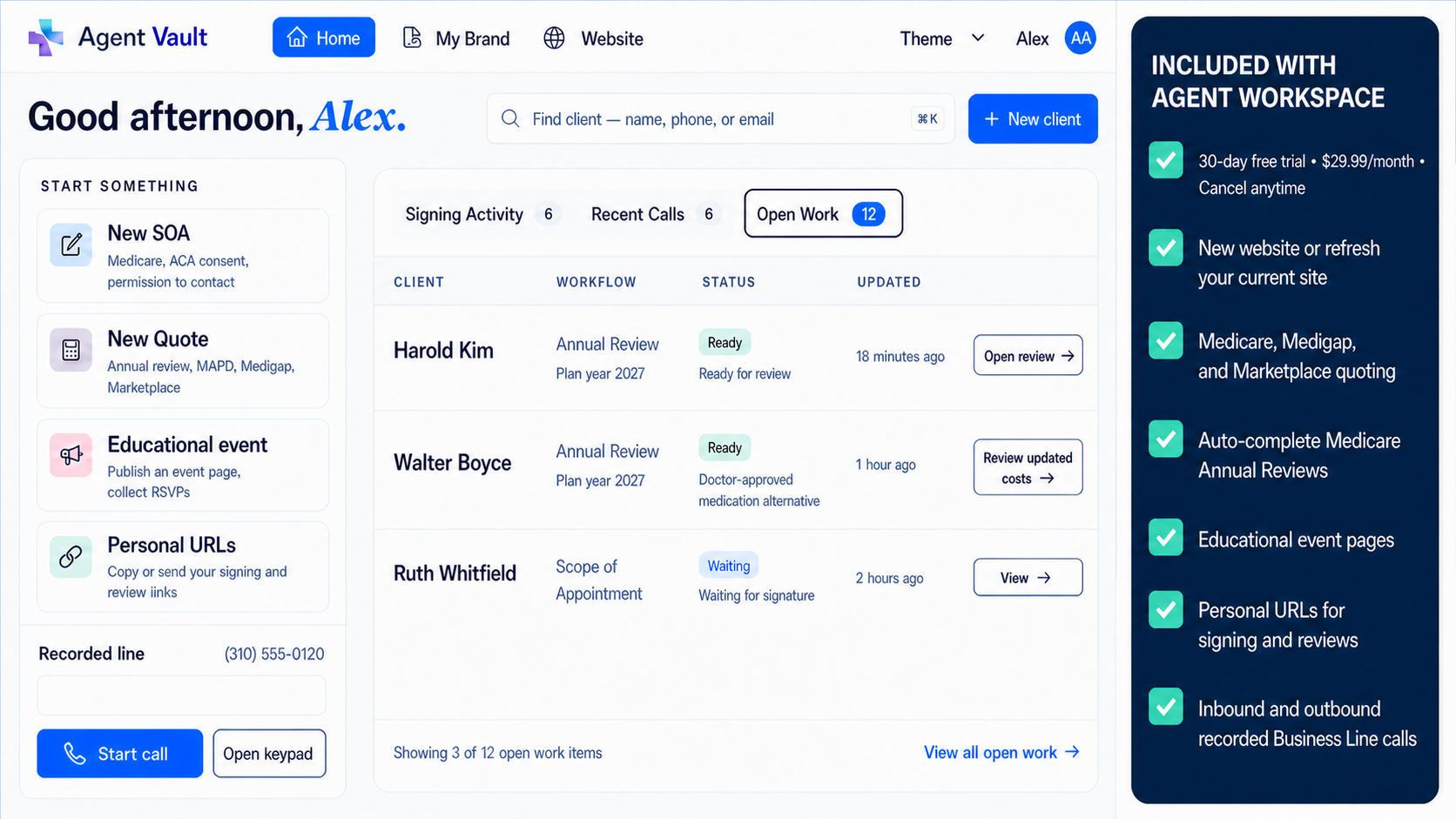
Agent Workspace brings the client CRM, recorded Business Line, electronic SOA, notes, documents, and exportable Vault records into one working account. The call can stay connected to the client and the records created before, during, and after the enrollment handoff.
Business calling is included in Essentials at $29.99/month after a 30-day free trial. Card required at checkout; one trial per NPN.
This article is for educational purposes only and is not legal advice. Agents should review current CMS guidance, approved scripts, carrier rules, state rules, and agency policies, and consult qualified counsel or compliance professionals for specific requirements.
Sources
Frequently Asked Questions
What is the difference between a Medicare marketing call and a Medicare enrollment recording?
A Medicare marketing or sales call is the part of the conversation where the agent discusses plan information, benefits, costs, networks, formularies, or plan options. A Medicare enrollment recording is the part of the call where the beneficiary is completing an enrollment request. CMS says the enrollment portion begins when the beneficiary is advised that they are completing an enrollment request and then provides required enrollment information and attests to intent to enroll.
How long do Medicare marketing and sales call recordings need to be retained?
For CY2027, Medicare marketing and sales calls must be recorded and retained in their entirety for at least six years. The first three years must be retained as audio. For years four through six, the record may be retained as audio or as a complete and accurate transcript.
Do Medicare enrollment recordings still need to be kept for 10 years?
Enrollment records remain separate from the six-year marketing and sales call framework. CMS stated that the CY2027 change maintained the requirement that enrollment records be retained for 10 years, and MA and Part D regulations refer to enrollment and disenrollment records for the current contract period and 10 prior periods.
What if one phone call includes both marketing discussion and enrollment?
Treat it as a mixed record. The marketing or sales portion may fall under the six-year marketing and sales framework, while the enrollment portion should be handled as an enrollment record. A practical workflow is to keep the full recording, note where the enrollment portion begins, and store the recording with the related SOA, enrollment record, and supporting documents.
Can agents use transcripts instead of audio?
For Medicare marketing and sales call records, audio is required for the first three years. During years four through six, CMS allows either audio or a complete and accurate transcript. A transcript should document the full recording and reflect the statements made by the participants as they occurred.
Is a call summary the same as a transcript?
No. A call summary is not the same as a complete and accurate transcript. A summary, short AI recap, or CRM note can help with workflow, but it should not be treated as the required audio record or as a full transcript substitute.
Do independent Medicare agents need to follow the recording rules?
Yes. CMS rejected limiting the recording requirement only to call centers and stated that all sales and marketing calls should be recorded because complaints involve both independent agents and call-center agents.
Can Agent Workspace be used for telephonic enrollment recordkeeping?
Yes, when telephonic enrollment is available through the agent's approved enrollment process. Agent Workspace includes an optional business number for inbound and outbound calling inside the app and can store supported enrollment-related recordings with SOAs, plan documents, ACA records, and supporting sales files. Agents still need to follow their approved scripts, disclosures, carrier procedures, agency policies, and state recording-consent rules.
Medicare and ACA Compliance Expert
Christian Rodgers is a Medicare and ACA compliance expert with over 30 years in the healthcare industry, having worked for some of the largest health plans in the United States. He has provided Medicare sales training to hundreds of agents in California and Florida.
Connect on LinkedIn