State call recording laws and recorded-line workflow for insurance agents

Call recording consent hub

State Call Recording Laws for Insurance Agents: One-Party vs. All-Party Consent

Insurance agents record calls for legitimate reasons: Medicare compliance, ACA consent documentation, telephone SOA workflows, voice signature records, quality assurance, complaint response, and sales-file documentation.

Before recording a call, agents need to understand whether everyone on the call needs to consent, or whether one party's consent is enough. The answer depends on the state, the type of call, where the people are located, and whether other rules apply.

Last reviewed: May 5, 2026. This guide is not legal advice. It is a practical starting point for licensed insurance agents, agencies, FMOs, and call centers.

One-party consentAll-party consentCross-state callsRecorded notice

Quick answer

Use an all-party consent workflow unless your compliance team approves otherwise

A simple national workflow is usually safest: tell everyone at the start of the call that the call is being recorded, get clear consent, and keep that consent statement in the recording.

Federal law generally permits recording when the person recording is a party to the call or one party has given prior consent, unless the recording is for a criminal or tortious purpose. States can impose stricter requirements, and several states require all-party consent for private or confidential calls.

For Medicare agents, state consent law is only one layer. CMS regulations separately require certain Medicare marketing, sales, and enrollment calls to be recorded, including web-based audio. State consent law still matters even when another compliance rule requires recording.

State Practical consent category for insurance calls Agent takeaway
California All-party consent for confidential communications Give a clear recording notice at the start and get consent before continuing.
Florida All-party consent Get all parties prior consent before recording.
Texas One-party consent A participating agent may generally record, but disclosure is still safer for interstate and compliance calls.
New York One-party consent A participating agent may generally record, but use notice for compliance and cross-state calls.
Pennsylvania All-party consent, with narrow business/QC exceptions Do not rely on exceptions for sales or compliance retention without legal review. Get all-party consent.
Massachusetts All-party consent for secret recordings Treat insurance calls as all-party consent calls.
Illinois All-party consent for private conversations recorded surreptitiously Announce the recording and get consent before continuing.
Washington All-party consent for private calls, with a recorded-announcement rule Make the recording announcement and keep the announcement in the recording.

One-party consent

What is one-party consent?

In a one-party consent state, a call participant can generally record the call because at least one party to the conversation has consented. If the agent is on the call and chooses to record, the agent is usually the consenting party.

That does not mean secret recording is always a good business practice. Medicare rules, carrier scripts, agency policies, state-specific privacy rules, complaint-handling procedures, and multi-state calls can still require or strongly support disclosure.
All-party consent

What is all-party consent?

In an all-party consent state, every party to the private or confidential conversation generally needs to consent before the call is recorded.

Many people call these two-party consent states, but all-party consent is more precise. If there are three people on the call, all three may need to consent.

Cross-state warning

Insurance agents often do not know exactly where the consumer is located when the call starts. For interstate business calls, use an all-party consent workflow unless your compliance team has approved a narrower state-specific process.

Scripts

Recommended call-recording script for insurance agents

Use your carrier-approved, agency-approved, and state-approved language when required. A simple starting point is:

Have counsel or your compliance team review state-specific recording language before using it in live Medicare, ACA, carrier, agency, or enrollment workflows.

Before we continue, I need to let you know that this call is being recorded for documentation, quality, and compliance purposes. Do I have your permission to continue on a recorded line?

Wait for a clear yes before continuing.

Once consent is captured, keep it with the file

Store the recording notice and consent statement with the call recording, SOA, ACA consent record, eligibility review documentation, enrollment record, notes, and supporting files.

Keep consent with the recorded-line file

If the consumer refuses to be recorded

Use a non-argumentative refusal workflow:

I understand. I cannot continue this phone workflow on an unrecorded line. We can use another available process, such as an in-person appointment or approved written or electronic workflow, if that is available for this situation.

State-by-state sections

Practical state guidance for recorded insurance calls

Use your approved scripts and have counsel or compliance review state-specific language before relying on any suggested phrasing.

California call recording law for insurance agents

All-party consent for confidential insurance calls

California Penal Code section 632 makes it unlawful to intentionally record a confidential communication without the consent of all parties. Insurance sales and service calls often involve private financial, medical, household, prescription-drug, provider, income, tax-credit, or enrollment information, so a conservative insurance workflow should treat those calls as confidential.

California deserves special attention for agents who sell nationally. Kearney v. Salomon Smith Barney addressed out-of-state recording of calls with California clients and explained that disclosure at the outset of the call can avoid violating section 632.

Agent takeaway

Announce the recording at the start.
Get clear consent from every participant.
Record the consent statement.
Do not continue a recorded phone sales or enrollment workflow if the consumer refuses consent.
Use your carrier, agency, CMS, Marketplace, and privacy-required scripts.

Suggested phrasing

This call is being recorded for documentation, quality, and compliance purposes. Do I have your permission to continue on a recorded line?

Florida call recording law for insurance agents

All-party consent

Florida Statutes section 934.03 provides that it is lawful to intercept a wire, oral, or electronic communication when all parties have given prior consent. The practical rule for ordinary insurance sales and service calls is all-party consent.

Agent takeaway

Do not rely on silent or undisclosed recording.
Use a clear recording notice before discussing plan details, eligibility, enrollment, or personal information.
Get consent before continuing.
Keep the consent statement in the recording.

Suggested phrasing

I'm required to let you know that this call will be recorded. Do I have your consent to continue on a recorded line?

Texas call recording law for insurance agents

One-party consent

Texas is generally a one-party consent state. A person who is a party to a wire, oral, or electronic communication may generally record it unless the recording is made for a criminal or tortious purpose.

Texas may allow one-party recording, but insurance agents often handle interstate calls. Disclosure creates a cleaner Medicare, ACA, carrier, complaint-response, and recordkeeping workflow.

Agent takeaway

One-party consent may be legally sufficient for Texas-only calls.
Use all-party notice anyway for Medicare, ACA, cross-state, and quality-control consistency.
Ask where the consumer is located if state-specific rules matter.
Do not assume Texas law controls every call just because the agent is in Texas.

Suggested phrasing

I record my calls for documentation and compliance. Is it okay if we continue on a recorded line?

New York call recording law for insurance agents

One-party consent

New York is generally a one-party consent state. New York Penal Law sections 250.00 and 250.05 define and prohibit unlawful eavesdropping around recording without the consent of either the sender or receiver.

New York one-party consent does not solve multi-state insurance calls. If a New York agent speaks with a consumer in a stricter state, the stricter state rules may matter.

Agent takeaway

A participating agent may generally record under one-party consent.
Use notice and consent for cross-state calls.
Use your approved Medicare, ACA, carrier, and agency scripts.
Store the recording with the related SOA, ACA consent, application review, or enrollment record.

Suggested phrasing

This call is recorded for documentation and compliance. Do I have your consent to continue?

Pennsylvania call recording law for insurance agents

All-party consent, with narrow business/QC exceptions

Pennsylvania law generally makes it a felony to intentionally intercept, disclose, or use a wire, electronic, or oral communication except as otherwise provided. Its consent exception allows interception where all parties have given prior consent.

Pennsylvania also has a business telephone marketing or customer-service exception for training, quality control, or monitoring when one party has consented, but that exception is risky for Medicare, ACA, sales-file, SOA, enrollment, or long-term compliance retention workflows.

Agent takeaway

Use all-party consent.
Get consent before recording plan discussions, eligibility discussions, ACA consent, SOA workflows, or enrollment calls.
Be cautious about relying on the business/QC exception for compliance recordings.
Do not assume training and quality language is enough if the recording will be stored as a sales or compliance record.

Suggested phrasing

This call will be recorded for documentation and compliance. Do I have your permission to continue on a recorded line?

Massachusetts call recording law for insurance agents

All-party consent for secret recordings

Massachusetts law focuses on secret recording. Its wiretap statute defines interception to include secretly hearing or secretly recording wire or oral communications through an intercepting device unless the person has prior authority from all parties to the communication.

Agent takeaway

Announce the recording before continuing.
Get express consent from all participants.
Keep the consent statement in the recording.
Do not treat Massachusetts as a reasonable-expectation-only state without legal review.
Use your carrier and agency scripts for Medicare, ACA, and other insurance calls.

Suggested phrasing

I need to record this call for documentation and compliance. Do I have your consent to continue on a recorded line?

Illinois call recording law for insurance agents

All-party consent for private conversations recorded surreptitiously

Illinois law is more nuanced than simple two-party charts suggest. It defines private conversation around circumstances where at least one party intended the communication to be private and prohibits surreptitious recording of private conversations without the required consent of all parties.

Agent takeaway

Do not record secretly.
Give a clear notice at the beginning of the call.
Get consent before discussing private insurance, health, prescription, financial, subsidy, or enrollment information.
Keep the consent statement in the recording.

Suggested phrasing

This call is being recorded for documentation and compliance. Do I have your permission to continue?

Washington call recording law for insurance agents

All-party consent for private calls, with recorded-announcement rule

Washington law generally prohibits recording a private telephone communication or private conversation without first obtaining consent of all participants. When all-party consent is needed, consent can be obtained through a reasonably effective announcement that the communication is about to be recorded, and if the conversation is recorded, the announcement must also be recorded.

Agent takeaway

Announce the recording at the start.
Make sure the announcement is captured in the recording.
Get clear consent before continuing.
Do not skip the recorded announcement.
Use the same workflow for phone calls, web-based audio calls, and other private recorded insurance conversations.

Suggested phrasing

This call is now being recorded for documentation and compliance. By continuing, you agree that this call may be recorded. Do I have your permission to continue?

Workflow

Practical call-recording workflow for insurance agents

Step 1

Use a universal all-party consent process

Even if you operate in a one-party state, your prospects and clients may be in stricter states. The simplest workflow is to use the same recording notice on every call.

Step 2

Record the notice and consent

The beginning of the recording should show that the call is being recorded, why it is being recorded, and that the consumer agreed before the substantive discussion.

Step 3

Ask where the consumer is located

For interstate calls, location matters. Ask where the consumer is currently located before moving into plan-specific, enrollment, or private information.

Step 4

Use approved scripts

Call-recording consent is not the only script requirement. Medicare, ACA, carrier, agency, FMO, state insurance, privacy, and enrollment workflows may require additional language.

Step 5

Stop if consent is refused

If a consumer does not consent to recording, follow your approved alternative process. Do not continue a recorded workflow after the consumer refuses consent.

Step 6

Store the recording with the rest of the file

A recording is most useful when it is stored with the related compliance documents, SOAs, ACA records, enrollment records, plan notes, disclosures, and complaint-response notes.

Store the recording with the rest of the file

Scope of Appointment
Telephone SOA or voice signature record
Medicare enrollment record
ACA consumer consent record
ACA eligibility application review documentation
Plan notes
Disclosures used on the call
Enrollment confirmation or application record
Complaint-response notes
Exportable client file

Workflow support

How Business Line + Vault fits in

This page explains the consent-law issue. Business Line + Vault helps with the workflow.

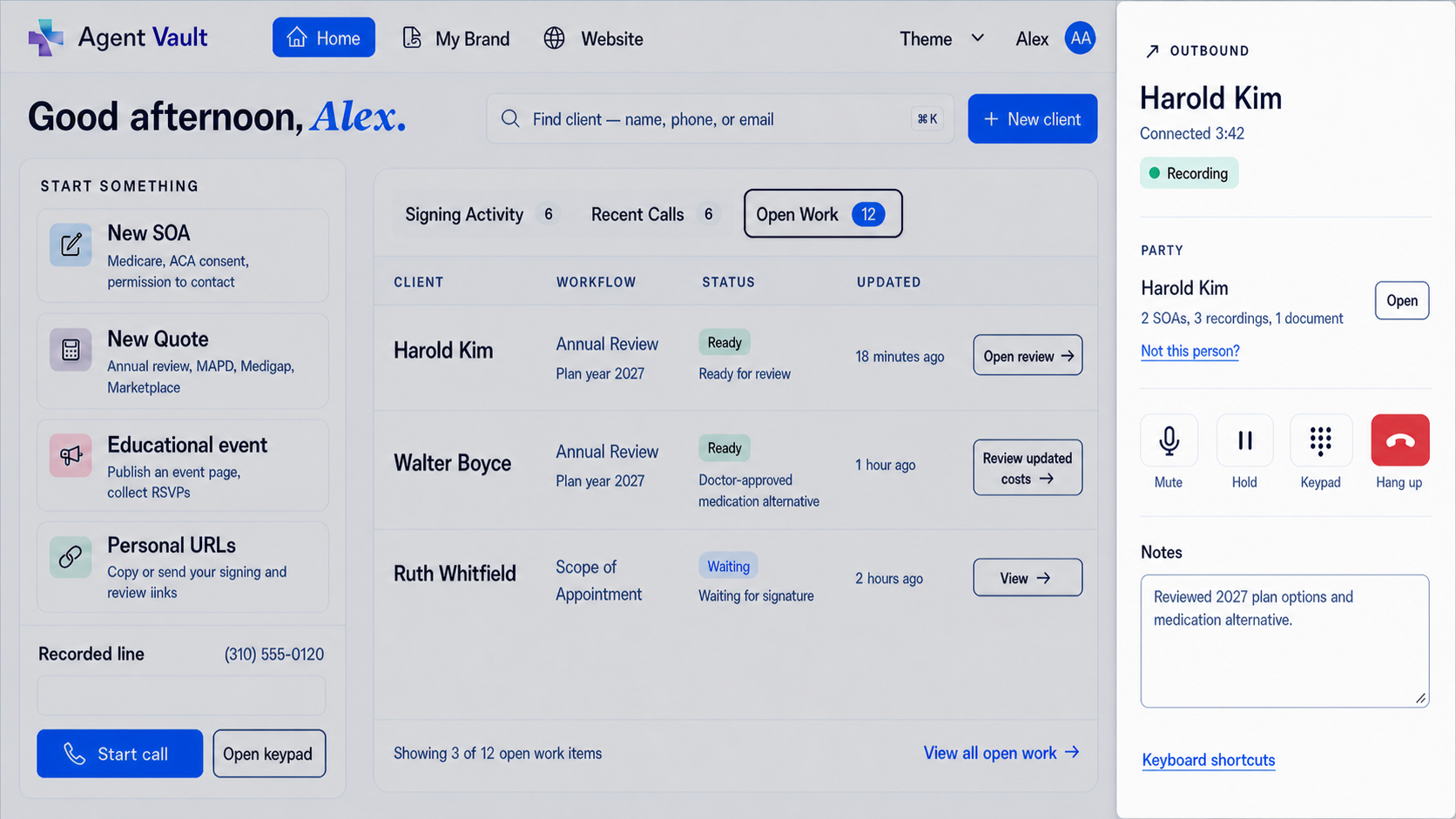
Informed + Choice Business Line + Vault gives licensed Medicare and ACA agents a dedicated recorded business line, automatic call recording, secure vault storage, electronic SOA workflows, telephone SOA and voice signature recordkeeping, ACA consent and eligibility review storage, and exportable records.

Use Business Line + Vault to help keep the call recording, consent statement, SOA, ACA records, enrollment records, and supporting sales documents together.

See Business Line + Vault

No software can guarantee compliance by itself. You remain responsible for using legally appropriate recording notices, obtaining required consent, following state law, using approved scripts, and complying with CMS, Marketplace, carrier, agency, FMO, and privacy requirements.

Bottom line

Assume all-party consent for practical insurance workflows

For insurance agents, the safest practical call-recording rule is: assume all-party consent, disclose the recording at the start, get clear consent, capture the consent in the recording, and store the recording with the related sales and compliance file.

That workflow is especially important when you sell Medicare, ACA, or other insurance products across state lines.

Legal source notes

Primary legal and regulatory sources

Federal law: 18 USC 2511(2)(d) generally permits recording by a party to the communication or with one party's prior consent, unless the recording is for a criminal or tortious purpose. Read 18 USC 2511.

Medicare call recording: 42 CFR 422.2274(g)(2)(ii) and 423.2274(g)(2)(ii) require recording Medicare marketing, sales, and enrollment calls, including audio from web-based technology. MA rule. Part D rule.

California: Penal Code section 632 and Kearney v. Salomon Smith Barney, Inc. (2006) 39 Cal.4th 95.

Florida: Florida Statutes section 934.03(2)(d). Texas: Texas Penal Code section 16.02. New York: New York Penal Law sections 250.00 and 250.05.

Pennsylvania: 18 Pa. Cons. Stat. sections 5703, 5704(4), and 5704(15). Massachusetts: Mass. Gen. Laws chapter 272, section 99.

Illinois: 720 Ill. Comp. Stat. 5/14-1 and 5/14-2. Washington: Wash. Rev. Code section 9.73.030.

FAQ

Frequently asked questions

Can insurance agents record phone calls? +

Yes, but agents must follow applicable federal law, state call-recording consent laws, CMS rules, carrier procedures, agency policies, privacy requirements, and approved scripts. In many cases, the safest workflow is to disclose the recording at the beginning of the call and get consent before continuing.

What is a one-party consent state? +

A one-party consent state generally allows a call participant to record the call if that participant consents. Texas and New York are generally one-party consent states.

What is an all-party consent state? +

An all-party consent state generally requires every participant in a private or confidential conversation to consent before the call is recorded. California, Florida, Pennsylvania, Massachusetts, Illinois, and Washington should generally be treated as all-party consent states for private insurance calls.

Is two-party consent the same as all-party consent? +

People often say two-party consent, but all-party consent is more accurate. If three people are on a private recorded call, all three may need to consent.

Can I record insurance calls in California? +

Treat California as an all-party consent state for confidential insurance calls. Give a clear recording notice at the beginning of the call and get consent before continuing.

Can I record insurance calls in Florida? +

Treat Florida as an all-party consent state. Get prior consent from all parties before recording a private insurance call.

Can I record insurance calls in Texas? +

Texas is generally a one-party consent state, meaning a participating agent may generally record a call. However, agents should still disclose recording for compliance consistency and cross-state calls.

Can I record insurance calls in New York? +

New York is generally a one-party consent state. A participating agent may generally record, but disclosure is still recommended for Medicare, ACA, carrier, agency, and cross-state workflows.

Can I record insurance calls in Pennsylvania? +

Treat Pennsylvania as an all-party consent state for insurance calls. Pennsylvania has narrow business-related exceptions, but agents should not rely on those exceptions for sales or long-term compliance recordkeeping without legal review.

Can I record insurance calls in Massachusetts? +

Treat Massachusetts as an all-party consent state. Do not secretly record insurance calls. Get consent from all parties before recording.

Can I record insurance calls in Illinois? +

Treat Illinois as an all-party consent state for private insurance calls. Announce the recording and get consent before continuing.

Can I record insurance calls in Washington? +

Treat Washington as an all-party consent state. Washington law specifically provides that when a recorded announcement is used to obtain consent, the announcement itself should also be recorded.

What if the agent and client are in different states? +

Use the stricter consent rule unless your compliance team or legal counsel has approved a different workflow. Interstate calls can create choice-of-law issues, and some states have a strong interest in protecting residents from undisclosed recording.

Do Medicare call recording requirements override state consent laws? +

No. Medicare rules may require certain calls to be recorded, but agents still need to follow applicable state recording-consent laws, required notices, carrier procedures, and agency policies.

What should I do if the consumer refuses to be recorded? +

Do not continue the recorded phone workflow. Follow your approved alternative process, such as an in-person appointment, written workflow, electronic process, or other carrier-approved option.

Does Business Line + Vault guarantee compliance with state call recording laws? +

No. Business Line + Vault provides recorded-line and recordkeeping infrastructure. Agents remain responsible for using proper notices, obtaining required consent, following applicable state laws, and complying with CMS, Marketplace, carrier, agency, and privacy requirements.

Use a recorded-line workflow that keeps consent with the file

Business Line + Vault helps agents keep call recordings, consent statements, SOAs, ACA records, enrollment records, and supporting sales documents together.

Medicare call recording requirements | ACA consent documentation and recordkeeping | Telephone Scope of Appointment | SOA Vault | Medicare agent tools

See Business Line + Vault