
Under the CMS 2027 final rule, TPMOs no longer have to give the disclaimer within the first minute of a sales call. Instead, the disclaimer must be verbally conveyed before any discussion of benefits. CMS also explained that basic demographic intake can happen first, that a mere passing mention of a benefit is not necessarily a “discussion of benefits,” and that the disclaimer is not expected if the call never gets to benefits at all.
Updated July 17, 2026
This guide was rechecked against the current Part C and Part D TPMO disclaimer regulations, the CMS final-rule explanation of residence-based counts, and the CY 2027 final rule. The MA-PD and mixed-material examples below are operational guidance, not a CMS-published counting algorithm; confirm them against carrier and FMO instructions.
For a lot of agents, this is one of the most welcome compliance changes in the 2027 Medicare rule.
The old standard forced the TPMO disclaimer into the first minute of a sales call, even when the first part of the conversation was just basic intake: confirming who the beneficiary is, figuring out where they live, checking whether there is a valid election period, and deciding whether the call is even going to turn into a real plan discussion. CMS agreed that this was awkward and not always helpful, so it changed the timing rule. The new marketing and communications policies in the final rule apply to contract year 2027 marketing beginning October 1, 2026.
The practical takeaway is simple:
Not before hello. Not after benefits.
That is the new lane.
What changed in the 2027 rule
CMS revised the TPMO disclaimer timing rule in 42 C.F.R. sections 422.2267(e)(41)(ii) and 423.2267(e)(41)(ii). The new rule says the disclaimer must be verbally conveyed during sales calls prior to the discussion of any benefits. Before this change, the rule required the disclaimer within the first minute of the call. CMS also removed SHIPs from the standardized disclaimer language and kept the Medicare.gov / 1-800-MEDICARE referral language.
That matters because CMS did more than move the disclaimer later in the call. It also explained why. CMS said many calls begin with demographic questions, and sometimes those early questions show that the conversation should not proceed to benefits at all. CMS even gave the example that the caller may not have a valid election period, which could end the call before any benefit discussion happens. In those situations, forcing the disclaimer into the first minute did not necessarily improve clarity for the beneficiary.
The practical rule for agents
Here is the cleanest way to think about it:
You can still open the call normally. You can verify basic information. You can figure out whether the person is even in a position to talk about plan options. But once you move into specific benefit discussion intended to influence plan choice, the disclaimer should already have been given.
That means the new rule gives agents a little more room to run a real conversation at the front end of the call. It does not give you room to push the disclaimer until after you are already comparing dental, copays, out-of-pocket exposure, or other plan features in a way that can influence the beneficiary’s decision.
What counts as a “discussion of benefits”?
This is the part CMS made more useful.
CMS said a mere mention of a benefit does not automatically count as a discussion of benefits. The example CMS gave was pointing out that nearly all Medicare Advantage organizations offer routine dental care. That alone is not the line-crossing moment.
What does move you into benefits discussion is talking about the specificity of benefits in a way that draws the beneficiary’s attention to a plan, influences plan selection, or influences the decision to stay enrolled. CMS said that can include discussing benefits listed in a plan’s Evidence of Coverage or explaining how out-of-pocket cost sharing would work given the plan structure and the beneficiary’s needs or health care experience. CMS also said this concept can align with the regulatory definition of marketing.
That is the real operational line.
If you are still figuring out the basics, you are probably not there yet.
If you are getting specific about how this plan works for this person, you are there.
What if the call never gets to benefits?
This is another practical point that agents should not miss.
CMS said that if there is no discussion of benefits, CMS would not expect TPMOs to provide the disclaimer to beneficiaries. That is a meaningful statement for real-world call handling. If the call ends during basic screening or never progresses into plan-benefit discussion, the verbal disclaimer timing trigger never really arrives.
That does not mean the disclaimer requirement disappeared in other formats. CMS made clear it did not change the other existing disclaimer requirements for websites, email, online chat, other electronic communications, and marketing materials. Those requirements still stand.
What you actually have to say
The exact standardized content depends on whether the TPMO sells for all MA organizations or Part D sponsors in the service area, or only some of them.
If you do not sell every plan available in the area, the required disclaimer starts with the now-familiar statement that “We do not offer every plan available in your area” and then requires you to disclose how many organizations and products you represent, followed by the direction to contact Medicare.gov or 1-800-MEDICARE for information on all options.
If you do sell for all MA organizations or all Part D sponsors in the service area, the standardized version instead says you currently represent a stated number of organizations offering a stated number of products in the area, and it tells the beneficiary they can always contact Medicare.gov or 1-800-MEDICARE for help with plan choices.
The important point for agents is not just memorizing the opening line. It is making sure the counts are accurate and the correct version is used for the applicable service area and line of business.
How to count organizations and products in the 2027 TPMO disclaimer
The count is based on what you represent where the beneficiary resides, not everything your agency represents nationally. CMS explained this with an example: a TPMO represents 10 organizations nationwide, but only three serve the beneficiary’s residence, and those three make eight products available there. The disclosure is therefore three organizations and eight products.
The first number is the count of represented MA organizations or Part D sponsors serving that residence. The second is the total count of their available plan products. One organization with five distinct local plans is ordinarily one organization and five products.
| Plan or entity | How to treat it |
|---|---|
| Stand-alone PDP | Count it as a Part D product when it is available through a Part D sponsor you represent in the beneficiary’s area. |
| MA-PD plan | The defensible operational treatment is one integrated plan product, not one MA product plus a second stand-alone PDP. Confirm the treatment with the carrier or FMO. |
| MA-only plan | Count each actual MA plan product you are authorized to offer in the applicable service area. |
| HMO, PPO, PFFS, D-SNP, or C-SNP | Count distinct sellable plans, not plan-type labels. Include a plan only when it is on the approved local roster and you are authorized to offer it. |
| Medigap or Medicare Supplement | Do not include it. These TPMO count provisions govern Medicare Advantage and Part D, not policies that supplement Original Medicare. |
| Unavailable local plan | Do not count it when the organization or plan does not serve the beneficiary’s residence. |
| Parent company or consumer brand | Do not deduplicate by logo or guess. Use the official MA organization or Part D sponsor roster supplied or approved by the carrier or FMO. |
CMS has not published a complete algorithm for every parent-company, affiliate, and mixed-product arrangement. That is why the count source should be an approved plan roster, not a spreadsheet built from brand names on public websites.
MA-only, Part D-only, and mixed communications
The regulations create parallel triggers. The Part C disclaimer applies when a TPMO sells plans for more than one MA organization. The Part D disclaimer applies when a TPMO sells plans for more than one Part D sponsor.
For an MA-only communication, use represented MA organizations and MA products. For a PDP-only communication, use represented Part D sponsors and PDP products. For a mixed MA and Part D website, call, or marketing asset, use the consolidated method approved by the applicable carriers or FMO. Do not invent your own rule for whether affiliated MA organizations and Part D sponsors collapse into one entity.
Worked example: three organizations and six products
Assume the approved roster for the beneficiary’s county shows:
- Organization A: two MA-PD plans and one MA-only plan;
- Organization B: one D-SNP;
- Part D Sponsor C: two stand-alone PDPs; and
- Medigap Carrier D: three Medicare Supplement policies.
For a carrier-approved combined MA and Part D disclosure, the ordinary operational result is three organizations and six products. The three Medigap policies are excluded. That result assumes the approved count source treats A, B, and C as three distinct sponsoring organizations.
Multicounty and multistate websites
A national total is not a substitute for the beneficiary-area count CMS described. A multistate website needs a documented, carrier- or FMO-approved location method that can present accurate counts for the applicable residence or service area. When residence is not yet known, collect enough location information to select the right approved count before moving into plan-specific benefit discussion. Do not guess.
The operational owner of the count table should also record the source roster, plan year, service area, effective date, last review date, and carrier or FMO approval. Annual plan changes, service-area changes, and contract changes should trigger a fresh review.
Use the 2027 Medicare Advantage county lookup to investigate local market changes. Its total listings are not your represented organization or product counts; use the approved roster for the disclaimer.
Where the TPMO disclaimer belongs
Do not calculate visibility from event type alone. For a qualifying TPMO, the rule depends on TPMO status, the MA or Part D organization threshold, product scope, residence or service area, channel, and whether the material is marketing.
| Touchpoint | TPMO treatment |
|---|---|
| Sales call | Convey it verbally before discussing benefits. If the call never reaches benefit discussion, CMS said it would not expect the oral disclaimer on that call. |
| Email, online chat, or other direct electronic communication | Convey it electronically. The regulation is not limited to messages labeled as marketing. |
| TPMO website or event landing page | Display it prominently. Calling an event educational does not remove the website requirement. |
| Social media | Include it when the post is marketing material. Document and obtain carrier approval for a genuinely general educational communication. |
| Educational print flyer | A genuinely educational communication is not automatically TPMO marketing material. It still needs the special-needs accommodations content; include the TPMO disclaimer if the piece is marketing or the carrier requires it. |
| Marketing-event flyer or presentation | Include it when the material is developed, used, or distributed by a qualifying TPMO and is marketing. |
| Live educational presentation | There is no separate duty to recite it merely because an educational event is occurring. The presentation should not become plan-benefit marketing. |
The separate CMS 2027 final-rule workflow guide explains what agents may and may not do at an educational event, including SOAs, applications, same-location transitions, and the event accommodations notice.
A call flow that actually works
A lot of agents do better when the rule is turned into workflow. The clean version looks like this:
Start the call and confirm the basics.
Figure out who you are speaking with and what kind of help they need.
Confirm the basic facts that tell you whether the conversation should continue.
Then, before you begin discussing specific plan benefits in a way that could influence plan choice, give the TPMO disclaimer.
Only after that should the call move into real benefits discussion.
That is why this change is helpful. It matches the way actual sales calls work without removing the disclosure itself. CMS expressly said the revised timing should fit better with the flow of the conversation and promote clearer communication with beneficiaries.
The biggest mistake agents should avoid
The mistake is reading “before benefits” as if it means “whenever I get around to it.”
It does not.
The new rule is more practical than the first-minute rule, but it is still a hard timing requirement. If you are already in the weeds on plan-specific cost sharing, Evidence of Coverage details, or other benefit specifics designed to help the person choose a plan, the disclaimer should have already been delivered.
The second mistake is assuming this change only matters for phone calls. It matters for phone scripts, yes, but it should also push agents and agencies to review their website disclaimer placement, chat flows, email language, and other marketing materials, because CMS left those other disclaimer requirements in place.
Why this change is actually better
This is one of the rare compliance changes that really does make everyday selling more sensible.
Commenters told CMS that the first minute was not the most effective place for the disclaimer. CMS agreed, finalized the timing change, and said the revised approach should improve communication and reduce confusion while preserving the disclosure’s purpose. In other words, the disclaimer still exists for a reason, but now it can be given at the point where it actually makes more sense to the beneficiary.
For agents, that means the goal should not be to hide from the disclaimer. The goal should be to build it into a cleaner script and a cleaner workflow.
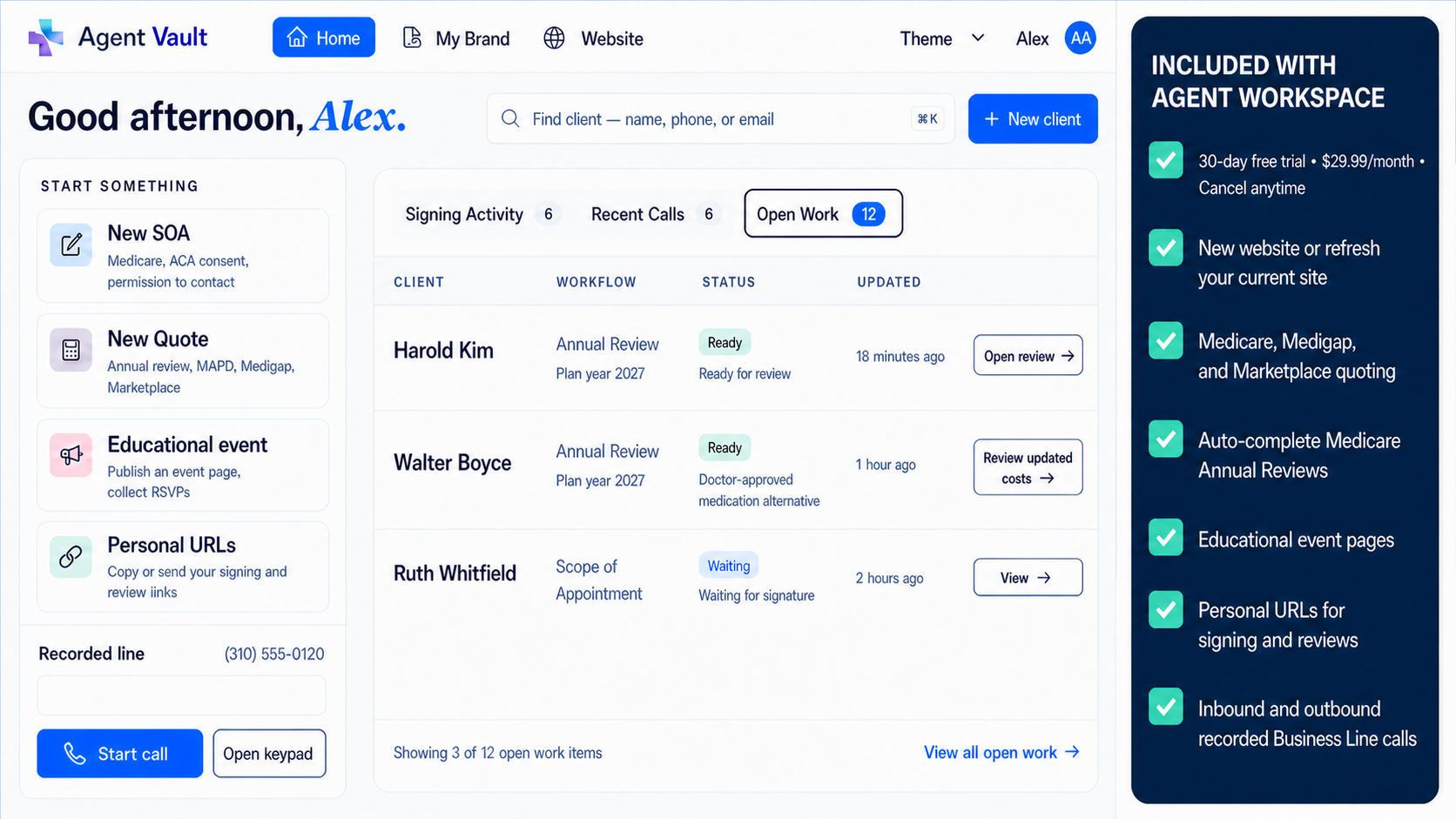
Disclaimer workflow inside Agent Workspace
Use the approved script, then keep the call and client record together.
Agent Workspace includes an optional business number for calls made and answered inside the app. Where recording is permitted, the call can stay connected to the client, SOA, notes, plan quotes, uploads, and long-term Vault records.
Build the disclaimer timing and carrier- or FMO-approved counts into your scripts and procedures before the call. The Workspace helps preserve the record; it does not decide when the disclaimer is required or validate the language or counts for a beneficiary’s service area.
Business calling is included in Essentials at $29.99/month after a 30-day free trial. Card required at checkout; one trial per NPN. Agent Workspace supports recordkeeping; it does not replace CMS rules, approved disclaimer language and count sources, carrier or FMO procedures, state recording-consent law, or agency review.
Bottom line
CMS did not eliminate the TPMO disclaimer. It changed when you have to say it.
For 2027 Medicare marketing, the rule is no longer “within the first minute.” The rule is before discussing benefits. CMS also made clear that basic demographic intake can happen first, that a passing mention of a common benefit is not automatically a benefits discussion, and that if the call never gets to benefits, CMS would not expect the verbal disclaimer at all.
That is the practical read agents can use right now: update the call script, update the counts in the disclaimer, make sure your website and other materials still carry the required language, and make sure your documentation process is clean enough that your sales activity is easy to support later.
If your team is tightening up scripts and call handling for the 2027 season, that is also a good time to get your SOAs and other compliance records out of scattered folders and into one place. A cleaner disclosure workflow works better when the agent compliance vault is clean too.
This article is for educational purposes only and is not legal advice. Agents should review current CMS guidance, carrier rules, and agency policies, and consult qualified counsel or compliance professionals for specific requirements.
Sources
- 42 CFR 422.2267 - Required materials and content : eCFR Accessed 2026-07-17.
- 42 CFR 423.2267 - Required materials and content : eCFR Accessed 2026-07-17.
- Contract Year 2024 Medicare Advantage and Part D Final Rule : Federal Register via GovInfo Accessed 2026-07-17.
- Medicare Program; Contract Year 2027 Final Rule : Federal Register Accessed 2026-07-17.
- 2027 Agent and Broker Training and Testing Guidelines : CMS Accessed 2026-07-17.
Frequently Asked Questions
Does the TPMO disclaimer still have to be given in the first minute of a call?
No. CMS changed the rule for 2027 Medicare marketing. The verbal TPMO disclaimer now must be given before any discussion of benefits, not within the first minute of the sales call.
Can I collect demographic information before I give the disclaimer?
Yes. CMS explained that many calls begin with basic demographic intake and that some calls may end before benefit discussion even begins. The disclaimer must still come before benefits discussion.
What counts as a discussion of benefits?
CMS said a mere mention of a benefit is not necessarily a discussion of benefits. The line is crossed when you begin discussing specific plan benefits in a way that can influence plan choice, such as Evidence of Coverage details or out-of-pocket cost sharing.
If the call never gets to benefits, do I still have to say the disclaimer?
CMS said that if there is no discussion of benefits, it would not expect TPMOs to provide the disclaimer to beneficiaries on that call.
Does this change affect websites, email, or online chat?
The call-timing rule changed, but the other disclaimer requirements remain. CMS still requires the disclaimer to be conveyed electronically in applicable communications, displayed on TPMO websites, and included in marketing materials.
Does a stand-alone PDP count in the TPMO disclaimer?
Yes. A stand-alone Prescription Drug Plan is a Part D product. For a Part D communication, count the represented Part D sponsors and PDP products available where the beneficiary resides.
Does an MA-PD plan count as one plan or two?
The defensible operational treatment is to count an MA-PD plan once because it delivers Parts A, B, and D through one integrated plan product. CMS has not published a complete TPMO counting algorithm for every mixed-product scenario, so use a carrier- or FMO-approved roster and method.
Do Medicare Supplement or Medigap plans count?
No. The TPMO disclaimer provisions discussed here apply to Medicare Advantage and Part D. Medigap policies supplement Original Medicare and should not be included in these MA and Part D organization or product counts.
What does "organization" mean in the TPMO disclaimer?
Use the official MA organization or Part D sponsor shown in the carrier- or FMO-approved roster, not a guess based on a parent company, consumer brand, or logo. CMS has not published a universal affiliated-entity deduplication algorithm.
Do I count every carrier plan nationally or only plans in the beneficiary's area?
Count only represented organizations and their products available where the beneficiary resides. Do not use everything the agency represents nationally when some organizations or plans do not serve that residence.
How should a multistate Medicare website display TPMO counts?
Use a documented, carrier- or FMO-approved location-based implementation that can present accurate counts for the applicable service area. Do not substitute a national aggregate or an invented affiliated-company rule for residence-specific counts.
Does the TPMO disclaimer have to appear in an educational-event email or flyer?
Event classification alone does not switch the TPMO rule on or off. A qualifying TPMO must convey it in direct electronic communications. A genuinely educational print flyer is not automatically TPMO marketing material, but it needs the event accommodations content and should include the TPMO disclaimer if it is marketing or the carrier requires it.
What should an agent do when the beneficiary's service area is not yet known?
Identify and document the beneficiary's residence before using a location-specific count or beginning plan-specific benefit discussion. Use the implementation approved by the applicable carriers or FMO rather than guessing at the numbers.
Medicare and ACA Compliance Expert
Christian Rodgers is a Medicare and ACA compliance expert with over 30 years in the healthcare industry, having worked for some of the largest health plans in the United States. He has provided Medicare sales training to hundreds of agents in California and Florida.
Connect on LinkedIn