
For CY 2027, an in-person Medicare Advantage or Part D personal marketing appointment requires a written Scope of Appointment before the plan-specific discussion begins. “Written” does not necessarily mean a paper CMS form. This guide explains which paper, electronic, online, and beneficiary-request records can work, which records are not enough, and how to handle walk-ins and same-day appointments.
| Record or situation | Likely treatment | Agent action |
|---|---|---|
| Signed paper SOA | Written record | Complete it before the personal marketing discussion |
| Signed electronic SOA | Written electronic record | Complete and retain it before the discussion |
| Online request identifying product type | May constitute the required written scope record | Confirm the required information and retain the request |
| Business Reply Card identifying product type | May function as the SOA record | Preserve the actual written request |
| Verbal agreement only at an in-person meeting | Not the written documentation required for the appointment | Obtain a written SOA first |
| Recorded scheduling call only | Does not replace the written requirement for the later in-person appointment | Obtain a written record before the face-to-face discussion |
The operative Medicare Advantage rule is 42 C.F.R. § 422.2264(c)(3)(i); Part D uses the parallel rule at 42 C.F.R. § 423.2264(c)(3)(i). Both require the scope to be agreed upon and recorded before the personal marketing appointment and require a written SOA for an in-person appointment.
Product type still matters. A Medicare Supplement-only meeting is different from an MA, MAPD, or Part D personal marketing appointment. For that distinction, see whether an SOA is required for Medigap.
What changed in 2027 and what did not
The biggest operational change is timing.
CMS finalized the removal of the 48-hour waiting period. That means agents no longer have to wait two days after getting the SOA to hold the personal marketing appointment. CMS said the SOA still has to be agreed upon and recorded before the appointment, but there is no longer a fixed 48-hour delay. CMS also removed the old walk-in exception because the whole 48-hour rule went away.
What did not change is the face-to-face writing requirement.
CMS was explicit that for an in-person personal marketing appointment, the SOA must be in writing. So 2027 made same-day meetings easier, but it did not turn face-to-face SOAs into something you can handle only with a verbal okay or a note to file after the fact.
What counts as “written” in plain English
The cleanest way to think about it is that “written” is broader than just a clipboard form, but narrower than “anything I can reconstruct later.”
In the CY 2027 final rule, 91 Fed. Reg. 17384, 17456-17457 (Apr. 6, 2026), CMS said plans may use online forms with check boxes or other beneficiary requests that identify the product types to be discussed. CMS also clarified that Business Reply Cards, online forms, and other requests for information containing the product scope are, in effect, SOAs, and that the agency does not provide a model SOA document.
So in practice, these are the strongest examples of what can count for an in-person appointment:
A paper SOA completed before the meeting.
A written electronic form completed on a tablet, website, or device before the meeting.
A written online request that identifies the product scope, such as MA, MA-PD, or PDP, before the in-person appointment happens.
A Business Reply Card or other written request for information that includes the product type to be discussed.
That last point matters because many agents think “written” means “wet ink on a CMS form.” CMS does not say that. The rule is about the written documentation of scope, not about one mandatory government template.
What has to be on the SOA
This is where agents often overcomplicate things.
CMS said the SOA must include, at minimum, the type of product(s) to be discussed. CMS gave non-exhaustive examples such as Medicare Advantage plans, MA-PD plans, and standalone PDPs. As a best practice, CMS also encouraged including other useful information like the appointment date and the beneficiary’s contact information.
That means the key compliance question is not “Did I use the prettiest form?” It is “Does this written record actually show what the beneficiary agreed to discuss?”
If it does not identify the product scope, it is weak.
If it does identify the product scope, it is much closer to what CMS is looking for.
What does not work well for in-person appointments
This is the practical part.
If the appointment is face to face, relying only on a recorded scheduling call or a verbal “sure, come on by” is not the clean answer. CMS specifically paired audio, audio-visual, and similar records with appointments that do not occur in person, while separately adding the writing requirement for in-person personal marketing appointments. That is the clearest signal that an in-person appointment should have actual written scope documentation, not just an agent’s memory of the conversation.
That does not mean you need to turn every living-room appointment into a paperwork ceremony.
It means that before you get into individualized plan discussion, you should have a written record showing what the beneficiary agreed to discuss.
What about walk-ins and same-day appointments?
This is one of the most useful 2027 changes.
CMS removed the fixed waiting period and clarified that SOAs are required for all appointments that meet the definition of personal marketing appointments, regardless of who initiated them. That includes beneficiary-initiated inbound contact such as walk-ins, unscheduled calls, web-based chats, and web-based forms when the discussion is tailored to an individual or small group for marketing topics.
So a walk-in does not mean “no SOA.”
It means you can now get the SOA and hold the appointment without a fixed 48-hour wait, but if the appointment is in person, that SOA still needs to be in writing before the personalized marketing discussion begins. The separate 48-hour SOA rule guide covers effective dates, same-day timing, and walk-in examples in detail.
That is a much more usable rule for agents. Same-day is easier. Face-to-face is still written.
Does the same written SOA cover more than one in-person visit?
Within the agreed product scope, a signed written SOA can support more than one in-person contact. But how long an SOA stays valid, and when a new one is required, are general SOA-timing questions rather than in-person-specific ones. For the full rule, see how long a Scope of Appointment is valid, and for the specific plan-year boundary, see whether a 2026 SOA covers a 2027 plan discussion.
Where can you collect the written SOA?
Under the 2027 changes, agents can collect a written SOA in more places, including educational events — useful because you can leave an event with a written SOA already in hand for a later one-on-one appointment. The educational-event specifics are their own topic; see whether you can collect an SOA at an educational event.
Why this matters operationally
This is one of those rules that looks small on paper but has a big workflow effect.
Once the 48-hour delay is gone, agents can move faster. But faster only helps if the documentation is still clean. If your in-person SOAs live in random PDFs, screenshots, email threads, texted photos, and desk drawers, the 2027 flexibility can actually make your process messier unless you standardize how you capture and store the writing. The rule got more convenient. Your recordkeeping still needs to keep up.
That is why the practical takeaway is not “get more formal.” It is “get more organized.”
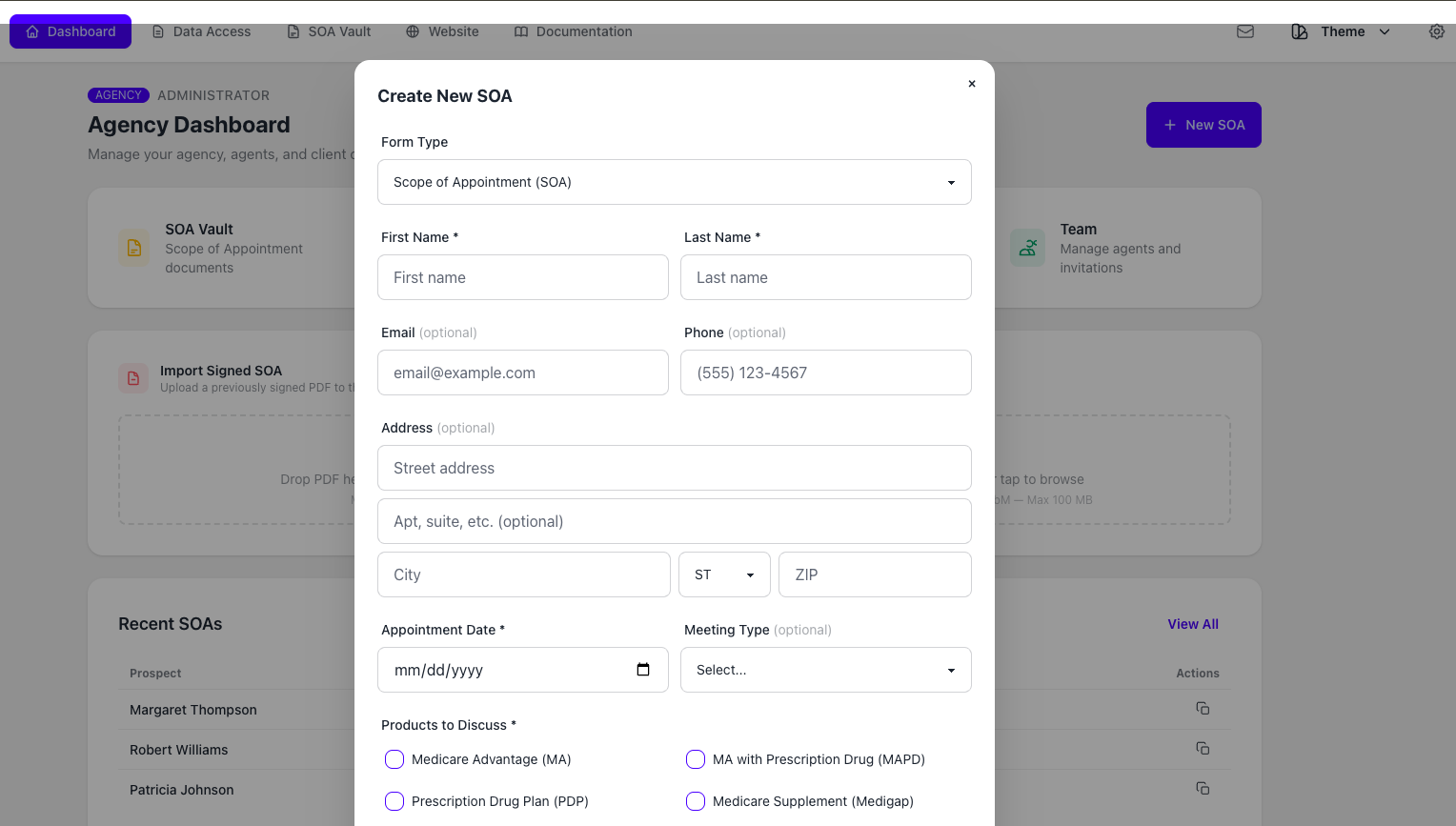
Written SOA signing and records
Send, sign, track, and retrieve written SOAs with SOA Vault.
Create a branded SOA, send a private signing link, track completion, and retrieve the completed record. Use the focused SOA workflow when that is the record you need to keep.
Electronic SOA is $9.99/month with no introductory trial. Choose it when you only need electronic Medicare Scope of Appointment links, signatures, status tracking, and completed-record storage and retrieval.
For a walk-in or same-day appointment, complete the applicable written SOA before the in-person personal marketing discussion begins.
Electronic SOA is $9.99/month, with first payment due at secure checkout and no introductory trial. Essentials is $29.99/month after a 30-day free trial. Card required at checkout; one trial per NPN. The software supports SOA creation, signing, storage, retrieval, and export; it does not determine whether an SOA is required or replace CMS, carrier, FMO, agency, or state procedures.
Bottom line
For 2027, Medicare SOAs for in-person personal marketing appointments still have to be written. CMS relaxed the timing rule by removing the 48-hour waiting period, but it kept the face-to-face writing requirement and made clear that non-in-person appointments can be documented differently.
So if you are sitting across from a beneficiary, the right question is not whether you need an SOA. You do. The right question is whether you have a written record, created before the appointment, that shows the agreed scope and at least the type of product(s) to be discussed. If you do, you are much closer to the rule than agents who rely on memory, a verbal okay, or loose notes after the fact.
And if you are trying to make same-day face-to-face appointments easier in 2027, a clean written SOA workflow is one of the simplest ways to do it.
This article is for educational purposes only and is not legal advice. Agents should review current CMS guidance, carrier rules, and agency policies, and consult qualified counsel or compliance professionals for specific requirements.
Sources
- eCFR, 42 CFR 422.2264(c)(3)(i) : Electronic Code of Federal Regulations Accessed 2026-07-13.
- eCFR, 42 CFR 423.2264(c)(3)(i) : Electronic Code of Federal Regulations Accessed 2026-07-13.
- Federal Register, 91 FR 17384 : Contract Year 2027 Medicare Advantage and Part D final rule Accessed 2026-07-13.
Frequently Asked Questions
Does a written SOA have to be paper?
No. Written does not have to mean paper. A properly completed electronic Scope of Appointment or online Scope of Appointment can create a written record. Agents should still follow current CMS rules, carrier procedures, FMO instructions, and agency policies.
Can I still do a same-day in-person Medicare appointment in 2027?
Yes. CMS eliminated the 48-hour waiting period, so a same-day appointment is allowed. But for an in-person personal marketing appointment, the SOA still needs to be in writing before the discussion begins.
Do walk-ins still need an SOA?
Yes. CMS clarified that SOAs are still required for personal marketing appointments, including walk-ins, as long as the contact is tailored to an individual or small group for marketing topics.
What has to be on the SOA?
At minimum, the SOA needs to identify the type of product or products to be discussed, such as Medicare Advantage, MA-PD, or standalone PDP.
Can one written SOA cover more than one in-person appointment?
Yes. Within the agreed product scope, a signed SOA can support multiple in-person or telephonic contacts during its validity window. Discussing a new product or a new plan year requires a new SOA. See our guide on how long a Scope of Appointment is valid for the full timing rule.
Is a Business Reply Card a valid written SOA?
It can be. CMS treats Business Reply Cards, online forms, and other written requests that identify the type of products to be discussed as SOAs, as long as the product scope is documented in writing before the in-person discussion begins.
Medicare and ACA Compliance Expert
Christian Rodgers is a Medicare and ACA compliance expert with over 30 years in the healthcare industry, having worked for some of the largest health plans in the United States. He has provided Medicare sales training to hundreds of agents in California and Florida.
Connect on LinkedIn