
Reviewed October 7, 2026 | For 2027 Medicare coverage
Yes. Medicare’s insulin cost-sharing protection continues in 2027. A one-month supply of each covered insulin product costs no more than $35, and the deductible does not apply to that covered insulin. Under Part D, the required limit can be lower than $35.
For agents, the useful question is what a particular client will pay for the insulin they actually use. That requires checking the exact product, coverage pathway, plan, pharmacy, and days’ supply.
A 25% coinsurance entry deserves a closer look. It can describe a valid benefit calculation. Verify the resulting dollar amount and the applicable insulin limit before giving the client a cost estimate. Federal Register final rule discussion
What changes for Medicare insulin users in 2027?
The central insulin protection continues, while two general Part D amounts increase:
| Part D amount | 2026 | 2027 |
|---|---|---|
| Maximum standard annual deductible | $615 | $700 |
| Annual out-of-pocket threshold | $2,100 | $2,400 |
CMS finalized these amounts in its 2027 Rate Announcement, Attachment V, Table V-2, printed page 95. Individual plans may have a lower deductible. CMS 2027 Rate Announcement
The higher deductible does not make covered insulin subject to a deductible. The insulin exemption continues under 42 C.F.R. § 423.120(h)(1). eCFR insulin requirements
There is also an insulin-specific change involving NovoLog and Fiasp: their Medicare negotiated-price-program status changes on January 1, 2027. Agents should recheck their 2027 coverage and prices, as explained below. CMS selected drugs and deselection determinations
What is the Part D insulin cost-sharing rule for 2027?
For a covered insulin product under a standalone prescription drug plan or Medicare Advantage plan with Part D coverage, the applicable limit before the annual out-of-pocket threshold is the lowest of:
- $35;
- 25% of the Medicare maximum fair price, when a maximum fair price applies to that insulin for the year; or
- 25% of the plan’s negotiated price for the covered insulin product.
This formula applies for 2026 and each subsequent year, including 2027. The maximum fair price is a price established through Medicare’s negotiation program. The plan’s negotiated price is a separate figure; neither should be replaced with an assumed retail list price. 42 C.F.R. § 423.100
Why 25% coinsurance does not necessarily mean a problem
CMS permits plans to use coinsurance or copayments within the insulin limit. A higher tier charge cannot override the limit, and the plan must honor a lower applicable tier benefit. Federal Register final rule discussion
These are hypothetical examples for a covered one-month Part D fill before the annual threshold. They assume no applicable maximum fair price, Extra Help, or other lower benefit unless stated:
| Example | Calculation | Maximum member cost in this example |
|---|---|---|
| Negotiated price is $100; plan uses 25% coinsurance | 25% × $100 = $25 | $25 |
| Negotiated price is $240; plan uses 25% coinsurance | 25% × $240 = $60; the $35 ceiling controls | $35 |
| Negotiated price is $100; plan provides a $15 copay | $15 is below both $35 and 25% of $100 | $15 |
The practical question is: What is the client’s final cost for this covered prescription after the insulin rule and the plan’s benefit are applied?
What changes for NovoLog and Fiasp in 2027?
CMS lists the following products for removal from the Medicare negotiated-price selected-drug list effective January 1, 2027:
- NovoLog, NovoLog FlexPen, and NovoLog PenFill;
- Fiasp, Fiasp FlexTouch, and Fiasp PenFill. CMS selected drugs and deselection determinations
For an agent, that means a 2026 maximum-fair-price calculation should not be carried forward as a guaranteed 2027 price for those products.
This is a change in negotiation-program status. It does not, by itself, tell you whether a particular 2027 plan covers the client’s insulin. The general Part D covered-insulin protection continues, including the $35 ceiling and the lower limit based on 25% of the plan’s negotiated price. CMS deselection determinations and Part D insulin formula
For a client using one of these products, check the exact presentation on the plan’s 2027 formulary and confirm the drug-specific estimate. A different estimate from 2026 is a reason to investigate the inputs and coverage.
Which insulin products qualify for the cap?
The phrase covered insulin product matters. The cap does not require every plan to cover every insulin brand, strength, or delivery form.
Part D coverage can include an insulin on the plan’s formulary or one treated as covered after an approved coverage determination or appeal. An applicable temporary transition fill can also provide a route to coverage while an ongoing issue is addressed. Part D coverage definitions and Medicare drug plan rules
Plans can use prior authorization, step therapy, or quantity limits. A formulary listing and a payable prescription claim are therefore separate checks. If coverage is missing or restricted, ask about the relevant exception or transition process and involve the prescriber when supporting medical information is needed. A temporary fill does not establish coverage for the entire year. Medicare drug plan rules
During the review, record the insulin’s exact name, strength or concentration, delivery form, prescribed quantity, and days’ supply. A vial and a pen presentation should be checked separately. Any medication change belongs with the prescribing clinician.
Does insulin fall under Part B or Part D?
Check the delivery method before reviewing the price:
| How the insulin is used | Coverage pathway to verify |
|---|---|
| Through a pump covered under Part B’s durable medical equipment benefit | Part B |
| Injected using a pen or needle | Part D |
| Through a disposable patch pump | Part D for the insulin |
| Through certain reusable pumps using disposable insulin cartridges | May be Part D; verify the exact device |
| Inhaled insulin | May be Part D, depending on coverage |
These distinctions come from Medicare.gov’s insulin coverage guidance. The device matters; a pump does not automatically establish Part B coverage. Medicare.gov insulin coverage
Part B separately limits cost sharing for insulin furnished through covered durable medical equipment to no more than $35 for a month’s supply. Its insulin deductible exemption also applies. The three-part lesser-of formula above is the Part D rule. 42 C.F.R. § 410.152(n) and Medicare.gov insulin costs
The insulin and its equipment can have different costs
The insulin protection does not automatically extend to a separate pump, needles, syringes, sensors, or other supplies. CMS specifically explains that a covered disposable patch pump can have its own cost sharing and deductible because it is equipment. CMS insulin cost-sharing FAQ, question 13
Under Original Medicare, covered infusion pumps and continuous glucose monitors have separate equipment cost sharing, generally 20% of the Medicare-approved amount after the Part B deductible when the supplier accepts assignment. Verify the client’s actual coverage and any supplemental insurance. Medicare infusion pumps and supplies and Medicare continuous glucose monitors
Ask for the insulin price and the equipment or supply price separately so the client understands the total expected cost.
Is the cap per product, per month, or per prescription?
For Part D, the regulation applies the limit to each prescription fill up to a one-month supply. Longer fills have a cumulative limit based on the fewest one-month supply increments needed. 42 C.F.R. § 423.120(h)
For budgeting examples:
- One covered insulin: a one-month fill has a ceiling of $35, with a lower amount when required.
- Two different covered insulins: each has its own limit, so two one-month fills could total $70.
- One covered insulin dispensed for three months: the ceiling is generally $105, with lower cost sharing possible. CMS insulin cost-sharing FAQ
The $35 figure is therefore not a single allowance covering every insulin prescription a client fills during a calendar month. CMS also does not require the $35 copayment to be prorated simply because a fill supplies fewer than a full month’s doses. Check the plan-defined month’s supply and the quantity actually dispensed. Federal Register duration-of-supply discussion
How does insulin count toward the $2,400 Part D limit?
Qualifying member cost sharing for covered Part D insulin counts toward the annual out-of-pocket calculation. Once the client reaches the 2027 Part D threshold, covered Part D drugs, including covered insulin, have $0 cost sharing for the rest of that calendar year. CMS insulin FAQ, question 6 and Part D catastrophic coverage requirements
The $2,400 threshold is based on Medicare’s rules for qualifying covered Part D costs. Premiums and Part B expenses are outside that Part D calculation. Eligible deductible spending is included; do not add the $700 deductible to $2,400 and describe the result as a $3,100 Part D ceiling. Part D incurred-cost definitions
The coverage gap, often called the donut hole, remains eliminated. The 2027 final rule codifies these continuing benefit protections; it does not introduce them for the first time. CMS 2027 final rule fact sheet
For a client with several prescriptions, compare the full year’s estimated drug costs and premiums. A small difference in one insulin copay may be outweighed by another medication’s coverage or the plan’s premium.
What should an agent do when a quote or pharmacy charge looks too high?
Use the following review process to connect the benefit rule with the client’s actual prescription.
1. Confirm the year, product, quantity, and supply
Use the 2027 plan and the client’s exact insulin presentation. Check whether the displayed amount covers one month, several months, multiple insulin products, or equipment as well as insulin. Ask the pharmacy to explain any difference between the requested and billed days’ supply.
2. Confirm the coverage pathway and claim status
Identify whether the claim should use Part B or Part D. For Part D, check formulary coverage and whether a prior authorization, quantity limit, or other requirement is blocking payment. A rejected claim needs a coverage review before its cash price can be treated as the client’s covered cost sharing. Medicare drug plan rules
3. Confirm the pharmacy or supplier
Both preferred and nonpreferred network pharmacies are subject to the covered-insulin protection. For out-of-network access, verify that the claim qualifies under Medicare and plan rules. The insulin protection can apply to qualifying out-of-network claims, but it does not make unrestricted routine use of any pharmacy covered. CMS insulin FAQ, question 5 and 42 C.F.R. § 423.120(h)(4)
4. Compare the dollar result with the applicable benefit
Ask whether the number is a tier percentage, an estimated member cost, a cash price, or the member amount returned after the claim was processed. For a covered one-month Part D fill, confirm the applicable insulin ceiling and any lower plan benefit. For NovoLog/Fiasp, use verified 2027 pricing assumptions.
5. Obtain a plan decision when the issue remains unresolved
If the pharmacy and plan cannot explain or correct the amount, help the client request a coverage determination through the plan’s process. Medicare explains that this decision can address whether a drug is covered, whether coverage requirements are satisfied, or how much the member pays. Medicare rights and coverage determinations
If the client is close to running out, flag the timing to the pharmacy, plan, and prescriber so they can address access while the issue is reviewed.
6. Save the evidence and next action
As a practical recordkeeping step, keep the plan name and identifier, year, exact insulin and form, quantity and days’ supply, pharmacy, quoted member amount, date, and source together. Add the carrier’s explanation or reference number and identify who is responsible for the next step.
This makes it easier to answer the client’s question later and to distinguish an unresolved estimate from a confirmed benefit.
A client explanation agents can use
Medicare’s insulin protection continues in 2027. For each insulin covered by your drug plan, a one-month supply costs no more than $35, and it can cost less. You do not have to meet the drug deductible first. We will check your exact insulin, pharmacy, and supply amount. If the plan shows 25% coinsurance, we will verify the resulting dollar cost under the insulin rule. We will also review your other prescriptions and supplies so you can understand the total expected cost.
This explanation summarizes the continuing Part D protection while making the plan-specific review clear. 42 U.S.C. § 1395w-102(b)(9)
Keep the insulin check connected to the annual review
Record the client’s confirmed medication list, pharmacy, coverage result, and any follow-up together. Informed + Choice Medicare Annual Review helps organize medication, pharmacy, provider, and plan information so the agent can focus on the client’s choices and unresolved questions.
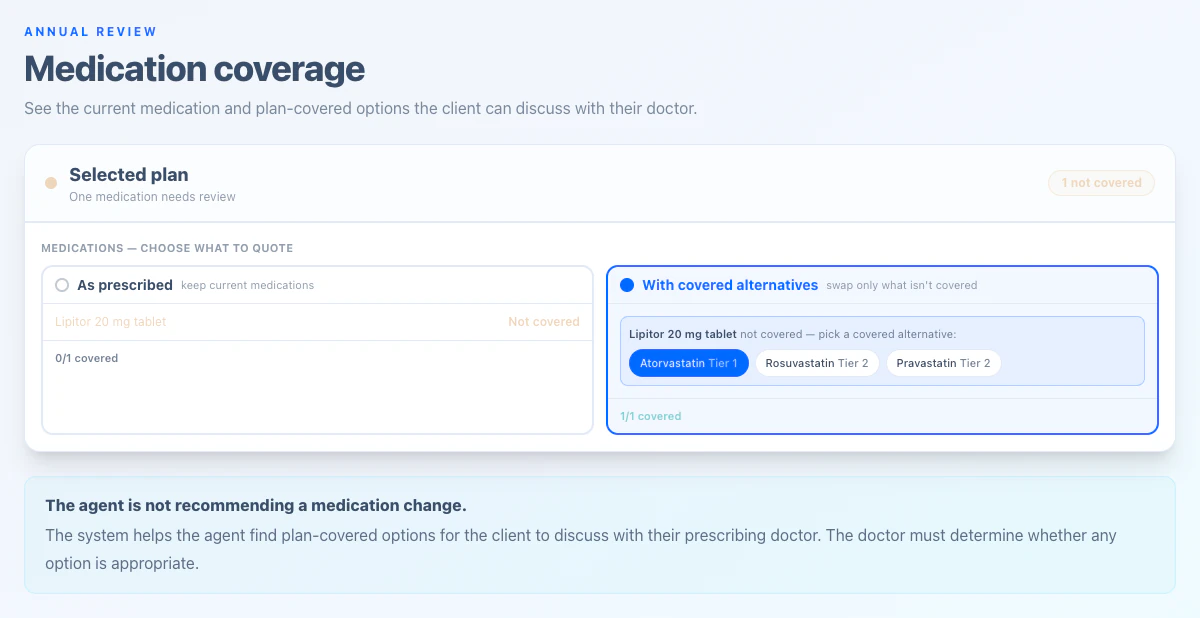
Keep the insulin check attached to the review
Keep the exact product, coverage result, pharmacy, and follow-up together.
Medicare Annual Review keeps medication, pharmacy, provider, and plan information together for the agent’s review. Confirm plan-specific costs with the plan or pharmacy; any medication change belongs with the prescribing clinician.
Essentials is $29.99/month after a 30-day free trial. Card required at checkout; one trial per NPN.
Sources
- Insulin coverage : Medicare.gov Accessed 2026-10-07.
- 42 C.F.R. 423.100 - Part D definitions and insulin cost-sharing formula : Electronic Code of Federal Regulations Accessed 2026-10-07.
- 42 C.F.R. 423.120(h) - Insulin deductible exemption and prescription-fill limits : Electronic Code of Federal Regulations Accessed 2026-10-07.
- 2027 Rate Announcement - Attachment V, Table V-2, printed page 95 : Centers for Medicare & Medicaid Services Accessed 2026-10-07.
- Selected Drugs and Negotiated Prices - Drugs with Deselection Determinations : Centers for Medicare & Medicaid Services Accessed 2026-10-07.
- Contract Year 2026 Medicare Advantage and Part D Final Rule Fact Sheet : Centers for Medicare & Medicaid Services Accessed 2026-10-07.
- Medicare and Medicaid Programs; Contract Year 2026 Policy and Technical Changes : Federal Register Accessed 2026-10-07.
- Drug plan rules, exceptions, and transition fills : Medicare.gov Accessed 2026-10-07.
- 42 C.F.R. 410.152(n) - Part B insulin furnished through durable medical equipment : Electronic Code of Federal Regulations Accessed 2026-10-07.
- Frequently Asked Questions about Medicare Insulin Cost-Sharing Changes (July 2023) : Centers for Medicare & Medicaid Services Accessed 2026-10-07.
- Infusion pumps and supplies : Medicare.gov Accessed 2026-10-07.
- Continuous glucose monitors : Medicare.gov Accessed 2026-10-07.
- 42 C.F.R. 423.104 - Qualified prescription drug coverage and catastrophic cost sharing : Electronic Code of Federal Regulations Accessed 2026-10-07.
- Contract Year 2027 Medicare Advantage and Part D Final Rule : Centers for Medicare & Medicaid Services Accessed 2026-10-07.
- Medicare rights and Part D coverage determinations : Medicare.gov Accessed 2026-10-07.
- 42 U.S.C. 1395w-102 - Part D insulin protection : U.S. Government Publishing Office Accessed 2026-10-07.
- Medicare Prescription Payment Plan : Medicare.gov Accessed 2026-10-07.
Frequently Asked Questions
Is Medicare insulin still $35 in 2027?
Yes. The covered-insulin cap continues. Under Part D, $35 is a ceiling; the applicable formula, a lower plan benefit, or assistance can reduce the amount.
Can a plan charge its $700 deductible before covering insulin?
The Part D deductible does not apply to a covered insulin product. Other prescriptions or separately covered equipment can have different rules.
Does the cap cover Ozempic, Mounjaro, or every diabetes medication?
No. Standalone non-insulin medications do not receive the insulin cap simply because they treat diabetes or are injectable. Qualifying licensed combination products containing insulin can fall within the covered-insulin definition. Compounded products containing insulin are excluded from that definition.
What if the client receives Extra Help?
Check the client's applicable lower cost sharing. The insulin ceiling does not replace a lower amount available through Extra Help.
Does the Medicare Prescription Payment Plan change the insulin cap?
It changes the timing of payments. Participants receive bills from their plan instead of paying their covered drug cost sharing at the pharmacy. The program does not itself reduce drug costs. A $0 pharmacy payment under this arrangement does not necessarily mean the prescription has no cost sharing.
Medicare and ACA Compliance Expert
Christian Rodgers is a Medicare and ACA compliance expert with over 30 years in the healthcare industry, having worked for some of the largest health plans in the United States. He has provided Medicare sales training to hundreds of agents in California and Florida.
Connect on LinkedIn