
A Medigap-only appointment generally does not trigger the federal Medicare Advantage and Part D Scope of Appointment rule. But before discussing specific standalone Part D, Medicare Advantage, or MAPD plans, the agent must have the applicable product scope documented. Carrier, FMO, agency, and state requirements may separately require additional documentation.
| Appointment scenario | Federal MA/Part D SOA analysis | Practical action |
|---|---|---|
| Medigap only | The federal MA/Part D SOA rule generally is not triggered | Document that the meeting stayed Medigap-only; check carrier, FMO, agency, and state requirements |
| Medigap plus standalone Part D | The Part D discussion falls within the federal SOA framework | Include Part D in the scope before plan-specific PDP discussion |
| Medigap meeting pivots to Medicare Advantage | The MA discussion falls within the federal SOA framework | Pause, obtain or update the SOA, then continue |
| MA appointment pivots to Medigap plus Part D | The original MA discussion and later PDP discussion require appropriate scope | Document the pivot and make sure Part D is included |
| Medigap only, but a carrier requires its own form | A contractual or operational requirement may apply even when the federal MA/Part D rule does not | Follow the carrier requirement |
Looking for the general rule rather than the Medigap-specific question? See how long a Scope of Appointment is valid and when you need a new one.
Working a Medigap application or replacement? Use the practical guide to Medigap underwriting, guaranteed-issue rights, trial rights, and state birthday rules to classify the client’s enrollment path before quoting.
Why agents find conflicting answers online
The disagreement usually comes from mixing different requirements together:
- Some generic appointment forms include a Medicare Supplement checkbox.
- Some carriers, FMOs, or agencies require their own appointment documentation.
- Some training materials use “Medicare appointment” as shorthand even when the federal rule being discussed is specific to Medicare Advantage and Part D.
- A meeting that begins as Medigap-only may later include Part D or Medicare Advantage plan-specific marketing.
The federal regulatory analysis turns on whether the discussion involves MA or Part D plan-specific marketing. A carrier requirement and a federal regulatory requirement are not the same thing, and agents should satisfy both when both apply.
The actual SOA rule is tied to MA and Part D marketing
CMS’s Medicare marketing rules are codified for Medicare Advantage and Part D at 42 C.F.R. § 422.2264 and 42 C.F.R. § 423.2264. Those provisions govern the appointment scope for MA and Part D plan-specific marketing; they are not a general federal Medigap SOA rule.
That matters for Medicare Supplement appointments.
If the appointment is truly limited to Medicare Supplement only, the federal MA/Part D SOA rule is generally not the rule that triggers the appointment requirement.
But once the conversation includes Medicare Advantage, MAPD, or stand-alone Part D, the Scope of Appointment rule becomes central.
The MA regulation says an organization may not market a health-care-related product during a marketing appointment beyond the scope agreed to by the beneficiary and documented in the SOA, and it may not market additional health-related lines of plan business not identified before the appointment without a separate SOA. It also prohibits marketing non-health-related products, such as annuities, during the appointment.
The Part D rule uses the same structure. It says Part D sponsors may not market products beyond the agreed scope, may not market additional health-related lines without a separate SOA, and may not market non-health-related products such as annuities.
So the safest way to explain it is:
A Medigap-only conversation is one thing. A Medicare Advantage, MAPD, or Part D plan-specific marketing conversation is another.
What if the appointment is Medicare Supplement only?
If the appointment is truly Medigap-only, the agent may not need a CMS MA/Part D Scope of Appointment for that appointment.
But that does not mean the agent should leave the file undocumented.
A professional file should still show that the appointment stayed within the Medigap lane.
A good note might say:
Appointment limited to Medicare Supplement options. No Medicare Advantage, MAPD, or stand-alone Part D plan-specific marketing discussion conducted.
That short note makes the appointment boundary clear without turning a Medigap-only meeting into unnecessary paperwork.
Why Medigap appointments often create Part D scope issues
The most common Medicare Supplement workflow problem is not the Supplement itself.
It is Part D.
Many beneficiaries who choose Original Medicare plus a Medicare Supplement also need a stand-alone Prescription Drug Plan. That means a conversation that begins as “Medigap only” can quickly become a PDP discussion.
Once the agent starts discussing specific Part D plans, premiums, formularies, pharmacy networks, star ratings, enrollment, or drug-cost comparisons, the appointment is no longer just a Medicare Supplement conversation.
At that point, the Part D discussion should be scoped before the agent moves into plan-specific PDP marketing.
A clean workflow would be:
- Confirm the beneficiary wants to discuss Medicare Supplement and Part D.
- Complete the Scope of Appointment before the PDP-specific discussion.
- Make sure Part D is included in the product scope.
- Document the Medigap discussion separately if your SOA workflow does not include Medigap.
- Store the SOA, notes, and related records together.
This is one of the reasons electronic Scope of Appointment workflows are useful in the field.
The agent may not know the beneficiary needs a PDP discussion until the needs analysis happens. If the agent can generate a new electronic SOA during the appointment, get it signed, and continue properly, the conversation does not have to become awkward or noncompliant.
What if a Medigap appointment turns into an MAPD discussion?
This is a common pivot.
The beneficiary starts with:
“I want to look at Medicare Supplement.”
Then, after reviewing premiums, budget, doctors, drugs, and household needs, the beneficiary asks:
“What about Medicare Advantage?”
Or:
“Can you show me the MAPD plans in my area?”
At that point, the agent should pause before discussing specific MAPD plans.
The agent can say:
“We can absolutely look at Medicare Advantage. Before I discuss specific MAPD plan options, I need to document that you want to discuss that product category. That keeps the appointment clear and makes sure we only discuss what you agree to discuss.”
Then the agent should complete or update the SOA to include Medicare Advantage or MAPD before discussing plan-specific benefits, networks, formularies, premiums, or enrollment.
Medicare.gov explains the consumer-facing version of this rule clearly: during a meeting, agents cannot tell beneficiaries about other plan options they did not agree to discuss unless the beneficiary specifically asks, and to discuss those additional options, the beneficiary needs to complete a separate appointment form.
That is the point.
The beneficiary can ask.
The agent can respond.
But the added product discussion should be documented before the plan-specific marketing continues.
Do not confuse a Medicare coverage pivot with cross-selling
Moving from MAPD to Medigap, or from Medigap to MAPD, may be appropriate when the beneficiary’s needs support it and the added discussion is properly documented.
Using the Medicare appointment to sell unrelated non-health products is different. The MA and Part D rules prohibit marketing non-health-related products such as annuities during the appointment. Keep a beneficiary-requested Medicare coverage pivot documented, and keep unrelated cross-selling out of the meeting.
Does the 48-hour rule affect a Medigap appointment?
For CY 2027, CMS eliminated the fixed 48-hour waiting period but kept the SOA requirement itself for MA, MAPD, and Part D personal marketing appointments. In a Medigap appointment that pivots into those products, that means you can scope and continue the same day, but you still need to document the added scope before the plan-specific discussion. The full rule change is covered in the Scope of Appointment 48-hour rule update.
What if the Medigap appointment is in person?
If an in-person appointment includes MA, MAPD, or Part D plan-specific marketing, CMS requires the SOA to be in writing before that discussion begins. A properly completed electronic SOA can create that written record, depending on carrier, FMO, agency, and state requirements. The in-person writing rule is covered in detail in the guide to written Scope of Appointment for in-person appointments. The core point for a Medigap appointment: if it pivots into MA, MAPD, or Part D, document the expanded scope in writing before the plan-specific discussion — not from memory or vague notes afterward.
A practical field workflow for Medigap, MAPD, and Part D
- Set the initial scope. Before plan-specific discussion, ask:
“Today, are you looking to discuss Medicare Supplement only, Part D prescription drug coverage, Medicare Advantage, or a comparison of your options?”
-
Scope MA or Part D before plan-specific marketing. General education is not the same as discussing specific benefits, premiums, networks, formularies, pharmacies, or enrollment options.
-
Document any pivot. If the beneficiary asks to add MA, MAPD, or Part D, pause and document the expanded scope. If the needs analysis points from MAPD toward Medigap, record why the recommendation changed and include Part D in the SOA before PDP-specific discussion.
-
Keep the file together. Store the SOA, appointment note, related forms, call recordings, and supporting records in a searchable place.
What the file should show if the recommendation is challenged
If a recommendation is ever questioned, the file should make the appointment easy to reconstruct.
A clean file should show:
- Initial scope: what did the beneficiary originally agree to discuss?
- Needs analysis: what facts were reviewed?
- Reason for any pivot: why did the discussion move from Medigap to MAPD, or from MAPD to Medigap?
- Beneficiary agreement: did the beneficiary ask about or agree to discuss the new product category?
- SOA documentation: was MA, MAPD, or Part D scoped before plan-specific marketing?
- Part D handling: if the Medigap path included PDP, was the PDP discussion scoped?
- Final recommendation: why did the final recommendation fit the beneficiary’s needs?
The file should tell the same story the agent would tell if the recommendation is later questioned.
How an electronic Scope of Appointment helps during the appointment
Paper can work, but an electronic Scope of Appointment workflow makes a same-day pivot easier to document. The agent can create the added scope, send it for signature, confirm completion, and store the record before continuing into the new MA or Part D plan-specific discussion.
So, do you need a Scope of Appointment for Medicare Supplements?
For a pure Medicare Supplement-only appointment, the federal MA/Part D SOA rule is generally not the rule that requires the appointment scope.
But in the real world, many Medicare Supplement conversations involve Part D, Medicare Advantage comparisons, MAPD alternatives, or mid-appointment pivots.
That is where agents need a strong workflow.
The practical answer is:
- Medigap-only appointment? Document that the appointment stayed Medigap-only.
- Medigap plus Part D? Complete the SOA before discussing PDP-specific options.
- Medigap appointment turns into MAPD? Pause, complete or update the SOA, then discuss MAPD.
- MAPD appointment turns into Medigap? Pause, document why the recommendation changed and confirm the beneficiary wants to discuss Medigap.
- MAPD to Medigap plus PDP? Document the Medigap pivot and make sure Part D is scoped before PDP-specific discussion.
- In-person MA, MAPD, or Part D appointment? Make sure the SOA is in writing.
- Unrelated products? Do not use the Medicare appointment to sell non-health products like life insurance or annuities.
- Any required record? Store it somewhere searchable and retrievable.
A good SOA process is not about slowing down good agents.
It is about protecting good agents.
Most agents are trying to help beneficiaries make the right decision. But good intentions do not always protect the file. Documentation does.
Listen first. Recommend honestly. Document the scope. Keep the proof.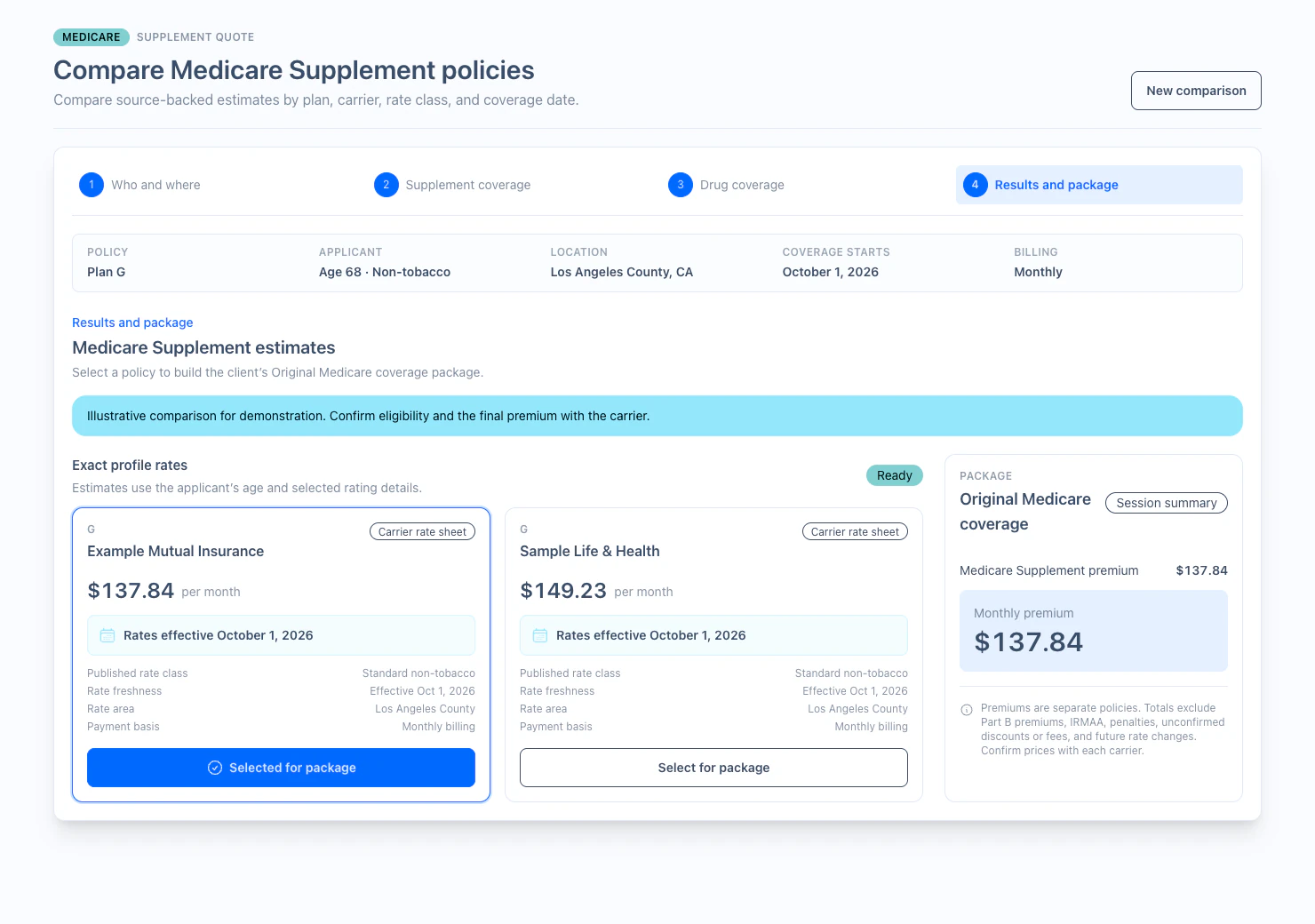
Carry the appointment pivot into the quote
Keep electronic SOA, Medigap estimates, Part D workflow, and the client record connected.
Agent Workspace includes Medicare Supplement and Part D quoting where available, alongside electronic SOA, Annual Review, recorded Business Line calls, and Vault records. When the appointment changes direction, the new scope and quote can stay around the same client instead of splitting across tabs and folders.
Electronic SOA is $9.99/month. First payment is due at secure checkout. No introductory trial. Medigap and Part D quoting require a separately approved Essentials rollout.
This article is for educational purposes only and is not legal advice. Agents should review current CMS guidance, carrier rules, FMO requirements, agency policies, state insurance requirements, and qualified compliance or legal counsel for specific requirements.
Sources
- eCFR, 42 CFR 422.2264: Electronic Code of Federal Regulations Accessed 2026-07-13.
- eCFR, 42 CFR 423.2264: Electronic Code of Federal Regulations Accessed 2026-07-13.
- Federal Register, 91 FR 17384: Contract Year 2027 Medicare Advantage and Part D final rule Accessed 2026-07-13.
- Medicare.gov, Marketing rules for health plans: Centers for Medicare & Medicaid Services Accessed 2026-05-20.
- Medicare Interactive, Marketing appointment rules: Medicare Rights Center Accessed 2026-05-20.
- CMS, Medicare Communications and Marketing Guidelines: Centers for Medicare & Medicaid Services Accessed 2026-05-20.
Frequently Asked Questions
Do you need a Scope of Appointment for Medicare Supplements?
For a Medicare Supplement-only appointment, the federal Medicare Advantage and Part D Scope of Appointment rule is generally not the rule that requires an SOA. However, agents should still follow state rules, carrier requirements, FMO procedures, agency policies, and documentation best practices.
Is a Medigap Scope of Appointment required by CMS?
CMS's Medicare marketing guidelines are focused on Medicare Advantage, MA-PD, PDP, and 1876 Cost Plans. A pure Medigap-only discussion is different from an MA or Part D personal marketing appointment. However, a Medigap appointment that includes Part D, MAPD, or Medicare Advantage plan-specific discussion should be scoped before those products are discussed.
Do you need an SOA if a Medicare Supplement appointment includes Part D?
Yes. If the appointment includes stand-alone Part D plan-specific discussion, the agent should complete the Scope of Appointment before discussing PDP options, formularies, pharmacies, premiums, or enrollment.
What if a Medigap appointment turns into a Medicare Advantage conversation?
Pause the conversation, document that the beneficiary wants to discuss Medicare Advantage or MAPD, complete or update the SOA, and then continue with the plan-specific Medicare Advantage discussion.
What if an MAPD appointment turns into a Medicare Supplement recommendation?
Pause the MAPD discussion, explain why the needs analysis points toward Medicare Supplement, confirm that the beneficiary wants to discuss Medigap, and document that pivot. If the new path includes a stand-alone Part D plan, make sure Part D is included in the SOA before discussing PDP-specific options.
Can an MAPD Scope of Appointment cover a Medigap discussion?
Do not assume an MAPD SOA gives blanket permission to discuss Medicare Supplement options. If the product discussion changes materially, document the beneficiary's request or agreement to discuss the new product category before continuing.
Does the 48-hour rule still apply?
For CY 2027 marketing, CMS finalized elimination of the fixed 48-hour waiting period between SOA completion and the personal marketing appointment. The SOA requirement itself remains.
Does an in-person SOA have to be in writing?
For CY 2027 workflows, CMS finalized language requiring the SOA to be in writing for in-person personal marketing appointments. Agents should follow current CMS rules, carrier procedures, FMO requirements, agency policies, and state rules.
Can agents discuss life insurance or annuities during a Medicare appointment?
No. A Medicare health or drug plan appointment should not be used to market non-health-related products such as life insurance or annuities.
Why should agents document Medigap-only appointments if an SOA is not required?
Because the agent may still need to prove what was discussed, what was not discussed, and why the recommendation was made. A short note showing the appointment stayed Medigap-only can protect the agent if the beneficiary later questions the scope of the conversation.
Medicare and ACA Compliance Expert
Christian Rodgers is a Medicare and ACA compliance expert with over 30 years in the healthcare industry, having worked for some of the largest health plans in the United States. He has provided Medicare sales training to hundreds of agents in California and Florida.
Connect on LinkedIn