Mistake 1
Assuming every Medicare recording is now 6 years
The 6-year framework applies to marketing and sales call records under the CY2027 final rule. Enrollment records remain subject to a separate 10-year retention framework.
CMS retention guide for Medicare agents
Reviewed
CMS uses separate retention tracks for Medicare marketing and sales call recordings and for telephone enrollment records. The effective date matters.
Through September 30, 2026: Continue applying the existing 10-year retention framework to Medicare Advantage and Part D marketing and sales call recordings.
Beginning October 1, 2026: Medicare Advantage and Part D marketing and sales calls—including the audio portion of calls conducted through web-based technology—must be recorded and retained in their entirety for at least six years. Keep the audio for years one through three. For years four through six, keep either the audio or a complete and accurate transcript of the full recording.
Telephone enrollment portions remain separate: When the recorded enrollment portion serves as the enrollment form and evidence of the beneficiary’s attestation of intent to enroll, the enrollment record remains subject to the 10-year retention requirement.
Practical rule: Beginning October 1, use six years for marketing and sales call records and ten years for enrollment records. Treat combined marketing, sales, and enrollment calls conservatively.
The CY 2027 final rule became legally effective June 1, 2026, so the amended eCFR may already display the six-year language. CMS separately states that the new marketing and communications policies apply beginning October 1, 2026, and specifically states that the call-retention change takes effect on that date.
This page is for general compliance education. It is not legal advice, carrier guidance, or a substitute for your MA organization, Part D sponsor, agency, FMO, compliance department, or legal counsel.
Quick summary
| Question | Current answer |
|---|---|
| Which Medicare calls must be recorded? | Under the TPMO rule, Medicare Advantage and Part D marketing and sales calls must be recorded in their entirety, including the audio portion of calls conducted through web-based technology. Telephone enrollment portions are also recorded when required as enrollment documentation. |
| What applies through September 30, 2026? | Continue using the existing 10-year retention framework for covered marketing and sales call recordings. |
| What changes October 1, 2026? | Marketing and sales call records move to a six-year minimum: audio for years one through three; audio or a complete and accurate transcript for years four through six. |
| Are telephone enrollment records also six years? | No. Telephone enrollment portions that serve as enrollment records remain on the separate 10-year retention track. |
| Can a six-year-old combined recording automatically be deleted? | No. First determine whether it contains an enrollment record or is subject to a carrier requirement, state requirement, audit, complaint, dispute, litigation hold, fraud inquiry, or other longer preservation obligation. |
Recording trigger
Under 42 C.F.R. § 422.2274(g)(2)(ii) and 42 C.F.R. § 423.2274(g)(2)(ii), the TPMO framework requires Medicare Advantage and Part D marketing and sales calls to be recorded in their entirety. The requirement includes the audio portion of calls conducted through web-based technology.
Telephone enrollment is a related but distinct recordkeeping category. CMS explains that, when an enrollment occurs over the telephone, the enrollment portion of the call must be recorded because the recording can serve as the enrollment form and proof that the beneficiary attested to an intent to enroll.
The distinction matters because the CY 2027 six-year change applies to marketing and sales call records, while enrollment records remain subject to a separate 10-year retention requirement.
Not every call
Not every call with a Medicare beneficiary is automatically a CMS-required recorded call. CMS training guidance states that calls other than those involving marketing, sales, and enrollments do not have to be recorded.
Agents should still follow carrier, agency, privacy, quality assurance, complaint-response, and state call-recording requirements. Read the CMS training guidance.
When in doubt, use a conservative workflow: provide the required recording notice, obtain any required consent, and keep the record organized.
Retention
Beginning October 1, 2026, Medicare marketing and sales calls must be recorded and retained in their entirety for a minimum of 6 years under the CY2027 final rule. For the first 3 years, the record must be maintained in audio format. For years 4, 5, and 6, the record may be maintained either as audio or as a complete and accurate transcript recording.
| Retention period | Required format | Practical meaning |
|---|---|---|
| Years 1-3 | Audio recording | Keep the actual audio file. Do not rely on a transcript only during this period. |
| Years 4-6 | Audio or complete and accurate transcript recording | Audio can still be kept, but CMS allows a complete and accurate transcript recording during this part of the retention period. |
| After year 6 | Depends on record type and other requirements | The CMS marketing/sales call retention rule does not mean every related record can be deleted after 6 years. Enrollment records, carrier rules, litigation holds, audits, disputes, fraud allegations, state rules, or agency policies may require longer retention. |
CMS explained that a complete and accurate transcription must document the full recording and reflect all statements made by the participants as the call originally occurred. Read the CY2027 final rule.
Separate track
Medicare enrollment recordings should not be treated the same way as ordinary marketing and sales call recordings.
CMS maintained the 10-year retention requirement for enrollment records. CMS also explained that, for enrollments that occur over the phone, the enrollment portion of the call is still required to be recorded because the recording can serve as the enrollment form and proof that the beneficiary attested to the intent to enroll.
CMS describes the enrollment portion as beginning when the beneficiary is advised that they are completing an enrollment request, after which they provide information required by the enrollment form and attest to their intention to enroll.
If a single call includes both marketing or sales discussion and a telephone enrollment portion, treat the file as containing an enrollment record unless your carrier, MA organization, Part D sponsor, agency, FMO, or compliance team has given you a specific approved way to segment and retain the required portions separately.
Mixed calls
A single recording may contain a marketing discussion, sales discussion, Scope of Appointment activity, and a telephone enrollment portion. Do not delete, trim, convert, or separate a combined recording merely because it is more than six years old.
Before applying the shorter retention period, confirm that the recording contains no enrollment record and is not subject to a carrier requirement, agency or FMO policy, state-law requirement, complaint, audit, dispute, litigation hold, fraud inquiry, or other longer preservation obligation.
Record the required call audio.
Identify when the enrollment request begins.
Keep the enrollment portion with the related SOA, plan documents, and attestation record.
Tag the record type so it is not deleted under the wrong retention assumption.
Export the full file if your business changes.
Call types
| Call type | Practical trigger | Recording approach | Retention approach |
|---|---|---|---|
| Appointment-setting call | The call only schedules a future meeting and does not discuss plan options, benefits, or enrollment. | CMS training guidance indicates calls outside marketing, sales, and enrollment do not have to be recorded, but follow carrier and state rules. | No CMS marketing/sales recording retention unless the call becomes marketing, sales, or enrollment. |
| Marketing or sales call | The agent discusses plan options, benefits, premiums, networks, drug coverage, plan comparisons, or recommendations. | Record the call, including web-based audio. | Beginning October 1, 2026: 6 years under the CY2027 framework, with audio for years 1-3 and audio or a complete and accurate transcript recording for years 4-6. |
| Web-based sales meeting | The agent discusses plan options through Zoom, Teams, screen-share, or another web-based voice workflow. | Record the audio portion. | Same marketing/sales retention framework. |
| Telephone enrollment call | The beneficiary is advised they are completing an enrollment request and then provides enrollment-form information and attests intent to enroll. | Record the enrollment portion. | Enrollment records remain subject to the separate 10-year retention framework. |
| Post-enrollment service call | The call is purely customer service and does not involve marketing, sales, or a new enrollment request. | Not automatically a CMS marketing/sales/enrollment recording, but follow carrier, plan, state, and agency procedures. | Depends on the nature of the record and applicable policy. |
Old framing
For several years, many agents were told to think in terms of 10-year Medicare call recording storage. That was understandable because MA organizations and Part D sponsors were expected to retain certain sales and marketing call recordings for 10 years under the prior framework.
Beginning October 1, 2026, the CY2027 final rule changes that framing for marketing and sales calls. CMS finalized a 6-year retention policy for marketing and sales call records, with audio required for the first 3 years and audio or complete and accurate transcript recordings allowed for years 4-6.
Medicare marketing and sales calls: 6-year retention framework.
Medicare enrollment records and telephone enrollment portions: separate 10-year retention framework.
Other records: follow CMS rules, carrier instructions, agency policies, state law, privacy requirements, and any litigation hold, audit, dispute, or fraud-related preservation obligation.
Decision checklist
Use this as a downloadable-style review list before AEP, during staff training, or when auditing recorded-line workflows.
Audio vs. transcript
For years 1-3, the marketing or sales call record must remain in audio format. A transcript alone is not enough during that first 3-year period. For years 4-6, CMS allows the record to be maintained either as audio or as a complete and accurate transcript recording.
A summary is not the same thing as a complete transcript. A short note that says "client reviewed Plan A and enrolled" is not a substitute for the full record.
Virtual meetings
CMS's call-recording requirement includes the audio portion of calls conducted through web-based technology. The key issue is not whether the communication happens on a traditional phone line. The key issue is whether the communication includes Medicare marketing, sales, or enrollment audio.
Complete file
A call recording is most useful when it is stored with the rest of the file. The goal is not just to record the call. The goal is to be able to find the complete file later.
State consent
CMS call recording rules do not eliminate state call-recording laws. Some states require one-party consent. Others require all-party consent. Agents may also be subject to carrier-required scripts or agency-specific recording notices.
Do not assume that a CMS requirement to record a call automatically solves state recording-consent requirements. Review state call recording laws for insurance agents.
Avoidable issues
Mistake 1
The 6-year framework applies to marketing and sales call records under the CY2027 final rule. Enrollment records remain subject to a separate 10-year retention framework.
Mistake 2
For marketing and sales calls, audio must be maintained for the first 3 years. A transcript-only record is permitted only for years 4-6, and only if it is complete and accurate.
Mistake 3
For phone enrollments, CMS states that the enrollment portion of the call can serve as the enrollment form and proof of the beneficiary's attestation of intent to enroll.
Mistake 4
A call recording alone may not prove the full compliance file. Medicare sales workflows often require related records, such as Scope of Appointment documentation, plan-review records, enrollment documentation, and carrier-required materials.
Mistake 5
A phone system may record the call, but the recording can become difficult to use if it is not connected to the client file, SOA, enrollment record, or supporting documents.
Mistake 6
Agents change CRMs, FMOs, agencies, carriers, and phone systems. If records cannot be exported, the agent may have a practical recordkeeping problem even if the recording was originally captured.
Mistake 7
CMS may require a call to be recorded, but agents still need to follow state consent rules, carrier scripts, privacy policies, and agency procedures.
Decision tree
A durable workflow should answer five questions before, during, and after the call.
Appointment only?
No CMS marketing/sales/enrollment recording requirement if no plan marketing, sales, or enrollment occurs.
Plan benefits or recommendations discussed?
Record the call and keep the marketing/sales record under the CY2027 retention framework.
Enrollment request begins?
Record and preserve the enrollment portion under the separate enrollment-record track.
Question 1
If yes, handle the call as a recorded Medicare call.
Question 2
For marketing, sales, and enrollment calls, the recording should capture the full required audio, including web-based audio where applicable.
Question 3
If yes, treat it as containing an enrollment record unless your carrier or compliance team has approved a different retention process.
Question 4
Keep the call with the SOA, plan documents, enrollment information, and related records.
Question 5
A record that cannot be found quickly is not very useful during a complaint, audit, carrier request, agency review, or book-of-business transition.
Workflow support
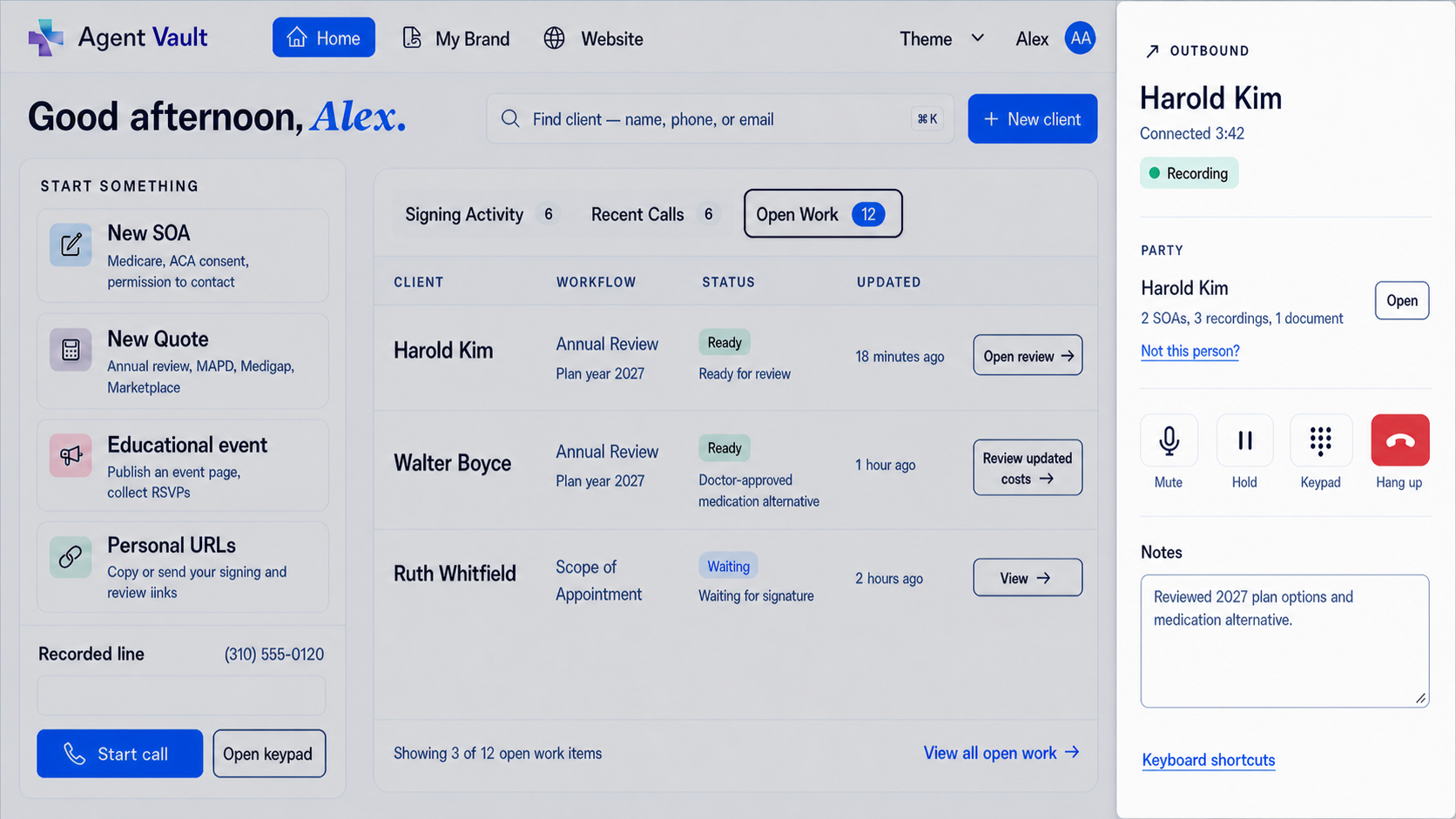
This guide explains the requirement. Business Telephone is being prepared to support the calling workflow.
Informed + Choice Business Telephone is coming soon at $39.99 per month for licensed Medicare and ACA insurance agents. It provides a focused business number for inbound and outbound calls inside the app, permitted recording, telephone history, storage, retrieval, and export. Payment will be required before activation, with no trial.
Use it to keep Medicare call recordings, SOAs, telephone authorization records, telephonic enrollment records, and supporting sales documents together instead of scattered across a phone provider, email inbox, CRM notes, desktop folders, and carrier portals.
You still remain responsible for using your approved scripts, disclosures, carrier procedures, agency policies, state recording notices, and enrollment workflows.
Join Business Telephone Early AccessBottom line
Record Medicare marketing, sales, and enrollment calls. Beginning October 1, keep marketing and sales call records for 6 years under the CY2027 framework, with audio required for years 1-3 and audio or complete and accurate transcript recordings allowed for years 4-6. Keep enrollment records, including telephone enrollment portions, under the separate 10-year retention framework.
Build your workflow around that distinction.
Compliance source notes
Primary authority: 42 C.F.R. § 422.2274(g)(2)(ii), 423.2274(g)(2)(ii); 42 C.F.R. § 422.504(e)(1)(iv), 423.505(e)(1)(iv); Medicare Program; Contract Year 2027 and Certain Contract Year 2026 Policy and Technical Changes to the Medicare Advantage Program, Medicare Prescription Drug Benefit Program, and Medicare Cost Plan Program, 91 Fed. Reg. 17,384, 17,464–17,468, 17,573 (Apr. 6, 2026).
The final regulation requires six years for marketing and sales call records, with audio during years one through three and audio or a complete and accurate transcript during years four through six. CMS separately retained the ten-year enrollment-record requirement.
Agents remain responsible for carrier procedures, agency policies, state recording-consent laws, privacy requirements, approved scripts, and any applicable legal hold, audit, dispute, or fraud-related preservation obligation.
FAQ
Under the TPMO rule, Medicare Advantage and Part D marketing and sales calls must be recorded in their entirety, including the audio portion of calls conducted through web-based technology. Telephone enrollment portions are also recorded when required as enrollment documentation.
No. CMS training guidance states that calls other than those involving marketing, sales, and enrollments do not have to be recorded. Agents should still follow carrier instructions, agency policies, state recording-consent laws, and any other applicable requirements.
Through September 30, 2026, continue using the existing 10-year retention framework for covered marketing and sales call recordings. Beginning October 1, they move to a 6-year minimum: audio for years 1 through 3, then audio or a complete and accurate transcript for years 4 through 6.
Beginning October 1, 2026, CMS requires audio format for years 1 through 3 of the marketing and sales call retention period. For years 4 through 6, CMS allows audio or complete and accurate transcript recordings.
Enrollment records remain subject to the separate 10-year retention framework. CMS explained that, for phone enrollments, the enrollment portion of the call can serve as the enrollment form and proof that the beneficiary attested to the intent to enroll.
CMS states that the enrollment portion begins when the beneficiary is advised that they are completing an enrollment request, after which they provide the information required by the enrollment form and attest to their intention to enroll.
Yes. The TPMO rule expressly includes the audio portion of Medicare Advantage and Part D marketing and sales calls conducted through web-based technology. Telephone enrollment portions are separately recorded when required as enrollment documentation.
Beginning October 1, 2026, the 6-year framework applies to marketing and sales call records. CMS maintained separate retention requirements for enrollment records. If a single call includes both sales discussion and a telephone enrollment portion, agents should confirm with their carrier, plan, agency, FMO, or compliance team before deleting, trimming, or converting any part of the file.
Yes. CMS call recording requirements do not eliminate state recording-consent laws. Agents should use the required notices and consent procedures for the states and call types involved.
No. No software can guarantee compliance by itself. Agent Workspace provides a recorded-line and recordkeeping workflow, but agents remain responsible for following CMS rules, carrier requirements, agency policies, state recording laws, privacy requirements, and approved scripts.
Business Telephone is coming soon for recorded-line workflows, while Electronic SOA is available now for signed Scope of Appointment records.
Recorded business line for Medicare agents | Telephone Scope of Appointment | Electronic Scope of Appointment | SOA Vault | Medicare agent tools