01
Get found
Publish a focused agent website so Medicare and ACA prospects have a credible place to understand the business and make an inquiry.
Comparison guide
HealthSherpa is a major ACA acquisition, quoting, enrollment, renewal, and servicing platform. Its public agent materials describe a customizable enrollment site, CRM tools, consent storage, AOR insights, and reporting.
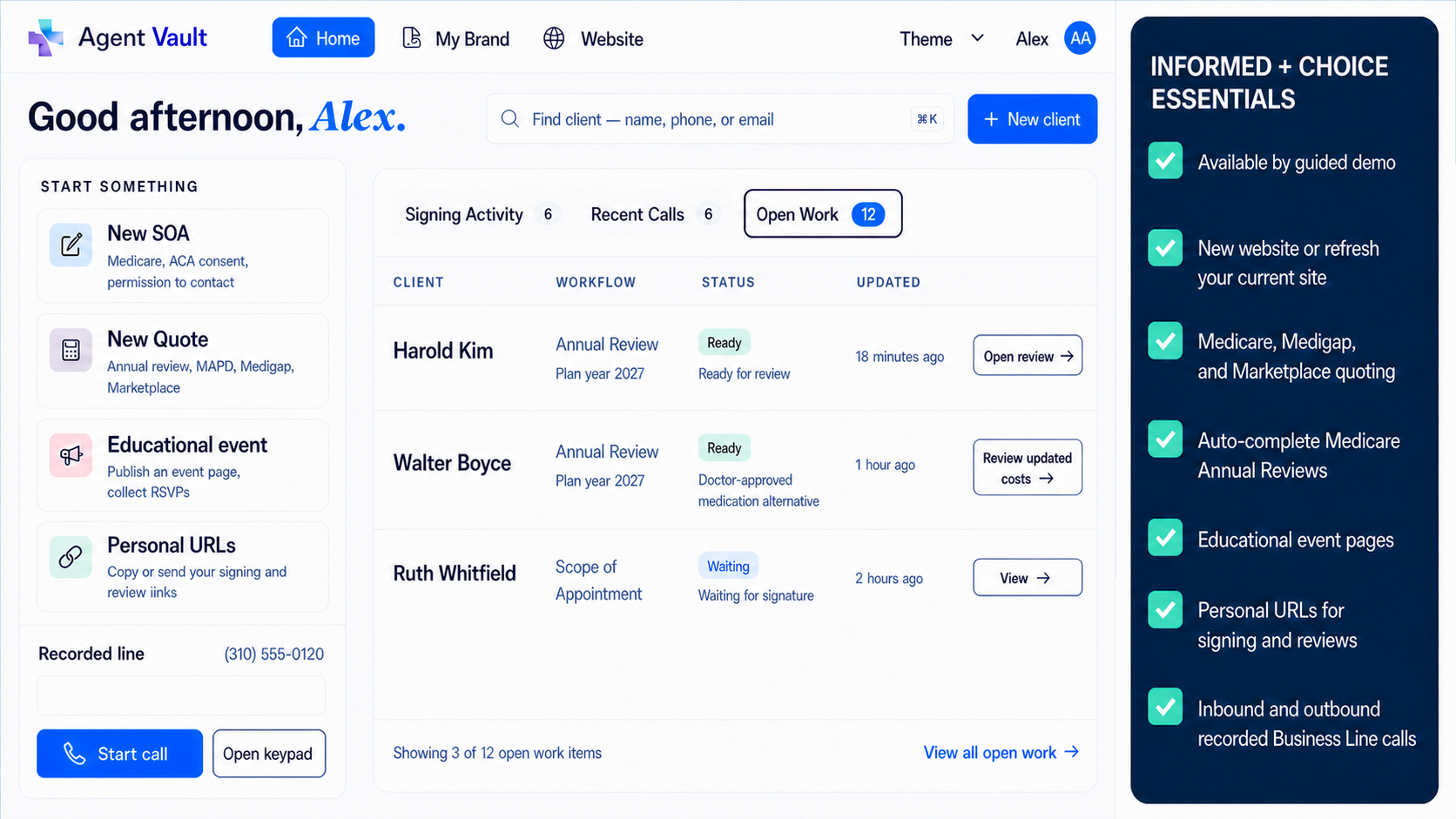
Agent Workspace serves a broader cross-market part of the agent business: a Medicare and ACA website, educational events, CRM, quoting workflows where available, recorded calling, electronic forms, Medicare Annual Review, follow-up, and connected records.
The practical question is not which product wins every feature. It is whether the agent needs HealthSherpa's ACA enrollment workflow, a broader Medicare and ACA operating workspace, or both.
Agent Workspace is not an EDE enrollment or HealthCare.gov application-submission platform. Agents can continue using HealthSherpa or another approved enrollment workflow where required.
Guided demo and fit review. Essentials does not have a public self-service price or trial.
The real comparison
HealthSherpa connects ACA acquisition to quoting, application, enrollment, renewal, and servicing. That is a substantial workflow, and its customizable enrollment site and CRM tools mean this is not a comparison against a narrow enrollment form.
Agent Workspace connects the agent's broader Medicare and ACA operation: public website, educational events, CRM, quoting workflows, recorded calling, electronic SOA and ACA consent, Medicare Annual Review, follow-up, and long-term records.
The systems can work together. HealthSherpa can support approved ACA enrollment while Agent Workspace keeps the cross-market client relationship and surrounding work connected.
The difference starts before the quote
HealthSherpa already gives ACA agents a customizable enrollment site and dashboard lead path. Agent Workspace adds a different kind of breadth: a Medicare and ACA website plus educational event pages that can carry an inquiry or RSVP into the same CRM used for calls, forms, quotes, reviews, follow-up, and records.
01
Publish a focused agent website so Medicare and ACA prospects have a credible place to understand the business and make an inquiry.
02
Publish an educational event page, printable flyer, QR code, and RSVP path for community outreach.
03
Carry the inquiry or RSVP into the CRM, then connect the appropriate ACA consent, quote, recorded call, documents, follow-up, and Medicare workflows.
| Feature | HealthSherpa | Informed + Choice Agent Workspace |
|---|---|---|
| Primary purpose | ACA acquisition, quoting, enrollment, EDE workflow, renewals, and client servicing | Connected Medicare and ACA workspace spanning public presence, CRM, quoting workflows, calling, forms, Annual Review, events, and records |
| Best for | Agents and agencies that need a Marketplace enrollment and servicing platform | Licensed Medicare and ACA agents who want the client relationship connected across product lines |
| Agent website / lead path | Customizable ACA enrollment site can market the agent brand and capture ACA leads into the dashboard | Focused Medicare and ACA agent website can carry an inquiry into the CRM |
| Educational events and RSVP | Not a primary workflow described on the public agent sources reviewed; agents should confirm current account options | Educational event pages, printable flyers, QR codes, and RSVP workflows connected to the prospect record |
| Lead-to-client handoff | Leads can enter the ACA dashboard and continue through quoting, enrollment, renewal, and servicing | Website inquiries and event RSVPs can become CRM records connected to calls, forms, quotes, reviews, and follow-up |
| ACA enrollment | Core HealthSherpa use case | Not intended to replace ACA enrollment platforms |
| ACA quoting | Core HealthSherpa use case | Marketplace quote workspace and branded quote exports may be available where enabled; not an EDE or HealthCare.gov application-submission platform |
| EDE workflow | HealthSherpa supports EDE account setup and Marketplace data sync workflows | Can be used beside EDE, Marketplace, agency, CRM, or quoting workflows |
| Medicare workflows | HealthSherpa public materials describe ACA and Medicare account options; the ACA workflow is the focus of this comparison | Medigap, Part D, SOA, recorded calling, and Medicare Annual Review workflows can stay with the same client relationship where available |
| Medicare Annual Review | Not the primary job of the ACA enrollment workflow reviewed here | Dedicated Annual Review organizes client facts, medications, doctors, plan evidence, costs, tradeoffs, and next actions for licensed-agent review |
| Consumer consent tools | HealthSherpa has built-in consent tools and a Consent Library | ACA Consent Personal URLs and signed consent records in an independent agent-controlled vault |
| Eligibility application review | HealthSherpa tools support consumer consent and eligibility application review management | ACA Review Personal URLs and signed review records with consent, calls, and supporting documents |
| Call recordings | Agents should confirm how recorded verbal confirmations are captured and stored in their workflow | Business Line available where enabled; completed recordings can be stored with ACA Consent and ACA Review records |
| AOR risk / AOR dispute support | HealthSherpa provides AOR monitoring and reporting tools in its platform | Stores the underlying evidence file: consent, review, call recording when used, notes, screenshots, and supporting documents |
| Export | HealthSherpa has exports, including agency and client-related exports; export permissions may be controlled by agency settings | Built around exportable Vault records under the agent account |
| Medicare + ACA records | HealthSherpa has ACA and Medicare account options, but the public ACA workflow is the main comparison here | Medicare SOAs and ACA Consent/Review records can live in the same vault strategy |
| Best fit | I need to acquire, quote, enroll, renew, and service ACA clients. | I want a public front door plus Medicare and ACA client work connected in one agent-controlled workspace. |
HealthSherpa may be the better fit when your main need is ACA enrollment workflow.
HealthSherpa help materials state that consent tools are built into the account to help agents collect and manage Consumer Consent and Eligibility Application Review, and its Consent Library includes search and filtering. Review consent overview.
Agent Workspace may be the better fit when your main need is a broader Medicare and ACA client relationship under your own account.
The job is not to replace HealthSherpa's EDE workflow. It is to connect the wider business before and after that enrollment.
Proof file
ACA compliance is not satisfied just because the application was submitted. The agent may later need to show that the consumer or authorized representative gave consent before assistance and reviewed the eligibility application information before submission.
CMS FAQ guidance states that agents, brokers, and web-brokers must maintain documentation of consumer consent and eligibility application review for at least 10 years and produce it to CMS upon request. Read the CMS FAQ.
Record sequence
Before Marketplace assistance, person search, application help, enrollment facilitation, or updates, document the consumer or authorized representative consent through a record-producing action.
Before submitting a new application, update, plan selection, or change, document that the consumer or authorized representative reviewed and confirmed the eligibility application information and relevant attestations.
Keep the consent record, review record, call recording when used, screenshots, notes, uploaded or imported files, and supporting Marketplace records together.
Retrieve the file for CMS requests, agency reviews, consumer complaints, AOR disputes, carrier inquiries, or internal compliance checks.
HealthSherpa help materials separate Consumer Consent from Eligibility Application Review. Review HealthSherpa consent overview.
AOR records
ACA agents are increasingly aware of Agent of Record issues, EDE sync issues, and unauthorized-change concerns.
HealthSherpa help materials explain that AOR may change if a different agent completes an update or submission, and describe AOR at-risk reporting. That is useful visibility. But visibility is not the same as a complete proof file. Review AOR reporting.
No tool can prevent every AOR dispute. But a better record can help the agent explain what happened.
Record ownership
HealthSherpa help materials explain that agents can only service an application and view the most up-to-date application information when there is an active EDE connection. Review EDE permission guidance.
That is an important workflow issue. It also highlights a separate recordkeeping issue: your enrollment workflow may depend on EDE sync status, account settings, agency hierarchy, or platform access. Your compliance records should still be organized and retrievable.
Recorded consent
Some ACA workflows happen by phone. When a workflow uses verbal consent, the record needs to satisfy the documentation requirements that apply to that workflow.
A note that says client consented may not be enough. Where Business Line recording is enabled and lawful for the call, Informed + Choice gives agents a place to store recorded verbal confirmations with the related ACA Consent and ACA Review file.
Exports
HealthSherpa has export functionality for agency and client-related workflows. That can be very helpful for agencies. But a CSV export is not always the same thing as a compliance evidence file. HealthSherpa documentation also states that agency administrators can disable export functionality for direct downline agents. Review export documentation.
Does the export include the actual consent record?
Does the export include eligibility application review documentation?
Does the export include recorded verbal confirmation?
Does the export include call recordings when used?
Does the export include screenshots, PDFs, notes, and supporting documents?
Does the export include timestamps and record status?
Does the export preserve the sequence: consent before assistance, review before submission?
Can individual agents export records if they leave an agency?
Can agency administrators disable export functionality?
Can the record still be retrieved if the EDE connection is inactive?
Can the evidence file be produced for CMS, agency, complaint, or AOR-dispute review?
Use together
This should usually be a complementary workflow, not a replacement decision. HealthSherpa can handle the ACA enrollment workflow. Agent Workspace can support the broader Medicare and ACA public presence, CRM, calling, forms, Annual Review, follow-up, and independent records.
Hybrid agents
Many agents do not work in only one product line. The point is not to force every task into one platform. The point is to keep the proof file from becoming scattered.
Complaint response
When a consumer, CMS reviewer, agency, or compliance team asks what happened, the agent should not have to reconstruct the story from memory. The file should make the sequence clear: consent first, review second, submission or update after that.
Archive due diligence
Is it stored inside the enrollment platform, in your agent account, in an agency account, in a CRM, in email, in a shared folder, or in a separate vault?
Can you prove the consumer reviewed and confirmed eligibility application information before submission?
If your workflow uses phone confirmation, where is the recording? Is it connected to the consumer record?
Can you still retrieve your consent and review documentation even if the application cannot be serviced through the current sync?
Can you produce the file showing what the consumer authorized and reviewed?
Do you keep access to your records? Can you export them? Are exports controlled by an agency administrator?
Can you export the actual records, not just a CSV summary?
Many agents collect consent by phone, email, text, or form. Your recordkeeping system should support more than one source.
Hybrid agents should avoid one archive for ACA and another disconnected archive for Medicare.
The real test is not whether the record exists somewhere. The real test is whether you can find it when someone asks.
Use HealthSherpa when your main need is ACA quoting, EDE enrollment, renewal, servicing, and Marketplace workflow.
Use Agent Workspace when you want a Medicare and ACA website and educational events plus CRM, recorded calling, electronic forms, Annual Review, quoting workflows where available, follow-up, and exportable records.
Enroll where it makes sense. Keep the broader client relationship connected in Agent Workspace.
FAQ
No. HealthSherpa is a major ACA acquisition, quoting, enrollment, renewal, and servicing platform. This comparison is about which jobs belong in that ACA workflow and whether the agent also wants a broader Medicare and ACA workspace around it.
No. Agent Workspace is not an EDE enrollment or HealthCare.gov application-submission platform. It adds a Medicare and ACA CRM, agent website, educational events, Annual Review, quoting workflows where available, recorded calling, electronic forms, and a connected record vault around the enrollment systems an agent uses.
Yes. Agents can use HealthSherpa for ACA acquisition, quoting, enrollment, renewal, and servicing while using Agent Workspace for their Medicare and ACA website, educational events, CRM, recorded calls, forms, Annual Review, follow-up, and independent records.
Yes. HealthSherpa help center materials state that consent tools are built into the HealthSherpa account to help agents collect and manage both Consumer Consent and Eligibility Application Review.
Some agents want an independent record layer under their own account, especially if they collect records outside the platform, use recorded verbal confirmations, write both Medicare and ACA business, want Vault access when active calling is not needed, or want exportable evidence files if their agency, CRM, EDE, or sales workflow changes.
Yes, where Business Line recording is enabled and lawful for the call. Informed + Choice can store completed recordings with the related ACA Consent and ACA Review records. Agents remain responsible for following CMS rules, Marketplace rules, state laws, privacy requirements, approved scripts, agency procedures, and the requirements that apply to their workflow.
CMS FAQ guidance states that agents, brokers, and web-brokers must maintain documentation of consumer consent and eligibility application review for a minimum of 10 years and produce it to CMS upon request.
Consumer consent documents that the consumer or authorized representative authorized the agent, broker, web-broker, or agency to assist. Eligibility application review documents that the consumer or authorized representative reviewed and confirmed the accuracy of the eligibility application information before submission. HealthSherpa help materials separate these two concepts.
Informed + Choice does not prevent every AOR dispute. It helps agents keep the records that may be needed to explain what happened: ACA Consent, ACA Review, call recordings when used, notes, screenshots, Marketplace files, and uploaded or imported supporting documents.
HealthSherpa may be better when the main need is ACA acquisition, EDE enrollment, renewal, and servicing. Agent Workspace may be better when the agent wants a Medicare and ACA website and educational events plus cross-market CRM, calling, forms, Annual Review, follow-up, and connected records. The two systems can be used together.
No. Agent Workspace gives agents practical lead-opportunity tools: a focused website, educational event pages, flyers, QR codes, RSVP workflows, and a CRM handoff. It does not guarantee traffic, leads, appointments, enrollments, or commissions. An inquiry or RSVP also does not automatically create permission to contact or replace required ACA consent.
HealthSherpa is an ACA acquisition, quoting, enrollment, renewal, and servicing platform. Agent Workspace is a connected Medicare and ACA business workspace that can help an agent get found, manage the relationship, complete specialized workflows, and retain the supporting record.
Use HealthSherpa when its ACA EDE and enrollment workflow fits your business. Use Agent Workspace when you want the Medicare and ACA public front door, client work, calls, forms, reviews, follow-up, and records connected in one agent-controlled system.
The enrollment can happen in HealthSherpa. The broader relationship can stay connected in Agent Workspace.
Related links
Sources reviewed: HealthSherpa, HealthSherpa for Agents, HealthSherpa consent overview, HealthSherpa consent page, HealthSherpa AOR reporting, HealthSherpa EDE permission lost, HealthSherpa export documentation, CMS ACA consumer consent FAQ, Informed + Choice Agent Workspace, and Informed + Choice ACA Compliance Vault.
Last reviewed: August 2026. This comparison is for educational purposes only and is not legal, CMS, Marketplace, carrier, compliance, technical, tax, business, or insurance advice. Product features, account permissions, and implementation details can change. Agents should follow current CMS rules, Marketplace rules, carrier guidance, agency procedures, approved scripts and materials, privacy requirements, state call-recording consent laws, and the requirements that apply to their specific ACA workflow. HealthSherpa is a trademark of its owner. Informed + Choice is not affiliated with or endorsed by HealthSherpa.