
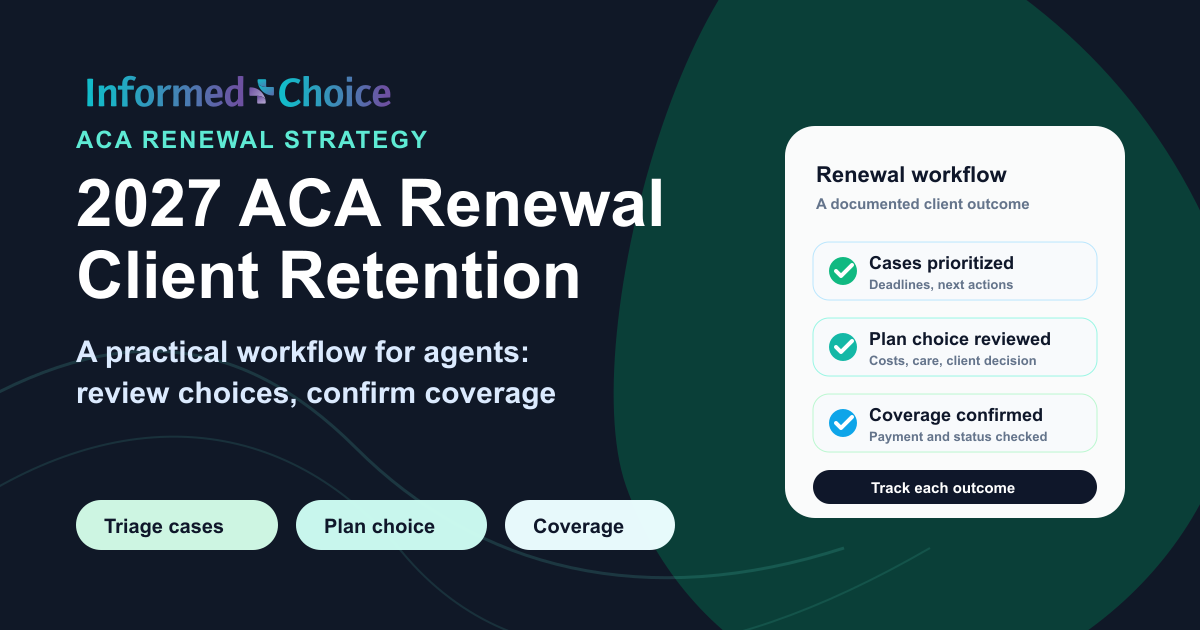
A useful ACA renewal process gives every client a documented outcome: an informed plan choice, current application information, and confirmation that the intended coverage is in place. It also gives the agent a clear next action whenever a case is unfinished.
Use this guide to organize your 2027 book of business, conduct renewal appointments, and follow cases through payment and coverage confirmation. Use the checklist fields below alongside your secure client records.
Federal-platform rules below apply to HealthCare.gov and state Marketplaces using that platform. Follow a state-run Marketplace’s own enrollment and agent procedures where applicable.
2027 rules to put on your desk
Federal enrollment window: November 1, 2026–January 15, 2027. December 15 is the ordinary selection deadline for January 1 coverage. State Marketplaces operating their own platforms may use different dates. cms.gov
Use current implementation guidance. CMS’s August 4 statement reflects court orders blocking several published changes, including the 2027 failure-to-file-and-reconcile policy and expanded SEP verification. Existing loss-of-coverage SEP verification remains. Check for later CMS updates before your enrollment campaign. cms.gov
Two practical additions to this year’s workflow are annual agent authorization on enhanced direct enrollment platforms and an active eligibility review for noncitizen households. The steps below explain both.
1. Build your calendar around the client’s effective date
| Date or period | Action for federal-platform renewals |
|---|---|
| October 2026 | Prepare the renewal list, verify agent readiness, confirm client contact access, and schedule reviews. These are suggested agency work targets. |
| November 1, 2026 | Open Enrollment begins. Update the 2027 application and compare available 2027 plans. |
| December 15, 2026 | Ordinary plan-selection deadline for January 1, 2027 coverage. |
| January 1, 2027 | Confirm intended January coverage, insurer billing, member materials, and unresolved issues. |
| January 15, 2027 | Final federal Open Enrollment deadline. Selections made December 16–January 15 generally start February 1. |
| February 2027 | Confirm February starts and finish the renewal outcome report. Continue tracking open document and payment issues. |
The enrollment dates and effective dates come from CMS and HealthCare.gov; the work schedule is a suggested agency process. Record each client’s applicable Marketplace, selection deadline, requested effective date, and any separate document or premium deadline. cms.gov
Follow the Marketplace’s notice for any applicable SEP or deadline exception. For clients using a state-run platform, start with HealthCare.gov’s state Marketplace directory and use that Marketplace’s 2027 instructions. cms.gov
After Open Enrollment, check the client’s actual eligibility for a Special Enrollment Period. The former monthly SEP based solely on income at or below 150% of the poverty level is not a fallback for a missed 2027 renewal. cms.gov
2. Turn your book into an actionable renewal list
Create one case per household for outreach, with separate coverage outcomes for each person when needed. Include a case owner, current stage, next action, due date, and the location of supporting records.
Useful stages are:
- Not started.
- Contacting.
- Review scheduled.
- Awaiting client action.
- Submitted.
- Coverage confirmed.
- Closed with another outcome.
Keep document and payment flags alongside the stage. A person may have active coverage while a data matching issue remains open.
| Priority | Cases to review | First action |
|---|---|---|
| Urgent deadline or coverage risk | Termination or document notice; unpaid premium; discontinued plan; imminent treatment affected by a network change. | Read the notice, verify the actual deadline, and assign an owner today. |
| Eligibility or affordability change | Income changes; noncitizen eligibility review; loss of financial help; new employer or public coverage; changing household members. | Schedule an application and eligibility review before relying on a renewal quote. |
| Plan-fit review | Changed doctors, prescriptions, expected care, budget, or cost-sharing reductions. | Collect the specific care needs and compare the applicable 2027 plans. |
| Routine renewal | No known change, including clients expecting automatic renewal. | Offer a review and verify the renewal outcome; silence does not establish satisfaction. |
This is a suggested triage method, not a CMS classification system. Sort by the nearest real deadline within each group. Record unsuccessful outreach and the next attempt instead of marking an unanswered case complete.
Before assisting, verify your 2027 Marketplace registration, state authority, and applicable carrier readiness. The Marketplace registration and training guide provides a separate preparation checklist. CMS maintains the official registration resources. www.cms.gov
3. Confirm consent and prepare for the new EDE authorization step
Before using client information for quotes, searching applications, or providing assistance, check that documented consent covers the work, remains within its stated duration, and has not been rescinded.
Existing consent can cover a renewal when its terms permit; the original consent document does not automatically expire at year-end. Obtain new consent when necessary. cms.gov
Enhanced direct enrollment, or EDE, has an additional 2027 workflow. CMS requires platforms to implement consumer identity proofing and agent authorization changes no later than October 12, 2026. Agent authorization is collected each plan year; plan for returning clients to authorize you again. Identity proofing may also be required, depending on the application and platform. cms.gov
Confirm that the client can access the phone and email on the application. Schedule time for the platform’s confirmation process. If existing contact information is wrong, have the consumer follow the consumer pathway or call the Marketplace to correct it. That correction call must be made without the agent on the line. Use the platform’s instructions for failed verification. cms.gov
Electronic authorization supplements documented consent. Separately preserve evidence that the consumer reviewed and confirmed the application’s accuracy before you submit it, including an update.
Keep required consent and application-review records for at least 10 years. The federal HHS-created form requirement applies beginning with plan year 2028; it is distinct from the EDE changes taking effect for 2027. cms.gov
4. Update the application before relying on the price
Locate the existing application and use the returning-consumer process. Avoid creating a duplicate application for a client who already has a renewal record. cms.gov
Build the estimate from the household’s expected 2027 income and tax household. Review who needs coverage, dependents, address, income sources, and access to employer or government coverage.
A prior tax return can inform the discussion, but last year’s income is not automatically the right projection. Use the Marketplace’s income and household instructions. HealthCare.gov
Explain the two continuing tax-credit risks
The enhanced federal premium tax credits ended after 2025; ordinary premium tax credits continue. Under current law, the general income range is 100%–400% of the applicable federal poverty level, subject to other eligibility rules. Income above 400% generally means no federal premium tax credit. This expiration is not a new January 2027 event. Internal Revenue Service
For tax years 2026 and later, there is no income-based cap on repayment of excess advance premium tax credits, or APTC. The client repays the amount advanced above the credit ultimately allowed.
For example, $7,200 advanced minus $4,800 allowed leaves $2,400 to repay. Clients can choose all, some, or none of the estimated credit in advance. Internal Revenue Service
For variable income, document the client’s estimate, discuss the advance-credit choice, and schedule an income check during 2027. Refer detailed tax calculations to the client’s tax preparer. A smaller advance may reduce an overpayment; it does not guarantee a particular tax outcome.
Keep tax filing and Marketplace eligibility separate
Ask about unresolved prior-year filing or Form 8962 reconciliation and help the client find the appropriate tax resources. The tax obligation remains.
However, current CMS guidance prevents all Exchanges from denying or removing 2027 APTC under a failure-to-file-and-reconcile policy. Do not condition the renewal on completing a 2026 tax return before that year has ended. cms.gov
5. Prioritize an active review for noncitizen households
From 2027, qualifying noncitizen categories for federal premium assistance and income-based cost-sharing reductions are lawful permanent residents, Cuban or Haitian entrants, and individuals lawfully residing under a Compact of Free Association. Other lawfully present people may qualify for full-price Marketplace coverage. Other eligibility requirements still apply. cms.gov
Update current immigration information and documents during Open Enrollment. Under CMS’s October guidance for the federal platform, a noncitizen enrollee who does not return by the deadline for January 1 coverage may be renewed without APTC or cost-sharing reductions if eligible status cannot be verified. This can affect someone whose qualifying status simply has not been established in the system. cms.gov
An active applicant who attests to eligible status but cannot initially be verified electronically may receive a 95-day document window with assistance if otherwise eligible. Track the actual notice. Losing assistance does not cancel the policy; a client declining renewal must act on the 2027 coverage. State-run platforms have their own procedures. cms.gov
6. Compare the actual 2027 renewal plan with useful alternatives
Read both the insurer’s renewal letter and the Marketplace notice. Automatic renewal may place a client in the same plan, another plan, or another insurer’s plan. Confirm the proposed 2027 plan rather than assuming that last year’s benefits continue. HealthCare.gov
Start with the 2027 renewal or replacement plan and add up to two meaningful alternatives when useful: perhaps a lower-premium option and an option better suited to expected care. This is a comparison method, not a required three-plan quota. A completed review may support keeping the renewal plan.
| Compare | Record for each 2027 option |
|---|---|
| Plan identity | Exact plan ID, insurer, network, metal level, and applicable CSR variant. Save the quote date and documents used. |
| Premium | Gross monthly premium, APTC applied, and the client’s net monthly payment. |
| Cost sharing | Medical and prescription deductibles, visit copays, coinsurance, and whether the deductible applies to each important service. |
| Financial exposure | Individual and family in-network out-of-pocket maximums and an estimated annual cost using stated care assumptions. |
| Care access | Named doctors, specialists, hospital, and service locations; referrals or other network restrictions. |
| Prescriptions | Drug name, strength and form, formulary tier, cost sharing, prior authorization or other restrictions, and the client’s pharmacy. |
Use the 2027 Summary of Benefits and Coverage, plan documents, provider directory, and drug formulary.
Verify important providers and locations with the insurer and provider’s office; record the source and date. Carrier name alone does not establish network access. Check prescription coverage against the specific plan and pharmacy. HealthCare.gov
For income-based cost-sharing reductions, compare the eligible Silver variant. A standard Silver quote does not show the client’s reduced deductible and copays. Moving to Bronze or Gold gives up those income-based reductions. American Indian and Alaska Native cost-sharing rules are separate. HealthCare.gov
Show the premium tradeoff in annual dollars
A working estimate is:
Annual net premium + expected covered cost sharing
State the assumed visits, prescriptions, and other services; actual use and costs can differ. HealthCare.gov
For illustration:
| Hypothetical comparison | Plan A | Plan B |
|---|---|---|
| Monthly net premium | $100 | $180 |
| Annual net premium | $1,200 | $2,160 |
| Estimated covered cost sharing | $2,800 | $1,200 |
| Estimated annual total | $4,000 | $3,360 |
Plan B costs $960 more in premiums but $640 less overall under those assumptions. These are hypothetical figures, not 2027 quotes.
For a high-use comparison, show annual net premium plus the applicable in-network out-of-pocket maximum. Do not add the deductible again when it is already included.
That figure is not a ceiling on every possible expense: premiums, noncovered services, and certain out-of-network costs are outside the plan’s out-of-pocket limit. HealthCare.gov
Record the client’s selected plan and why it fits: for example, keeping a specialist, lowering expected prescription costs, or maintaining a manageable monthly payment. Explain the material tradeoff the client accepted.
7. Submit the reviewed application and track every open item
Before submitting, obtain and retain the consumer’s confirmation that the application is accurate. Your record should include the review date, consumer or authorized representative, assisting agent, and explanation of the application’s attestations. A completed checklist alone does not provide this evidence. ecfr.gov
After submission, save the eligibility notice, selected plan, effective date, confirmation, and the client’s remaining actions. Use a short open-item log:
| Issue | Required record | Completion evidence |
|---|---|---|
| Data matching issue, or DMI | Requested information, notice deadline and applicable extension, owner, submission date. | Marketplace confirms the information or issues updated eligibility. |
| SEP verification, when applicable | Qualifying event, selection window, verification deadline, required evidence. | Marketplace verification result and effective date. |
| Premium or enrollment issue | Insurer contact, amount and due date, transaction or case reference, next follow-up. | Payment posted when due and intended coverage confirmed. |
Follow the actual notice and current Marketplace instructions. Document deadlines, selection deadlines, and payment deadlines are different.
Some rules include extensions; do not replace the notice with a universal “90-day” instruction. Upload through the approved channel and save the receipt. HealthCare.gov
Uploaded is not the same as resolved. HealthCare.gov sends a notice after reviewing documents and may request more information. Keep the item open until its disposition is confirmed. HealthCare.gov
8. Confirm payment requirements and the intended coverage
Ask the insurer whether this case requires a new first or binder payment, and record the amount, due date, and payment instructions.
CMS’s enrollment manual distinguishes continuing renewals from new enrollments. Continuing coverage and qualifying same-insurer renewals do not require a new binder payment. A change to another insurer, including an automatic cross-insurer enrollment, requires one when a member premium is owed; an active change outside the issuer’s designated renewal product can also require one. Normal renewal premiums still must be paid. cms.gov
Have the client pay any amount due directly to the insurer. Verify that autopay, if used, applies to the intended 2027 policy and amount. Check the Marketplace enrollment record and obtain insurer confirmation when payment or active status is unclear. Follow up on missing member materials. HealthCare.gov
When premiums are overdue, verify the applicable grace period and balance with the insurer. A three-month grace period is not available in every situation, and termination for nonpayment does not itself create a Special Enrollment Period. HealthCare.gov
Automatic renewal does not reset an existing delinquency. A grace period can carry into 2027, and a later retroactive nonpayment termination can undo the renewal. cms.gov
HealthCare.gov says clients do not need to end their coverage separately when enrolling in a different Marketplace plan during Open Enrollment. For a move to another source of coverage, confirm the new start date before ending the Marketplace policy. HealthCare.gov
Record each affected household member’s outcome and keep unresolved billing or document tasks open even when coverage is active.
9. Use outreach that tells the client what to do next
Adapt these drafts to the client’s actual circumstances and your permitted communication channels.
Schedule the review
It’s time to review your 2027 health coverage. Please have your renewal notices, expected household income, doctors, prescriptions, and any new coverage offers available. We’ll check whether your renewal plan still fits. Are you available on [date/time]?
Prepare for platform authorization
During our appointment, the enrollment platform may send you a confirmation so you can authorize me to assist. Please have access to the phone and email on your application. Let me know beforehand if those details have changed.
Explain a price change
Your current 2027 quote shows a monthly payment of $amount, using the household information we reviewed. Let’s compare that with the available alternatives, including doctors, prescriptions, and what you would pay when you use care.
Close an outstanding task
Your remaining step is [specific action] by [verified deadline]. Please use [approved channel]. Once it is completed, we’ll check [payment posting/document acceptance/coverage status] and confirm the result.
Offer referrals after the service work is complete:
If someone you know would find a coverage review useful, you’re welcome to share my contact information.
Keep the client’s own renewal outcome at the center of the conversation.
10. Measure completed outcomes with a consistent denominator
Freeze a dated starting cohort of household renewal cases.
For reporting, define a confirmed renewal as a case in which all continuing Marketplace members have confirmed intended coverage through your agency. Track member or policy totals separately when needed; do not mix them with household counts.
| Measure | Suggested calculation |
|---|---|
| Review completion | Cases with completed reviews ÷ starting renewal cases. |
| Original-book retention | Confirmed renewed cases ÷ starting renewal cases. |
| Eligible-cohort retention | Confirmed renewed cases ÷ starting cases still needing Marketplace renewal, with every exclusion recorded. |
| Payment completion | Cases with confirmed payment ÷ cases with a payment due by the reporting date. |
| Unresolved work | Number of cases with overdue actions, unknown coverage status, or unresolved document issues. |
For example, a book starts with 200 household cases. Twenty have documented transitions entirely to other coverage, leaving 180 Marketplace renewal cases. If 162 are confirmed renewed:
- Eligible-cohort retention is 90%: 162 ÷ 180.
- Original-book retention is 81%: 162 ÷ 200.
Report both figures and the 20 transitions. This is an illustration, not an industry benchmark.
Record other outcomes honestly: employer coverage, Medicare, Medicaid or CHIP, another agent, a client declining coverage, or an unresolved case. A suitable transition to other coverage can be a successful service outcome even though it is not retained Marketplace business.
Review open cases weekly during enrollment, then publish a dated coverage report after February starts are checked. Use the unresolved reasons to improve your next outreach cycle and create useful client resources.
Related resources:
Printable client checklist
Use these fields in a printable client checklist:
- Case ID, agent, review date, Marketplace, selection deadline, and start date.
- Chosen 2027 plan and plan ID.
- Gross premium, APTC applied, and the client’s monthly payment.
- Payment requirement, amount, due date, and verification.
- Open action, responsible person, and deadline.
- Coverage confirmation date, final outcome, and next follow-up.
Sources
- CMS August 4, 2026 statement on City of Columbus court orders: Centers for Medicare & Medicaid Services
- The Marketplace in your state: HealthCare.gov
- FFE 2026 Enrollment Manual: Centers for Medicare & Medicaid Services
- Special Enrollment Periods fact sheet: Centers for Medicare & Medicaid Services
- Registration and Training for Marketplace Agents and Brokers: Centers for Medicare & Medicaid Services
- Consumer Consent and Application Review Requirements FAQ: Centers for Medicare & Medicaid Services
- EDE Identity Proofing and Agent/Broker Authorization FAQ: Centers for Medicare & Medicaid Services
- How to estimate expected income and count household members: HealthCare.gov
- Questions and Answers on the Premium Tax Credit: Internal Revenue Service
- CMS failure-to-file-and-reconcile statement for plan years 2026 and 2027: Centers for Medicare & Medicaid Services
- Guidance on Noncitizen Eligibility for APTC and CSR for Plan Year 2027: Centers for Medicare & Medicaid Services
- Renew, change, update, or cancel your plan: HealthCare.gov
- Three things to know before you pick a health insurance plan: HealthCare.gov
- Cost-sharing reductions: HealthCare.gov
- Your total costs for health care: HealthCare.gov
- Out-of-pocket maximum/limit: HealthCare.gov
- 45 CFR 155.220: Assistance by agents, brokers, and web-brokers: eCFR
- Why the Marketplace asks for more information: HealthCare.gov
- What happens after sending application documents: HealthCare.gov
- Complete your enrollment and pay your first premium: HealthCare.gov
- Premium payments, grace periods, and losing coverage: HealthCare.gov
- How to cancel a Marketplace plan: HealthCare.gov
Medicare and ACA Compliance Expert
Christian Rodgers is a Medicare and ACA compliance expert with over 30 years in the healthcare industry, having worked for some of the largest health plans in the United States. He has provided Medicare sales training to hundreds of agents in California and Florida.
Connect on LinkedIn