
ACA work is year-round because Marketplace agents have to keep up with recurring workflows: document consumer consent before helping, document consumer review and confirmation of application information before submission, manage data-matching issues and SEP verification separately, handle NPN and Marketplace Call Center issues, and keep Marketplace registration and training current. In HealthCare.gov states, tools like Help On Demand and EDE can help operationally, but they do not replace the underlying documentation requirements.
A lot of ACA content is either too consumer-focused or too abstract to be useful for working agents.
That is a mistake, because the ACA side of the business is not just an Open Enrollment sprint. It is a year-round operational system. Once OEP ends, agents are still dealing with consent, application updates, SEP document problems, NPN fixes, call center access, training status, and platform differences between HealthCare.gov states and state-based exchanges. For plan year 2026, CMS says there are 21 state-based exchanges and 3 state-based exchanges on the federal platform, which is one reason ACA workflows are not uniform across the country.
If you want to stay productive on the ACA side, this is the practical checklist that matters.
The real ACA workflow never stops
The ACA side creates year-round work because agents do not just enroll people once and move on.
They update applications when income or household information changes. They help clients use SEPs after life events. They troubleshoot missing or incorrect agent attribution. They answer Marketplace notice issues. They help with post-enrollment document uploads. And in HealthCare.gov states, approved Enhanced Direct Enrollment, or EDE, sites can support year-round application updates, status checks, document uploads, and notice access directly on the entity’s website, even though the Exchange still makes the eligibility determination.
That is why the best ACA operational habit is not “be more compliant” in the abstract. It is knowing which recurring records and processes actually create risk or delay.
1. Consent and application review are prerequisites
This is the first place agents get tripped up, but it should not swallow the whole operations conversation.
CMS documentation rules create two checkpoints: consent before assistance and eligibility application review before submission. Those records generally must be maintained for at least 10 years and produced to CMS upon request.
For the full breakdown of required elements, timing, attestation language, phone confirmations, auto-renewals, and NPN dispute records, use the dedicated pillar guide to ACA consent vs. application review requirements.
The operational lesson is simpler here: do not let consent, review, SEP documentation, NPN fixes, call center authorizations, and platform-specific files land in different inboxes. Treat the documentation as part of the live workflow, not cleanup work after submission.
2. Verbal-only ACA workflow is weaker than many agents think
A lot of agent workflows still sound like this: “The client told me over the phone, so I’m covered.”
That is not a safe assumption. CMS says unwritten verbal consent by itself does not satisfy the Marketplace consent requirements. The agency’s FAQ explains that unwritten verbal consent must be documented in a compliant way; a bare conversation that is not captured in a recording or adequate writing is not enough.
That is why the ACA side rewards systems more than memory.
If your process is phone-based, a recorded call can work. If it is electronic, a timestamped text or email path can work. If it is document-based, a digital or wet-signature form can work. But “I talked to them and wrote myself a note later” is not the standard you want to rely on.
3. SEP work is operational, not just eligibility-related
This is where year-round ACA business really lives.
Special Enrollment Period work is not just about knowing whether someone likely qualifies. It is about getting the case all the way through. HealthCare.gov says that when a consumer qualifies for a SEP due to a life event, they may be asked to submit documents to confirm eligibility. The site says the consumer will find out after applying whether documents are required, it is usually best to pick a plan first and then submit the documents, and after plan selection the consumer generally has 30 days to send the documents. HealthCare.gov also says coverage cannot be used until eligibility is confirmed and the first premium is paid.
For loss-of-coverage SEP cases, HealthCare.gov says consumers generally must pick a plan within 60 days after losing coverage, or within 60 days before future loss of coverage. If they lost Medicaid or CHIP, the post-loss window is 90 days. The documents then still need to be submitted within 30 days of plan selection.
That is why good ACA agents do not just help people submit an application. They manage the follow-through. A 2026 ACA SEP file is not really done when the application is sent. It is done when the documents are accepted, the notice issues are resolved, and the first premium is paid.
For the narrow income-based change, pair that workflow screen with the dedicated guide to the 150% FPL SEP elimination for ACA agents.
Marketplace data-matching issues need their own follow-up path. A client may have both a data-matching issue and an SEP verification issue, so keep the notice, affected household member, requested evidence, deadline, upload proof, review status, and final outcome tied to the correct issue. Use the newly published ACA Marketplace data-matching issues guide for agents to work through notices, document collection, uploads, and resolution tracking without treating an upload confirmation as the Marketplace’s final determination.
2027 update: broader SEP verification is currently stayed
CMS finalized broader federal-platform SEP verification and a requirement to verify at least 75 percent of new SEP enrollments, but a July 16, 2026 federal court order stayed that expansion pending a final ruling. CMS says the stayed provisions did not or will not take effect as finalized and that the stay does not affect existing SEP verification for loss of coverage.
For the complete active-versus-stayed breakdown, including marketing claims, income verification, failure to reconcile, agent training, and the HHS form that begins with 2028 enrollments, use the 2027 ACA Marketplace final rule checklist for agents.
For agents, the practical approach is to keep SEP files document-ready without telling clients that the stayed 75 percent rule is currently operative or that proof will never be requested. Follow the request and deadline in the client’s actual application or notice, use current CMS and Marketplace instructions, and preserve the qualifying-event timeline and supporting evidence.
This is especially important for agents working through HealthCare.gov or state-based Exchanges on the federal platform. State-based Exchanges may handle some operational details differently, so agents should not assume one national upload workflow applies everywhere.
4. NPN and Marketplace Call Center issues are still real bottlenecks
ACA agents know this one from experience: sometimes the real problem is not eligibility. It is attribution and access.
CMS says federally facilitated Marketplace systems require the direct involvement of consumers to add or change the agent associated with the consumer’s enrollment. CMS also blocks agents and brokers from making changes to a consumer’s FFM enrollment unless the agent or broker is already associated with that enrollment. To update the NPN on an eligibility application, CMS says agents and brokers must either do a three-way call with the Marketplace Call Center or direct the consumer to submit the change through an approved EDE consumer pathway or HealthCare.gov.
CMS also says that to act on behalf of a consumer with the Marketplace Call Center, the client must call the Call Center and provide the agent’s name and NPN or do a three-way call, and the authorization has to be renewed every 365 days. CMS separately notes that this authorization is not the same thing as ensuring the NPN is actually on the application for payment purposes.
That is a good example of why ACA operations generate year-round traffic. Agents search these issues when something is broken in a live file, not when they are casually reading compliance material.
5. Marketplace training is not just an annual nuisance
It is easy to treat registration and training like a box to check before OEP. Operationally, it matters much more than that.
CMS says agents and brokers who completed plan year 2026 Individual Marketplace registration and training are eligible for shorter plan year 2027 training, while new agents and those who did not complete the 2026 cycle must take the full 2027 training. CMS also posts a Registration Completion List containing NPNs for agents and brokers who completed Marketplace registration for the current year. Agents and brokers without an approved health-related line of authority, as determined by their resident state, do not have access to Marketplace systems and are not allowed to assist consumers with Marketplace enrollment.
CMS further says Help On Demand is a CMS-contracted consumer referral system that connects consumers with Marketplace-registered, state-licensed agents and brokers in their area, and only agents and brokers who have completed Marketplace training and registration are eligible to participate.
For the full completion workflow, use the 2027 Marketplace registration and training guide for agents. It separates the new- and returning-agent paths and shows how to verify agreements, the Registration Tracker, the Registration Completion List, and NPN status.
CMS also finalized the end of the HHS-approved vendor training program. That does not mean Marketplace training goes away. Agents and brokers still need to complete annual Exchange training and registration through CMS. The plain-English takeaway: do not build agency operations around a third-party vendor path that CMS is sunsetting.
So training is not just about staying eligible in theory. It affects access, referral channels, and whether your operational tools stay open.
6. Platform differences matter more than many agents admit
The ACA workflow is not identical in every state.
CMS says that for plan year 2026 there are 21 state-based exchanges and 3 state-based exchanges on the federal platform. EDE, meanwhile, is specifically described by CMS as an option in states that use HealthCare.gov, meaning FFE and SBE-FP states. CMS says EDE allows approved issuers and web-brokers to support eligibility applications, enrollment, application updates, document uploads, status views, notice access, and other post-enrollment capabilities directly on their sites, but the Exchange still retains responsibility for eligibility determinations.
That means agents should stop assuming every ACA operational article applies the same way in every state.
If your state uses its own exchange, some process details may differ. If you work in HealthCare.gov states, EDE may meaningfully change how updates, uploads, and consumer communication happen. Either way, the compliance records around consent and application review still matter.
A practical ACA recordkeeping system is part of production
This is the operational point underneath all of it.
On the ACA side, the agent who moves fastest is usually not the one who takes the most risks. It is the one who has a repeatable recordkeeping workflow. When consent, application review, SEP document follow-up, NPN fixes, and Marketplace authorizations are all stored in different inboxes, phones, and portals, the work gets slower and the file gets weaker.
CMS’s rules do not require one magic format. They do require durable documentation that can be produced later. That is why the right ACA system is less about “paperwork” and more about being able to find the exact record you need when a client, carrier, Marketplace representative, or CMS question turns up months later.
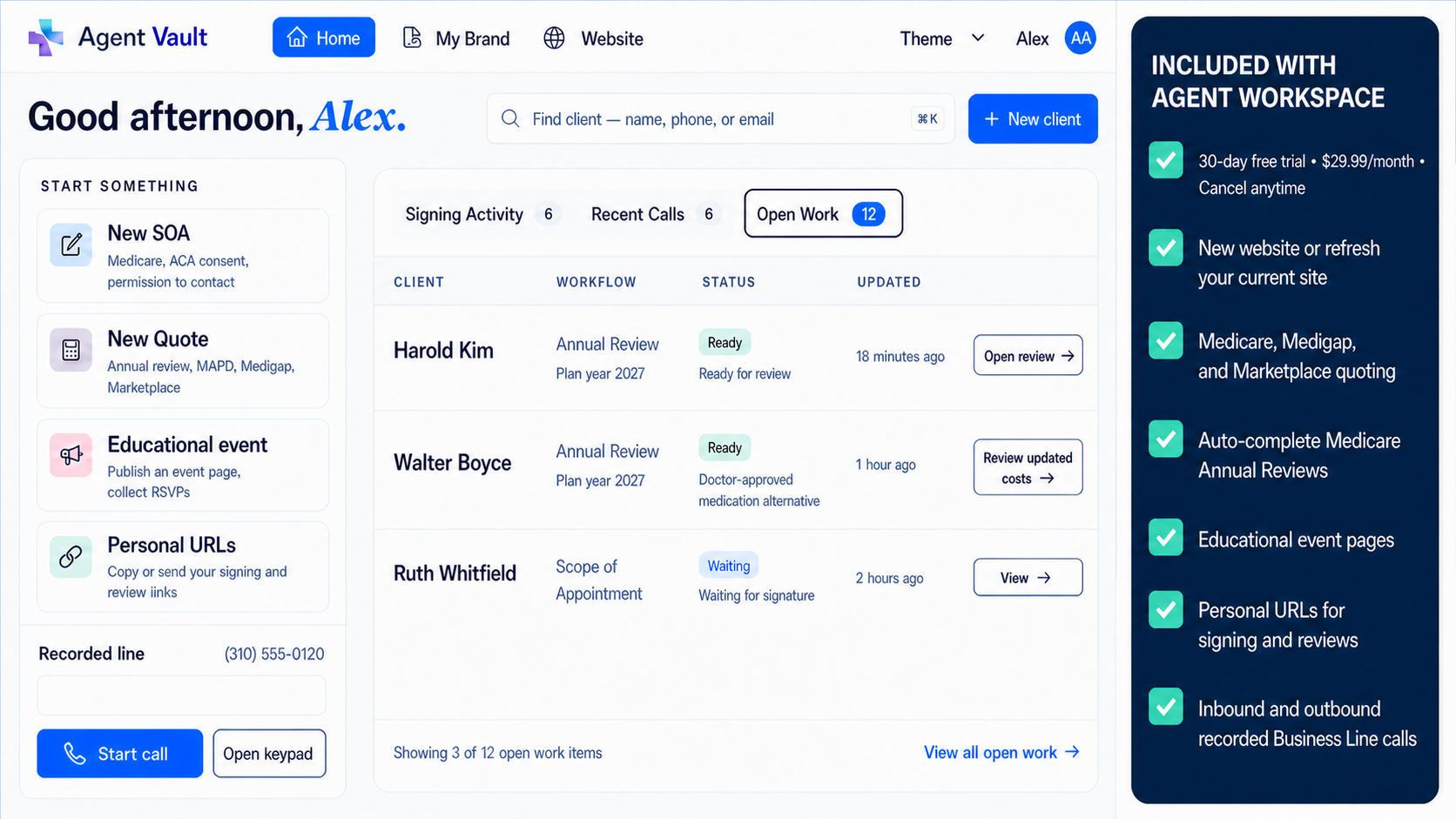
Year-round ACA records need one client file
Keep consent, application review, Marketplace notices, supporting files, and follow-up connected.
ACA Compliance Vault helps agents organize consent and application-review records alongside data-matching issue notices, SEP records, supporting files, upload proof, notes, and documented outcomes instead of leaving each step in a separate inbox or portal.
The Marketplace determines eligibility and whether submitted evidence resolves an issue. The Vault supports agent-controlled recordkeeping and follow-up; it does not make or guarantee that determination.
Essentials is $29.99/month after a 30-day free trial. Card required at checkout; one trial per NPN.
Bottom line
The ACA side is year-round because the work does not end when Open Enrollment ends.
It shifts into operations: getting consent, documenting application review, managing SEP documents and timelines, fixing agent attribution, keeping Marketplace access current, and working within the right platform rules for the state and channel you are using. CMS’s current guidance makes clear that those are separate, ongoing responsibilities, not one-time OEP tasks.
If you want ACA content that brings in working agents, this is the lane: practical operational questions, real documentation problems, and workflow bottlenecks that agents actually hit throughout the year.
This article is for educational purposes only and is not legal advice. Agents should review current CMS guidance, carrier rules, and agency policies, and consult qualified counsel or compliance professionals for specific requirements.
Sources
- CMS Statement Regarding City of Columbus v. Kennedy : Centers for Medicare & Medicaid Services Accessed 2026-09-03.
- HHS Notice of Benefit and Payment Parameters for 2027 Final Rule : Centers for Medicare & Medicaid Services Accessed 2026-05-30.
- Federal Register: HHS Notice of Benefit and Payment Parameters for 2027 : Federal Register Accessed 2026-05-30.
Frequently Asked Questions
What is the difference between ACA consumer consent and application review?
Consumer consent is permission to help the consumer with Marketplace enrollment or updates. Application review is the separate requirement to document that the consumer reviewed and confirmed the accuracy of the eligibility application information before submission.
Can one document cover both consent and application review?
Yes. CMS says the same documentation may be used for both requirements as long as it appropriately captures the two separate events.
Does verbal consent alone satisfy ACA documentation rules?
No. Unwritten verbal consent by itself is not enough unless it is documented in a compliant way, such as through a recording or other acceptable documentation.
How long do I have to keep ACA consent and application review records?
CMS says both types of documentation must be maintained for at least 10 years and provided to CMS upon request.
What happens if my client NPN association needs to be changed?
In the FFM, agents generally need the consumer directly involved. To update the NPN on the eligibility application, the agent must either do a three-way call with the Marketplace Call Center or direct the consumer to use an approved EDE consumer pathway or HealthCare.gov.
Do I need Marketplace training every year to use Help On Demand?
Only agents and brokers who have completed Marketplace training and registration are eligible to participate in Help On Demand.
Do all ACA states use the same Marketplace workflow?
No. CMS says plan year 2026 includes 21 state-based exchanges and 3 state-based exchanges on the federal platform, so workflows can differ depending on whether the state uses HealthCare.gov or its own exchange platform.
Medicare and ACA Compliance Expert
Christian Rodgers is a Medicare and ACA compliance expert with over 30 years in the healthcare industry, having worked for some of the largest health plans in the United States. He has provided Medicare sales training to hundreds of agents in California and Florida.
Connect on LinkedIn